Nepal Flood Crisis: Balen Shah Faces His Biggest Test Yet as India-China Challenge Looms
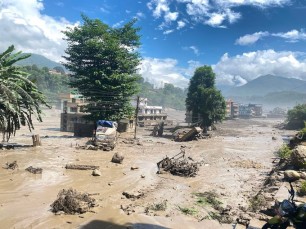
Nepal flash flood ravaged scores of villages (Image Bangladesh PM on X)
By NIRENDRA DEV
Five months after riding a Gen Z wave to power, Nepal’s young prime minister faces a devastating Himalayan disaster, mounting domestic scrutiny and the delicate task of coordinating with India and China.
New Delhi, August 28, 2026 — The devastating flash floods in Nepal are turning into a major test for the country’s young, rapper-turned-prime minister, Balen Shah.
Shah, 36, was sworn in as prime minister on March 27 after riding a wave of Gen Z protests and public anger against Nepal’s established political order. He came to office promising clean governance, faster decision-making and a break from conventional politics.
Just five months into his premiership, a catastrophic natural disaster has placed his government under extraordinary pressure.
In a Facebook statement posted Wednesday, Shah said that “sudden flooding in Rasuwa’s Bhote Koshi river” had caused “massive human and physical damage.”
“This unexpected thunder of natural disaster has pushed many of our brothers, sisters and young children in deep pain,” Shah said.
Expressing condolences to those affected, he added: “In this unbearable pain, the whole Nepal government and the entire countrymen are with you. Wishing a speedy recovery to all the citizens who are injured by the flood and undergoing treatment at the hospital.”
According to the figures supplied for this report, at least 484 travellers, including 105 Indians, 93 Nepalis, three US citizens and 12 British citizens, have been reported missing. Eight South Koreans working at a hydropower plant were also unaccounted for.
The immediate challenge for Shah is, therefore, humanitarian. But the political consequences could be equally significant.
A Young Government Confronts a Himalayan Disaster
A team of international scientists has theorised that the flooding may have been triggered by a large chunk of ice shearing off a glacier. A landslide may have occurred simultaneously, producing a devastating mixture of ice, rock and mud that swept down the mountainside and picked up waterlogged sediment along the way.
If further scientific investigation confirms this sequence, the disaster will underline Nepal’s extraordinary vulnerability to cascading Himalayan hazards.
For Shah, however, the question is not merely what caused the disaster. It is whether his relatively new administration can demonstrate that it is capable of responding quickly, coordinating rescue operations and maintaining public confidence when the country faces a crisis of this magnitude.
That is precisely the test that comes with a mandate built around youth, disruption and administrative efficiency.
From Gen Z Hope to the Reality of Governance
Shah entered office with enormous expectations.
After becoming Kathmandu mayor, he had built a political identity around challenging established parties and presenting himself as an outsider capable of cutting through bureaucratic inertia.
His national rise followed the Gen Z protests, with young Nepalis demanding greater accountability, better opportunities and an alternative to the country’s traditional political leadership.
After assuming office, his government moved quickly to launch anti-corruption investigations, restructure state institutions and pursue an ambitious 100-point governance agenda.
But the early months of the premiership have also been marked by controversy.
The government has faced criticism and political confrontation over arrests of senior political figures, administrative overhauls, parliamentary tensions, diplomatic friction, press-freedom concerns and questions surrounding investor confidence.
Taken together, these developments have produced a paradoxical image of Shah’s premiership: a government that projects speed and disruption but is simultaneously confronting questions about governance, institutions and political accountability.
The floods now bring the most unforgiving test of all — delivery on the ground.
Nepal Flood Disaster: What Planet Satellite Images Reveal About the Trigger
India and China: The Diplomatic Test
The crisis will also require Shah to work closely with Nepal’s two giant neighbours —India to the south and China to the north.
Both countries have enormous strategic, economic and geographic importance for Nepal. Both have also been affected by the latest disaster.
That will require a particularly deft diplomatic touch from Shah.
The Nepali prime minister has previously attracted attention for his fiercely nationalist posture towards both India and China.
During his tenure as Kathmandu mayor in 2023, Shah cancelled a scheduled trip to China after Beijing released a new standard map that did not acknowledge Nepal’s updated 2020 political map, which included disputed Himalayan territories.
That episode illustrated the sensitivities surrounding Nepal’s territorial questions and its balancing act between its two powerful neighbours.
The current disaster leaves little room for diplomatic posturing.
Rescue operations, border coordination, humanitarian assistance, infrastructure restoration and the movement of stranded citizens will require practical cooperation.
For Shah, this could become an opportunity to demonstrate that nationalism and pragmatic diplomacy do not have to be mutually exclusive.
China Faces Its Own Disaster
The crisis has simultaneously spread across the China-Nepal border.
According to the supplied Xinhua report, a mudslide occurred on Wednesday morning in Nepal, leaving three people dead and 265 missing at Gyirong Port in Gyirong County of southwest China’s Xizang Autonomous Region, as of 8 p.m., according to initial estimates.
Xizang has activated its highest-level relief and emergency response for natural disasters. The People’s Liberation Army and armed police have also sent rescue and relief teams to the affected area, Xinhua reported.
A Chinese expert cited in the supplied material warned that rescue operations were facing major challenges because of uncertainty over the stability of the landslide source area and the narrow terrain.
That warning is significant.
In a Himalayan disaster, the initial landslide or flood may only be the beginning. Unstable slopes, blocked rivers, debris accumulation and sudden releases of water can create secondary hazards, making rescue operations particularly dangerous.
Domestic Political Pressure Is Mounting
Even before the floods, Shah’s government was dealing with a complicated political environment.
The Nepali Congress and Nepali Communist Party have demanded a fair and impartial investigation into the Oli-Lekhak case, distancing themselves from the UML’s allegation of political vendetta.
Kathmandu’s legal community has also continued to debate whether due process was followed in the arrests of Oli and Lekhak.
The government has simultaneously been pursuing financial investigations. Shanker Group figure Sulav Agrawal has been arrested in a money-laundering probe, while the Department of Money Laundering Investigation has begun formally reviewing financial transactions linked to the case.
These developments have contributed to a political atmosphere in which the government’s anti-corruption campaign is being judged not only by its stated objectives but also by questions of due process, institutional independence and political neutrality.
The flood crisis could intensify that scrutiny.
If rescue and relief operations are efficient, Shah may emerge from the disaster with his credibility strengthened. If the response is seen as slow, chaotic or politically selective, the same crisis could deepen doubts about his government’s capacity.
Nepal Floods: Was a Massive Glacier Collapse Behind the Deadly Debris Flood?
The Economic Dimension
The stakes are particularly high because Nepal remains heavily dependent on remittances from migrant workers, which account for around a quarter of the country’s GDP.
That makes the country’s economic prospects especially sensitive to employment opportunities, migration, infrastructure and investor confidence.
A disaster affecting hydropower projects, transport corridors, tourism infrastructure and border trade can therefore have consequences far beyond the immediate humanitarian toll.
Shah’s government had promised to address the lack of opportunities confronting Nepal’s young population.
The irony is difficult to miss.
A leader who rose largely because young Nepalis wanted a break from an old political system must now demonstrate that a new political generation can manage an old problem — a country repeatedly exposed to devastating natural and economic shocks.
Foreign Policy Under Pressure
Foreign Minister Shisir Khanal has said that the government’s foreign policy will rest on non-alignment, sovereignty, territorial integrity and mutual respect.
Those principles will now be tested in practice.
Nepal cannot afford to alienate either India or China while dealing with a humanitarian emergency along its borders.
India’s geographical proximity, deep people-to-people ties and role in Nepal’s economy make New Delhi an indispensable partner. China, meanwhile, is a crucial northern neighbour with growing economic, infrastructure and strategic interests in Nepal.
Shah’s challenge will be to ensure that disaster diplomacy does not become another arena for geopolitical rivalry.
The immediate objective must be simple: save lives, restore connectivity and prevent further loss of life.
The Balen Shah Test
The floods have arrived at a politically awkward moment for Shah.
The glamour of being a young outsider is beginning to collide with the less glamorous demands of governing a difficult country.
Running Kathmandu and challenging traditional politicians was one kind of political project. Running a national government during a Himalayan catastrophe is another.
The test will not be decided by speeches, social-media posts or nationalist rhetoric.
It will be decided by the speed of rescue operations, the transparency of relief distribution, coordination with provincial and local authorities, cooperation with India and China, protection of stranded foreign nationals and the government’s ability to communicate credible information to an anxious public.
For Shah, the Nepal floods could therefore become more than a humanitarian catastrophe.
They could become the defining test of whether the Gen Z political revolt that brought him to power can translate into effective national governance.
The young prime minister came to office promising to change Nepal’s political culture.
Now nature has presented him with a crisis that demands something more difficult than political disruption: competence, coordination and compassion at scale.
Nepal will be watching.
(This is an analysis/opinion piece. Views expressed are the author’s own.)
Nepal Flood Horror: 1,500-Ft Surge? New Terrain Analysis Reveals Shocking Scale
Follow The Raisina Hills on WhatsApp, Instagram, YouTube, Facebook, and LinkedIn




About The Author