Mushkil Waqt, Commando Sakht: Nana Patekar, The Man Who Redefined The Angry Young Man
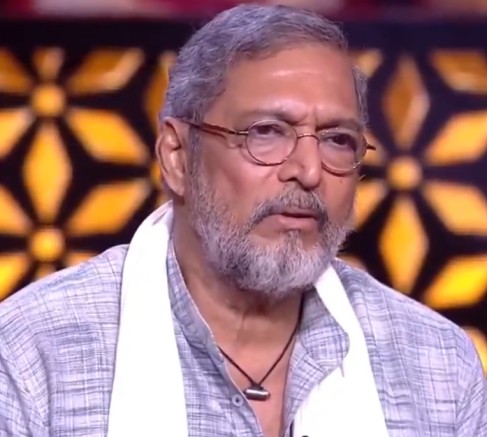
Nana Patekar, remembered for his intense performances and unmistakable dialogue delivery. (Image Sony TV video grab)
By NIRENDRA DEV
From Prahaar and Krantiveer to Parinda, Yeshwant and Welcome, Nana Patekar made intensity, realism and the common man’s anger his unmistakable screen signature.
New Delhi, October 8, 2026 — Nana Patekar, who died in Goa on Thursday at the age of 75, will be remembered not merely as an actor but as a voice, a temperament and a distinctly Indian screen presence. His death marks the end of a career in which intensity was never an ornament. It was the substance of his characters.
For generations of viewers, Nana was the man who could make a dialogue sound less like a line from a script and more like something a common man had been carrying inside him for years.
In Krantiveer (1994), Nana Patekar delivered the unforgettable line, “Aa gaye meri maut ka tamasha dekhne” — a chilling expression of defiance and wounded pride that became emblematic of the intensity he brought to the screen. The dialogue captured the spirit of a man confronting those who had gathered to watch his downfall, turning a moment of vulnerability into one of raw defiance.
“Go tell your parents they didn’t give birth to a soldier, they gave birth to a coward!”
The line from Prahaar: The Final Attack captured much of what Nana brought to the screen: discipline, anger, patriotism, vulnerability and an uncompromising sense of duty.
But could Nana Patekar be called a military officer’s favourite star?
Perhaps. His association with the armed forces was not limited to cinema. For Prahaar, he underwent rigorous military training with the Maratha Light Infantry. During the 1999 Kargil War, after receiving permission from then Defence Minister George Fernandes, he spent around 60 days with Army personnel and became part of a Quick Reaction Team.
That real-life experience gave an additional authenticity to the soldier he portrayed.
Nana was never simply a hero or villain. He played the grey character — the ordinary Indian caught between anger and helplessness, idealism and pragmatism, humour and pain.
That is why “Control Uday” from Welcome became more than a comic line. It was a middle-class, middle-aged man’s command to himself. The phrase could belong to anyone who has ever been pushed to the edge and then told himself to remain composed.
Nana’s characters often had a heart before they had a strategy.
In Krantiveer, his dialogue about Hindu and Muslim blood cut through the politics of religious identity:
“Yeh Musalman ka khoon, yeh Hindu ka khoon… bata, ismein Musalman ka kaunsa, Hindu ka kaunsa, bata.”
The question was simple: blood has no religion. It remains a question that politicians of every hue can find difficult to answer.
Then came Yeshwant, where Nana played an undercover police inspector married to an IAS officer. “Hum sab system ka hissa hain,” he says — a line that captured the dilemma of the individual trapped inside institutions.
In Ab Tak Chhappan, he inhabited the world of Mumbai police encounters with the same unsettling realism.
And in Prahaar, he went beyond acting. The film was close to his heart because it allowed him to explore military discipline, sacrifice and patriotism. Its larger message was that national duty demands sacrifice and that military training should not be viewed merely as a profession.
Nana’s military connection was real enough to continue beyond the screen. He later recalled that he had approached George Fernandes during the Kargil conflict and was eventually permitted to go to the war zone. He travelled with troops and later spoke about becoming part of a QRT.
“Parinda” was another landmark.
Nana was initially considered for Jackie Shroff’s role, but was eventually cast as Anna, a performance that became one of the defining achievements of his early career. He reportedly later joked that whatever role he was given, he would become the star anyway.
In Angaar, he played Majid Khan, the violent son of Kader Khan’s underworld don. In Ankush, he portrayed an ordinary student confronting a cheating racket. In Agni Sakshi, he played an obsessive and abusive husband. In Khamoshi, he showed that his intensity could also inhabit silence.
His detractors sometimes pointed to theatrical intensity, sharp physical gestures, explosive speech and a tendency toward repetition.
But those very qualities became his signature.
Before Nana, the “angry young man” had largely been associated with youth. After Nana, anger could belong to the middle-aged, the wounded, the policeman, the soldier, the struggler, the father or the ordinary citizen.
His dialogue delivery carried the force of a knock-out punch, but there was usually something underneath it — a wound, a memory, an injustice or a moral dilemma.
Nana Patekar did not merely play strong men.
He played men who were trying to remain strong.
That distinction made him different.
His characters could be comical, authoritarian, confused, patriotic, bitter, tender or violent. Yet they almost always appeared recognisable. They were not distant cinematic heroes. They were people one could encounter in a railway compartment, a police station, an army camp, a neighbourhood or an office.
Perhaps that is why Nana’s lines survived long after the films ended.
“Aa gaye meri maut ka tamasha dekhne.”
Theatre, cinema and television have produced many stars. Nana Patekar produced something rarer — characters whose voices seemed to continue speaking after the screen went dark.
He came, he raged, he laughed, he questioned and, above all, he made the ordinary Indian visible.
Nana Patekar is gone.
The voice remains.
Sharad Yadav, socialist who shined in saffron camp, passes away
Follow The Raisina Hills on WhatsApp, Instagram, YouTube, Facebook, and LinkedIn




About The Author