Kumbh Girl: India Celebrates Her Faith. Then Polices Her Heart.
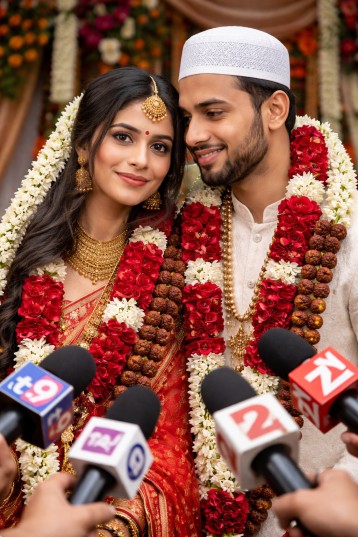
A representative image of an interfaith marriage and public scrutiny.
The Monalisa Bhonsle marriage controversy exposes India’s oldest double standard — a woman’s most personal decision becomes public property the moment she goes viral
By AMIT KUMAR
New Delhi, March 15, 2026 — She was photographed selling garlands at the Maha Kumbh Mela in Prayagraj. The internet decided she was beautiful. It made her famous overnight. And then, as it always does, it decided her life was now public property.
Monalisa Bhonsle — the young woman from Indore who became the viral “Rudraksha girl” of the 2025 Maha Kumbh — has now married her partner Furman Khan in Thiruvananthapuram, Kerala. According to her, the ceremony followed Hindu rituals and involved no religious conversion.
“My marriage is not a case of love jihad. We did not convert,” she said at a press conference after the wedding, adding that she respects all religions equally and believes every faith holds the same value.
That should have been the end of the story. Instead, it was the beginning of a familiar national spectacle.
The Relatives Have Opinions
Within hours, outraged relatives appeared before television cameras.
Her elder uncle, Vijay Bhosle, told reporters in Madhya Pradesh: “In our caste and community this is not acceptable, and Monalisa herself knows it. We are not educated people… We don’t know how these people brainwashed our girl who went viral and even called her to Kerala.”
Note the framing. A grown woman travelling to another state and choosing a life partner is recast as “brainwashing.” Her agency disappears. Someone must have manipulated her — because the possibility that she simply made her own decision is apparently too difficult to accept.
The groom’s family has also expressed displeasure. According to reports, Furman Khan’s father said he knew his son had a friendship with Monalisa and had worked in a film project with her, but the marriage has upset him. He noted that his son rarely visits home because he spends most of his time where he works.
Both families are unhappy. Both sides feel wronged. And caught in the middle is a young woman whose only “transgression” is marrying the person she chose.
The ‘Love Jihad’ Label
The phrase that quickly attached itself to the marriage — “love jihad” — deserves clarity.
It is not a legally defined crime in India. Nor has any investigative or judicial authority established it as an organised conspiracy. Yet the term regularly appears whenever a Muslim man marries a Hindu woman.
The pattern is predictable. A woman chooses a partner. The relationship becomes public. The label arrives. And suddenly the woman must defend her own marriage as if it were a criminal case.
Monalisa Bhonsle has already done more than any citizen should be required to do. She has explained, clarified and publicly justified a deeply personal decision. She reiterated that the ceremony followed Hindu rituals and that no religious conversion occurred.
She does not owe further explanations — not to relatives, not to television studios, and certainly not to the internet that first made her famous.
Women at the Centre of Crime: OTT Rewrite Female Protagonists
Fame Does Not Transfer Ownership
At the heart of the controversy lies a deeper question: when does public visibility become public ownership of someone’s private life?
Monalisa Bhonsle did not run for office. She did not sign a contract trading her autonomy for virality. A photograph of her at a religious gathering circulated online and captured public attention. The internet decided she was interesting.
That does not create a permanent obligation to live according to the internet’s expectations.
The arguments being deployed against her — that community norms override individual choice, that family comfort supersedes personal consent, that marriage requires social approval — are not unique to this case. They are part of a familiar script applied to women whose choices cross social boundaries.
The only difference here is the speed and scale of scrutiny created by viral fame.
The Questions Nobody Is Asking
If Monalisa Bhonsle had married a Hindu man from another caste, would her uncle’s objections have become national news? Probably not.
If her husband belonged to another minority faith — Christian, Sikh or Jain — would accusations of “brainwashing” have circulated with such intensity? Recent public debates suggest otherwise.
And if Monalisa were a man — a viral groom who had married a Muslim woman — would the controversy have unfolded the same way?
These questions reveal what this story is really about. The anxieties driving the debate have far less to do with Monalisa Bhonsle’s safety or happiness than with the intersection of gender, community and religious identity.
What the Story Really Says About Us
India today is a country where a woman can go viral for her grace at a religious gathering and be celebrated nationally as a symbol of devotion and beauty. Yet the moment she makes a personal choice that crosses communal lines, that same audience demands explanations.
The Maha Kumbh gave Monalisa visibility. Her marriage gave the outrage cycle fresh material. And somewhere in the noise, the actual person — a young woman who made a decision about her life — has almost disappeared.
She stated the facts plainly: it is her marriage, it was her choice, and it followed her beliefs.
In a constitutional democracy that guarantees personal liberty, that should have been sufficient. The real question is not whether her marriage fits a political label. The real question is why a woman’s choice of partner continues to invite public interrogation, family veto and ideological scrutiny.
That question remains uncomfortable. Which is precisely why it is rarely asked.
(This is an opinion piece. Views expressed are author’s own.)
The Nomad Who Left Silicon Valley for Goats, Art and Conscience
Follow The Raisina Hills on WhatsApp, Instagram, YouTube, Facebook, and LinkedIn




About The Author