Voting Ends in Kerala and Assam: Love Jihad Rhetoric Rings Loud
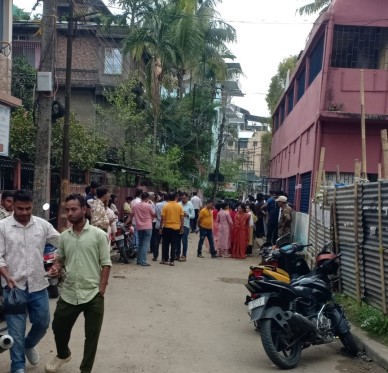
Voting ended on Thursday in Barak valley in Assam (Image TRH)
As votes are counted in Kerala and Assam, BJP’s ‘Love Jihad’ rhetoric and shifting Muslim voter loyalties could decide outcomes in dozens of constituencies where margins may not cross 3,000 votes.
By NIRENDRA DEV
Kolkata, April 9, 2026 — Voting in Kerala and Assam is over — and as results approach, the political calculus in both states hinges on identity, religion, and razor-thin margins. In Kerala, BJP’s repeated ‘Love Jihad’ statements handed the Left Democratic Front (LDF) powerful campaign ammunition. In Assam, the BJP’s decade-long incumbency faces tests from demographic tensions and anti-incumbency.
Victory margins could fall below 3,000 votes in as many as 30 constituencies in both states — making minority vote consolidation a decisive factor.
How BJP’s ‘Love Jihad’ Statements Became Campaign Fodder for LDF in Kerala
The ‘Love Jihad’ statements made periodically by BJP leaders became a gift to the Left in the 2026 Kerala polls. The CPI(M) leveraged these statements to project the BJP as an existential threat to the Muslim community — a strategy aimed at consolidating minority votes behind the LDF.
Kerala elections, however, present a familiar paradox. The Communist Party of India (Marxist) — ideologically positioned as secular and class-focused — has in 2021 and again in 2026 adopted what critics describe as “soft Hindutva.” This subtle accommodation of majority religious sentiment helps the LDF attract Hindu voters who may not ideologically align with the Left but prefer it over a Congress-led government backed by the Indian Union Muslim League (IUML).
Traditionally, many Hindus in Kerala vote LDF not out of ideological affinity but to keep the IUML — a key constituent of the Congress-led UDF — away from power.
Muslim Voters in Kerala: IUML, SDPI, and Shifting Loyalties
An important political marker from recent electoral history: Congress swept Kerala’s Lok Sabha seats in 2024 on the back of strong Muslim support, a trend that mirrored the party’s performance in the 2025 civic polls. Should that support base erode even slightly in 2026, the Congress-led UDF’s path to power remains uncertain.
Going by historical patterns, the Congress should have won the 2021 Kerala assembly elections — it did not.
An estimated 20 percent of Muslim voters in Kerala are youth and women, whose choices may not follow traditional voting patterns. Gauging this shift, the IUML has fielded more young candidates and two women in general category seats in 2026.
Complicating the picture further:
– In Kerala, the Congress is aligned with the Muslim-dominated Welfare Party of India (WPI).
– The Social Democratic Party of India (SDPI) — the political arm of the now-banned Popular Front of India — has extended unconditional support to the LDF to ensure the BJP’s defeat.
BJP’s Electoral Strategy: Splitting Minority Votes, Consolidating Hindu Support
Nationally, the BJP’s approach revolves around splitting minority votes while consolidating Hindu support. In Bihar, this strategy succeeded in dividing Muslim votes in both the 2020 and 2025 assembly polls. In West Bengal, it remains the dominant subtext. Similar tactics were deployed in campaign messaging across Assam, Kerala, and West Bengal in 2026.
In Kerala, the BJP is also pursuing a long-term project — building Catholic voter outreach — more a future investment than an immediate electoral expectation.
Assam 2026: Muslim Population, Bengali Identity, and Himanta Biswa Sarma’s Challenges
Assam presents a more layered demographic battleground. The state’s Muslim population stood at 34.22 percent in the 2011 census and has continued to grow. Alleged infiltration by Bengali-speaking Muslims from Bangladesh remains a contentious electoral issue, particularly in the tea- and coal-rich Upper Assam region.
Assam’s BJP government has been in power since 2016 under Chief Minister Himanta Biswa Sarma — a former Congress leader known for hardline pro-Hindutva positions. His government faces mounting criticism on multiple fronts:
– Anti-Christian measures, including legislation against “magical healing”
– Restrictions on beef supply
– Economic stagnation and rising unemployment
The state’s diverse demographics — tribal communities, Hindus, Muslims, Christians, Hindu Bengalis, Bhojpuri speakers, and tea garden communities — make identity politics unpredictable.
Key Battleground Regions in Assam
Muslim voters could prove decisive in several closely contested constituencies:
– Cachar belt (Karimganj-Halikandi): Substantial Muslim population with significant Bengali-speaking voters
– Hojai, Lumding, Nagaon-Batadraba: Bengali voters — both Hindu and Muslim — hold swing potential
– Nagaon region: Now has an overwhelming Muslim-majority Bengali population. The locality of “Dhakapatty” — named after Hindu migrants who relocated here from present-day Dhaka around 1947 — stands as a historic marker of the region’s complex identity
What These Results Mean for 2029
Whatever the outcome, the 2026 assembly mandates in Kerala and Assam carry national implications. Results will recalibrate the balance of political power ahead of the next general election cycle in 2029 — particularly in how regional alliances position themselves against or alongside the BJP.
Assembly Elections 2026: How Far Will Religion Go This Time?
Follow The Raisina Hills on WhatsApp, Instagram, YouTube, Facebook, and LinkedIn




About The Author