Islamabad Talks Fiasco: Why India’s Restraint Was the Right Call
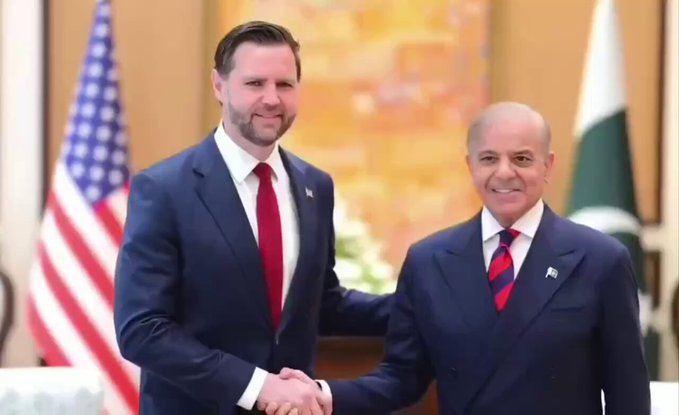
US Vice President JD Vance with Pakistan Prime Minister Shehbaz Sharif in Islamabad. (Image X.com)
Modi the hawkish pragmatist, Trump the gimmick star, and Pakistan’s impossible diplomatic assignment — making sense of a disorderly 2026
By NIRENDRA DEV
New Delhi, April 13, 2026 — Nothing could be more fallacious than to judge Pakistan by Indian or even European standards. Donald Trump went that route — and the much-hyped Islamabad Talks came a cropper.
JD Vance tried his best to offer consoling words — to Pakistan, to himself, and presumably to Trump and his son-in-law Jared Kushner. But no amount of diplomatic language could paper over the April 11-12 fiasco. Pakistan could not fairly be blamed for it. What happened was that a nation was made to attempt something well beyond the size of its shoes. Only Trump, as US President, could have ordered Islamabad to host such a venture — and only Pakistan, in its current condition of strategic dependence on Washington, could have so readily agreed. There was no diplomatic originality, no strategic imagination. General Asim Munir, PM Shehbaz Sharif and their team simply did what they were told. Islamabad is not in a position to say no to Washington.
The domestic backdrop makes this more pitiful. Pakistan today operates under a hybrid governance model — a military-controlled civilian government — that is an unedifying spectacle of misrule. Its economy is in shambles. It faces insurgencies, a hostile Afghanistan, and a permanently strained relationship with India. On April 11, even as Pakistan hosted the first US-Iran high-level talks since 1979, it was simultaneously dispatching a warship to Saudi Arabia — not to send flowers to Tehran, but to fight it. The contradiction could not have been more stark.
Congress MP Shashi Tharoor captured the absurdity with characteristic precision: “There have been some allegations that Washington wrote that tweet for the Pakistani PM, because it had the heading ‘Draft for Pakistan PM’. The language used was Washington’s language. Some phrases were similar to those used by Trump a few hours ago. Only Pakistan can play the kind of role it has played with Washington.”
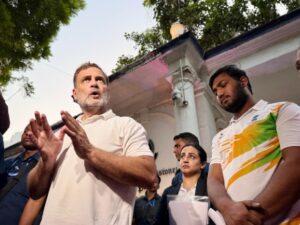
And yet, parts of India’s own opposition — led by Congress and its fellow travellers — seemed inclined to garland Islamabad with peace flowers. Nothing was more fallacious. Rahul Gandhi and his intellectual associates appeared to inhabit a different strategic universe altogether. Fanatical optimism, as ever, disobeys unambiguous evidence.
Indian leadership and the foreign policy engine room — under PM Narendra Modi — did well to stay away from the illusory peace theatre between Americans and Iranians. More so at a time when a wholly unpredictable character occupies the White House. The way to counter a war-loving gimmick star like Trump is not to attempt something silly, as Munir’s team was forced into. The Persian DNA has made the battlefield murkier than it was before February 28.
The international community must now think structurally. India and its BRICS partners — especially the big three of Brazil, Russia and China — should draw the US into a more open diplomatic arena. The focused demand must be UN reform. The RIC triangle — Russia, India, China — offers a credible pathway to hedge against adverse outcomes from India’s partnership with the United States. Though technically dormant since 2020 due to border tensions, the RIC trilateral must be revived, driven by shared interests in economic sovereignty, trade route development and non-Western financial architecture. At the G20 summit in 2019, China had proposed a 5G partnership with Russia and India — a direct challenge to US interests and a signal of what multilateral leverage could look like.
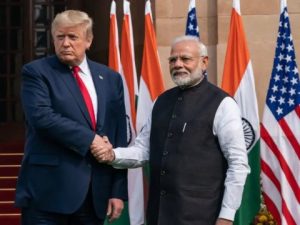
As for Modi himself: since 2014, the tag of “soft nation” does him little justice. Domestically polarising, internationally pragmatic — he carries, in the words of foreign policy observers, “the image of a hawkish but seasoned and time-tested operator.” He has protected India against myriad external pressures across twelve years as PM and thirteen before that as Gujarat chief minister. The moment now demands a more decisive role in international polity. The lesson from Islamabad is clear: do not burn fingers by doing Washington’s bidding beyond your capacity.
Unreason is fighting Reason in 2026. The wound that never heals is vengeance left unchecked. The new geopolitical chemistry must work with the old arithmetic of power. The global community is unravelling as old borders blur — and in that disorder, strategic restraint may be the most powerful card of all.
(This is an opinion piece. Views expressed are the author’s own.)
Iran’s Unbroken Resolve: Trump Brinkmanship Meets Persian Wall
FAQ
Q: Why did the Islamabad Talks between the US and Iran fail?
A: After 21 hours of negotiations, no agreement was reached. The US demanded a firm long-term commitment from Iran not to pursue nuclear weapons, which Iran declined to give. JD Vance left Islamabad with a “final offer” pending Iran’s response.
Q: What was Pakistan’s role in the Islamabad Talks?
A: Pakistan served as a mediator and host — but critics argue it was directed by Washington to take on a diplomatic task beyond its capacity, without strategic originality or independent leverage.
Q: What did Shashi Tharoor say about Pakistan’s role?
A: Congress MP Shashi Tharoor alleged that a tweet posted by Pakistan’s PM appeared to have been drafted by Washington, noting similar language to Trump’s own statements and a reported “Draft for Pakistan PM” heading.
Q: Why did India stay out of the US-Iran mediation effort?
A: India maintained strategic neutrality — engaging with both Iran and Gulf nations without taking sides. Analysts argue this was the correct approach given Trump’s unpredictability and the risk of diplomatic overreach.
Q: What is the RIC trilateral and why is it relevant now?
A: The Russia-India-China (RIC) trilateral is a grouping advocating a multipolar world order. Though dormant since 2020 due to India-China border tensions, analysts argue it should be revived to give India strategic leverage against both US and Chinese dominance.
Follow The Raisina Hills on WhatsApp, Instagram, YouTube, Facebook, and LinkedIn




About The Author