Talks Fail After 21 Hours: Vance Leaves, Iran Yet to Answer
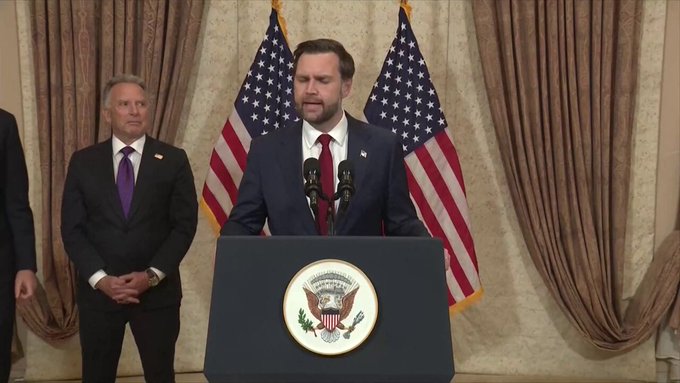
JD Vance says No Deal After 21-Hour Iran Talks “Final Offer” Left on Table (Image X.com)
US hands Iran its “final and best offer” on nuclear commitment — ceasefire hangs in the balance
By TRH World Desk
New Delhi, April 12, 2026 — Marathon negotiations between the United States and Iran in Islamabad ended without agreement on Sunday, after what Vice President JD Vance called 21 hours of “substantive discussions” — leaving the fragile two-week ceasefire in dangerous uncertainty.
Speaking at a press conference in the Pakistani capital alongside Steve Witkoff and Jared Kushner, Vance delivered a sober verdict on the outcome. “This is bad news for Iran much more than this is bad news for the United States,” he stressed, adding that Washington had “made very clear what our red lines are — and they have chosen not to accept our terms.”
The US delegation did not walk away entirely. Vance told reporters: “We leave here with a very simple proposal — a method of understanding that is our final and best offer. We’ll see if the Iranians accept it.”
The Nuclear Sticking Point
Vance was pointed about where the core disagreement lies. He said the US needs “an affirmative commitment that they will not seek a nuclear weapon and they will not seek the tools that would enable them to quickly achieve a nuclear weapon.” He acknowledged that Iran’s previous enrichment facilities have been significantly degraded, but framed the remaining obstacle as political rather than technical — a matter of will, not capability.
“The simple question is: do we see a fundamental commitment of will for the Iranians not to develop a nuclear weapon — not just now, not just two years from now, but for the long term? We haven’t seen that yet. We hope that we will,” he said.
Vance also confirmed that frozen assets, the Strait of Hormuz and broader regional issues were on the table, but no breakthroughs were achieved on any front. He insisted the US negotiated in good faith and remained “flexible” throughout, while maintaining its core conditions. US officials were in constant contact with US President Trump and the national security team across all 21 hours of talks.
Iran’s foreign ministry had earlier called on the US to negotiate with “seriousness and good faith,” with its spokesperson confirming that the Strait of Hormuz, nuclear issues, war reparations, sanctions and a permanent regional ceasefire were all discussed.
The deadlock puts the two-week ceasefire agreed last week in limbo, with the possibility of renewed and escalating warfare now a live threat.
How the Islamabad Talks Came About
The Islamabad Talks represent the first direct high-level in-person engagement between the United States and Iran since the 1979 Islamic Revolution. The six-week war has killed thousands, sent global oil prices soaring, and caused extensive damage to energy infrastructure across the Middle East.
Pakistan formally offered to host talks on March 23, with PM Shehbaz Sharif echoing the offer publicly on X, tagging Trump, Araghchi and Witkoff. Both the US and Iran named Sharif and army chief Asim Munir in their ceasefire announcements — a rare concurrence, because no other country enjoyed the same trust from both parties.
The Pakistani foreign ministry expressed hope that both sides would engage in constructive talks, reiterating its desire to continue facilitating the parties toward a “lasting and durable solution.” Whether that window remains open now rests with Tehran.
FAQ
Q: Did the US and Iran reach a deal in Pakistan?
A: No. After 21 hours of negotiations in Islamabad, no agreement was reached. Vance said the US left its “final and best offer” with Iran.
Q: What was the key US demand from Iran?
A: A long-term affirmative commitment that Iran will not seek a nuclear weapon or the capability to rapidly build one.
Q: Are the Iran-US talks over?
A: Vance did not say the US was walking away. Washington has presented a final proposal and is awaiting Iran’s response.
Q: What happens to the ceasefire now?
A: The two-week ceasefire is now in limbo. Analysts warn that a collapse of negotiations could trigger renewed and escalating conflict.
Iran’s Unbroken Resolve: Trump Brinkmanship Meets Persian Wall
Follow The Raisina Hills on WhatsApp, Instagram, YouTube, Facebook, and LinkedIn




About The Author