India-China Reset Explained: Border, Trade, Security and the Road Ahead
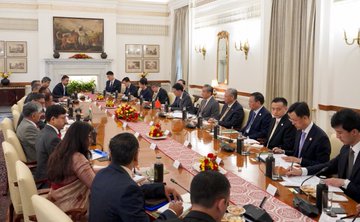
India and China held 24th round of talks on boundary in New Delhi! (Image China Embassy)
By TRH World Desk
From Galwan to Normalisation: Is India Softening Its China Policy or Playing a Long Strategic Game?
New Delhi, July 10, 2026 — Five years after the deadly Galwan Valley clash shattered India-China relations, New Delhi appears to be pursuing a gradual normalization with Beijing. The process has accelerated over the past year through diplomatic engagement, economic easing, and efforts to restore people-to-people exchanges. The shift has prompted a debate: Is India pragmatically managing an unavoidable neighbour, or quietly abandoning the strategic leverage it built after 2020?
Strategic affairs expert Brahma Chellaney has been among the sharpest critics of the government’s approach. In a post on X, he argued that India is normalizing ties “largely on China’s terms” while giving up its earlier insistence on restoring the territorial status quo that existed before the 2020 incursions in eastern Ladakh.
His criticism raises important questions. Yet the picture is more nuanced than either unqualified optimism or outright pessimism.
The relationship reached its lowest point in decades after the Galwan clash in June 2020, which claimed the lives of 20 Indian soldiers and an undisclosed number of Chinese troops. India responded with a multi-pronged strategy.
The government banned hundreds of Chinese mobile applications, tightened scrutiny of Chinese investments, slowed visas, restricted telecom participation, imposed additional customs checks, and made it politically difficult for Chinese firms to participate in sensitive infrastructure projects. Prime Minister Narendra Modi’s government repeatedly stressed that normal bilateral relations could not return until peace and tranquility were restored along the Line of Actual Control (LAC).
That linkage between border stability and broader ties became the cornerstone of India’s China policy.
What Has Changed?
Since late 2024 and into 2026, several developments suggest that New Delhi is recalibrating rather than maintaining maximum pressure.
Among them are:
- Restoration of high-level diplomatic contacts.
- Gradual revival of direct flights.
- Resumption of pilgrimage routes, including Kailash Mansarovar.
- Relaxation of some restrictions affecting Chinese businesses.
- Approval for Chinese participation in selected government tenders, particularly in the power sector under specified conditions.
- Continued discussions on visa facilitation and business exchanges.
The Economic Reality India Cannot Ignore
One reason for the policy shift lies in economics.
Despite years of political tensions, India-China trade has continued to grow. China remains India’s largest source of imports, particularly in sectors where domestic manufacturing remains dependent on Chinese inputs.
From Galwan to Recovery: India, China Review Roadmap for Better Ties
These include:
- Electronics and smartphone components.
- Solar equipment.
- Pharmaceutical active ingredients (APIs).
- Industrial machinery.
- Electric vehicle supply chains.
- Rare earth processing.
This dependence became even more evident during India’s manufacturing push under the Production Linked Incentive (PLI) schemes. Ironically, many products assembled in India continue to rely heavily on Chinese intermediate goods.
Completely decoupling from China, therefore, proved far more difficult than political rhetoric initially suggested.
Chellaney’s Concerns
Chellaney argues that normalization benefits China more than India.
His key concerns include:
- India has eased restrictions without securing restoration of the pre-2020 territorial status.
- China’s trade surplus with India continues to widen dramatically.
- Chinese firms are regaining access to sensitive infrastructure sectors.
- Beijing could exploit technological access to critical infrastructure in future crises.
- Economic dependence may eventually weaken India’s strategic autonomy.
His warning echoes concerns expressed in several Western capitals that have tightened scrutiny of Chinese involvement in telecommunications, ports, power grids and semiconductor supply chains.
Why the Government May Think Differently
The Modi government is unlikely to view the issue through a single security lens. Instead, policymakers may believe India now possesses greater leverage than in 2020.
Several factors support this view.
Border Infrastructure Has Improved
India has dramatically accelerated construction of roads, bridges, tunnels and airfields along the northern frontier.
Military logistics have improved substantially, reducing one of China’s traditional advantages.
Military Deployments Have Become Permanent
Unlike before Galwan, India now maintains significantly larger troop deployments across eastern Ladakh.
This has altered the military balance along sensitive sectors.
Is the Border Issue Really Settled?
Not entirely.
Although disengagement has occurred at several friction points, military infrastructure and troop deployments remain significantly higher than before 2020.
Large stretches of the LAC remain heavily militarized.
Trust between the two militaries remains low.
This suggests normalization is occurring despite unresolved strategic competition—not because those disputes have disappeared.
The broader question is whether India is moving from confrontation to competitive coexistence. Many countries now pursue exactly this approach with China.
They compete strategically while continuing economic engagement. India may increasingly be following that model.
Rather than complete decoupling, New Delhi appears to favour selective engagement:
- cooperate where beneficial,
- compete where necessary,
- deter where essential.
Whether that balance proves sustainable will depend largely on China’s behaviour along the border.
The Risks Ahead
Normalization carries both opportunities and dangers.
Potential benefits include:
- Reduced military tensions.
- Greater economic stability.
- Easier supply chains.
- Increased diplomatic space.
- Regional stability.
Potential risks include:
- Renewed strategic dependence.
- Technology vulnerabilities.
- Expanded Chinese economic leverage.
- Reduced bargaining power in future border negotiations.
- Political criticism that India compromised without achieving restoration of the status quo.
India’s China policy is entering a new phase—not one of friendship, but of managed competition.
The post-Galwan strategy of sustained pressure has gradually given way to calibrated engagement. Whether this represents strategic realism or strategic concession remains contested.
Critics such as Brahma Chellaney argue India is yielding too much without resolving the core border dispute. The government, however, appears to believe that economic pragmatism, military preparedness and selective engagement can coexist.
The real test will come not in diplomatic meetings or trade figures, but at the Line of Actual Control. If border stability endures, the current approach may be vindicated. If tensions return while economic dependence deepens, today’s normalization could be judged far more harshly.
China-Bangladesh Strategic Shift: Why India Should Be Concerned
Follow The Raisina Hills on WhatsApp, Instagram, YouTube, Facebook, and LinkedIn




About The Author