China Built a Solar Empire. Can India Catch Up Before 2030?
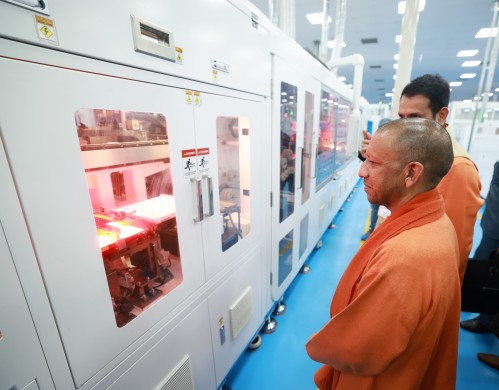
Uttar Pradesh CM Yogi Adityanath on Saturday inaugurated solar module plant in Gautam Budh Nagar (Image credit UP Info dept)
By P. SESH KUMAR
As China builds a solar empire spanning manufacturing, storage and supply chains, India faces a decisive decade in its quest for clean energy leadership and energy sovereignty
The global solar revolution is no longer merely an environmental story. It is now a story of geopolitics, industrial policy, economic survival, strategic autonomy and technological supremacy. Nowhere is this more dramatically visible than in the contrasting solar trajectories of China and India. China has transformed itself into the undisputed solar superpower of the world, commanding manufacturing, deployment, technology, financing and supply chains at a scale unprecedented in modern industrial history. India, though a late entrant, has emerged as the world’s third-largest solar power producer and among the fastest-growing renewable energy markets globally. Yet the gap between the two Asian giants remains staggering. China’s solar additions in a single year now exceed India’s cumulative installed capacity.
This note seeks to critically examine the comparative achievements of China and India in solar energy, the historical background behind their respective journeys, the institutional and technological choices made, the hurdles confronting India, the strategic lessons emerging from China’s experience, and the urgent reforms India must undertake if it hopes to meet its clean energy and carbon reduction commitments. The note argues that while India’s progress has been impressive, its challenge is no longer incremental expansion but systemic transformation involving manufacturing ecosystems, transmission infrastructure, storage technologies, financing architecture, distribution reforms and industrial strategy. Solar energy is no longer merely about electricity generation; it is about economic sovereignty in the twenty-first century.
For much of the twentieth century, energy security meant oil wells, coal mines and pipelines. In the twenty-first century, however, energy security increasingly means solar panels, battery storage systems, rare earth supply chains, transmission corridors and manufacturing ecosystems. The country that dominates clean energy technologies may well dominate future global industry itself. It is in this context that the solar race between China and India acquires extraordinary significance.
China’s rise in solar energy is nothing short of astonishing. What began as a manufacturing-driven export strategy in the early 2000s evolved into a full-spectrum national mission backed by state financing, aggressive industrial policy, subsidized capital, cheap land, state-supported R&D, massive transmission investments and centralized planning. China today controls nearly 80 percent of the global solar supply chain across polysilicon, wafers, cells and modules. Its cumulative installed solar capacity crossed 1,000 GW by 2025 and is projected to rise toward 2,500–3,000 GW by 2030. Its gigantic “Great Solar Wall” project in the Kubuqi Desert and mega renewable clusters across Inner Mongolia represent infrastructure ambition on a civilizational scale.
India’s solar journey began much later and under very different economic circumstances. For decades, India remained heavily dependent on coal and conventional thermal generation. Renewable energy was treated more as an environmental obligation than a strategic economic priority. The launch of the International Solar Alliance and the ambitious National Solar Mission changed the discourse substantially. India moved from negligible solar capacity in the early 2010s to over 133 GW by late 2025, becoming the world’s third-largest solar market. Yet India’s success remains both inspiring and sobering. Inspiring because the scale-up has been rapid. Sobering because China’s dominance remains overwhelming.
The contrast between the two countries is not merely quantitative but structural. China built an industrial ecosystem. India initially built a procurement ecosystem. China focused simultaneously on manufacturing, research, transmission and deployment. India focused primarily on deployment through reverse bidding and low tariffs. China created vertically integrated supply chains. India became heavily import dependent. China treated solar energy as a national strategic sector. India often treated it as a tariff-sensitive infrastructure sector.
This divergence produced predictable consequences. Chinese firms captured global economies of scale. Their massive production capacities drove down module prices worldwide, helping global solar adoption but simultaneously crushing manufacturing competitors across Europe, the United States and developing countries. India became one of the largest importers of Chinese solar modules and cells. Ironically, India’s solar expansion for years indirectly strengthened Chinese manufacturing dominance.
China’s cumulative installed capacity exceeded 1,100 GW by mid-2025 while India stood at around 133 GW. China’s annual additions in 2024 alone ranged between 277–329 GW compared to India’s approximately 30 GW. China achieved its 2030 renewable target nearly six years ahead of schedule. India, meanwhile, still faces the daunting challenge of reaching its 500 GW renewable energy target by 2030.
Yet statistics alone do not tell the full story. India’s growth rate itself has been remarkable. Solar additions surged sharply in 2024 and 2025. India’s rooftop solar mission under the PM Surya Ghar Muft Bijli Yojana aims to transform millions of households into decentralized energy producers. India’s Production Linked Incentive (PLI) scheme has begun catalyzing domestic manufacturing capacities in modules and cells. Imports of modules from China have started declining due to Approved List of Models and Manufacturers (ALMM restrictions), domestic content requirements and tariff measures.
Still, the uncomfortable reality remains that India’s solar ecosystem continues to suffer from several structural vulnerabilities.
The first and perhaps biggest challenge is manufacturing depth. While India has rapidly expanded module assembly capacities, deeper upstream integration remains weak. China dominates polysilicon, ingots and wafers- the real strategic choke points of the solar industry. Without upstream capabilities, India risks remaining dependent despite outward manufacturing growth. A nation that imports critical inputs cannot claim genuine energy sovereignty.
The second major challenge concerns financing. Chinese solar expansion benefited enormously from state-directed finance through public banks and provincial support structures. Indian renewable developers often struggle with high financing costs, payment delays from Electricity Distribution Companies (DISCOMs) and policy uncertainties. Solar power may be technologically cheap, but capital costs still determine viability. India’s cost of capital remains significantly higher than China’s.
Third comes the grid problem. Solar energy is intermittent. A nation cannot merely add generation capacity without simultaneously strengthening transmission and storage systems. China invested massively in Ultra High Voltage transmission networks that transport renewable power across vast distances. India’s transmission infrastructure, though improving, still faces serious bottlenecks. Renewable-rich states often struggle with evacuation infrastructure, land acquisition and balancing requirements.
Fourth is storage technology. The future of renewable energy will depend not merely on generation but on storage dominance. China has aggressively scaled battery manufacturing, pumped hydro and grid storage ecosystems. India is only beginning this journey. Without large-scale storage capability, renewable integration will increasingly hit technical limits.
Fifth is the issue of policy consistency. China’s centralized governance structure allowed long-term continuity. India’s federal structure creates fragmentation across states, regulators, DISCOMs and agencies. Renewable policies frequently encounter delays, renegotiations, land disputes and bureaucratic hurdles. Investors fear regulatory unpredictability more than technological uncertainty.
India also faces a difficult political economy challenge. Coal remains deeply embedded in employment structures, railway freight revenues, state finances and industrial ecosystems. Transitioning rapidly toward renewables without destabilizing economic sectors requires extremely careful management. China too continues to rely heavily on coal, but its state capacity allows simultaneous expansion of both coal and renewables. India’s balancing act is more financially constrained.
Another important challenge relates to land and social acceptance. Utility-scale solar projects require enormous tracts of land. Acquiring such land in densely populated regions generates conflicts involving agriculture, ecology and local livelihoods. China’s desert-based mega projects face fewer population pressures compared to India’s land-intensive development context.
India’s rooftop solar segment also reveals the complexity of implementation. Despite enormous potential, rooftop penetration remained modest for years due to financing hurdles, consumer awareness gaps, procedural delays and DISCOM resistance. Distribution companies often view decentralized solar generation as a threat to their revenue structures. PM Surya Ghar seeks to address this challenge through direct subsidies and simplified processes, but implementation consistency remains crucial.
Yet despite these hurdles, India possesses several important advantages.
The first is demographic and demand potential. India remains one of the world’s fastest-growing electricity markets. Rising urbanization, industrialization, electrification of transport and digital infrastructure growth will dramatically increase power demand. This creates enormous space for renewable expansion.
Second, India possesses some of the best solar irradiation conditions globally. Large parts of Rajasthan, Gujarat, Maharashtra, Andhra Pradesh and Ladakh offer ideal conditions for solar generation.
Third, geopolitical dynamics increasingly favor diversification away from excessive Chinese dependence. The United States, Europe and several strategic blocs are actively searching for alternative clean energy supply chains. India can position itself as a trusted manufacturing and export hub if it builds scale and reliability.
Fourth, India’s democratic governance, though slower, may ultimately produce more socially resilient energy transitions. China’s model achieves scale rapidly but through centralized state control. India’s challenge is to combine democratic legitimacy with developmental speed.
Fifth, India’s digital governance infrastructure-including Aadhaar-linked transfers, smart metering, fintech integration and digital subsidy systems- offers unique opportunities for decentralized energy democratization.
However, India cannot succeed merely through slogans or isolated subsidy schemes. The challenge ahead demands systemic industrial strategy.
India must first recognize that solar policy cannot remain confined to the Ministry of New and Renewable Energy alone. Solar energy policy must integrate industrial policy, trade policy, technology policy, transmission planning, urban development, mining strategy, research funding and financial sector reform.
The country urgently requires upstream manufacturing integration. Domestic wafer and polysilicon ecosystems must be developed aggressively even if short-term costs rise. Strategic dependence on imported upstream inputs creates long-term vulnerability.
India must also massively accelerate grid modernization. Transmission infrastructure should not remain a reactive afterthought. Renewable evacuation corridors, smart grids, interstate transmission integration and storage-linked balancing systems require wartime-scale execution.
Storage technology deserves national mission status. Battery manufacturing, sodium-ion technologies, pumped hydro storage, green hydrogen integration and long-duration storage systems will determine future competitiveness. Solar without storage is incomplete infrastructure.
Research and development must also move beyond tokenism. China’s dominance did not emerge solely from cheap labor but from relentless technological scaling. India must invest deeply in next-generation photovoltaic technologies including TOPCon, HJT, tandem cells and perovskite technologies.
Financing reforms are equally critical. Renewable developers require stable payment systems, lower financing costs and credible long-term policy visibility. DISCOM reforms remain central to renewable expansion. A financially broken distribution system cannot sustain a clean energy revolution.
India must also develop a coherent solar export strategy. Merely meeting domestic demand is insufficient. The future solar economy will be export driven. India must target markets in Africa, Southeast Asia, Latin America and the Middle East through financing partnerships, diplomatic engagement and manufacturing competitiveness.
There is also an important environmental paradox that India must address honestly. Solar energy itself requires minerals, land, water and manufacturing energy inputs. A green transition cannot become another extractive industrial cycle without sustainability safeguards. Solar waste management, recycling systems and circular economy models require urgent attention.
The broader geopolitical implications are profound. China currently enjoys enormous leverage through its control of clean energy supply chains. Nations dependent on Chinese solar manufacturing may gradually replace oil dependence with technology dependence. India’s ambition to emerge as an alternative manufacturing centre is therefore strategically significant not only for itself but for global energy diversification.
At the same time, India must avoid simplistic anti-China narratives. China’s success contains important lessons. Long-term planning, manufacturing ecosystems, infrastructure synchronization, technological ambition and state-backed execution mattered enormously. India need not and cannot replicate China’s political model, but it must certainly learn from China’s strategic seriousness.
Ultimately, India’s clean energy commitments are not optional environmental aspirations. They are developmental necessities. India has pledged to achieve around 500 GW of non-fossil fuel capacity by 2030 and pursue net-zero emissions by 2070. Failure would carry economic, environmental and geopolitical consequences.
The next decade will therefore determine whether India merely becomes a large solar consumer or evolves into a genuine solar superpower.
China has already demonstrated what industrial-scale renewable transformation looks like. India’s task now is not merely to admire that achievement or complain about the gap. Its task is to build its own pathway -democratic, decentralized, technologically ambitious and globally competitive.
The sun shines equally on both nations. But history rewards not those who receive sunlight, but those who build the systems capable of capturing it.
(This is an opinion piece. Views expressed are the author’s own.)
Follow The Raisina Hills on WhatsApp, Instagram, YouTube, Facebook, and LinkedIn




About The Author