Trump’s 20% Hormuz Toll: Why Critics Say the U.S. Just Out-Priced Iran’s Own Blockade
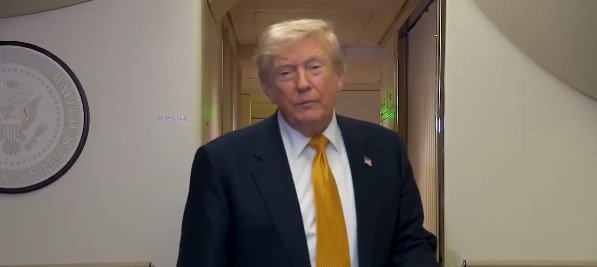
US President Donald Trump aboard Air Force One while on way to Ankara for NATO Summit. (Image White House)
By TRH World Desk
U.S. strikes inside Iran, Saudi-backed action against Houthis signals broader regional escalation as global shipping and oil markets face renewed uncertainty.
New Delhi, July 14, 2026 — The Middle East is once again moving toward a dangerous phase of military escalation after US President Donald Trump announced the reinstatement of a US naval blockade against Iran, imposed a 20% transit fee on commercial cargo moving through the Strait of Hormuz, and warned of further military strikes against Tehran.
The announcement comes amid reports of fresh US military action, growing tensions involving Saudi Arabia and Yemen’s Houthis, and renewed fears that one of the world’s most important energy chokepoints could become the center of a broader regional conflict.
In a post on Truth Social, Trump declared that the Strait of Hormuz was “OPEN, and will remain OPEN, with or without Iran,” while announcing that commercial vessels using the strategic waterway would be required to pay a flat 20% fee to compensate Washington for providing maritime security.
Trump portrayed the United States as the “Guardian of the Hormuz Strait,” arguing that countries benefiting from safe navigation should share the financial burden of maintaining freedom of navigation.
Critics highlight contradiction
The proposal immediately triggered criticism because Washington has spent months condemning Tehran for suggesting it could levy charges on ships transiting the Strait of Hormuz.
Analysts noted that Iran’s previously discussed proposal reportedly amounted to roughly $1 million per oil tanker—estimated by critics to represent only about 1–2% of the value of a typical crude cargo.
By comparison, Trump’s proposed 20% levy would be significantly higher, leading critics to argue that Washington is no longer opposing the concept of charging vessels for passage but instead proposing a far more expensive version of it.
The International Maritime Organization has consistently maintained that international straits used for global navigation should remain free from transit tolls, making any unilateral fee—whether imposed by Iran or the United States—legally and commercially controversial.
Shipping industry remains cautious
Despite Trump’s declaration that the waterway is open, commercial shipping companies appear unlikely to immediately resume normal operations.
Industry executives have repeatedly indicated that they require a durable political and military settlement between Washington and Tehran before restoring regular traffic.
Recent shipping data has shown that vessel movements through the Strait remain far below pre-conflict levels, with many operators preferring to keep tankers anchored outside the Gulf rather than risk exposure to missile attacks, drone strikes or naval confrontation.
For shipping companies, the primary concern remains physical security rather than transit fees.
Military conflict intensifies
The political announcement coincided with reports of fresh military escalation.
Military analyst Babak Taghvaee reported on X that the US Army launched Precision Strike Missiles (PrSMs) from HIMARS systems based in Bahrain against targets inside Iran. While the claims have circulated widely on social media, independent official confirmation remains limited at the time of writing.
Trump himself adopted increasingly aggressive rhetoric, declaring: “We’re going to hit them very hard tonight and we’re going to hit them hard tomorrow, and there’s not a damn thing they can do about it.”
The remarks suggest Washington is preparing additional military operations despite previous diplomatic efforts aimed at reducing tensions.
Iran responds with strategic messaging
Iranian Foreign Minister Abbas Araghchi also responded on X, striking a mix of defiance and irony. He wrote that Trump was correct in saying whoever guarantees safe passage through the Strait of Hormuz deserves compensation but insisted that Iran—not the United States—has always been the true guardian of the strategic waterway.
Araghchi added that while a 20% fee would be excessive, Iran “will be fair,” underscoring Tehran’s longstanding claim that it retains sovereign influence over navigation through the Strait.
The exchange illustrates how both governments are now competing over legitimacy and authority in one of the world’s most strategically important maritime corridors.
Saudi Arabia and Yemen enter the equation
The regional picture became even more complex after journalist Barak Ravid reported that Saudi Crown Prince Mohammed bin Salman spoke with President Trump last Friday seeking US support for military action against Yemen’s Houthi movement.
According to Ravid, Trump approved the request.
If confirmed, the development would significantly expand the crisis beyond the US-Iran confrontation by drawing Saudi Arabia more directly into renewed regional military operations.
The Houthis have repeatedly targeted commercial shipping in the Red Sea and have aligned themselves politically and militarily with Iran, raising concerns that simultaneous conflicts in the Persian Gulf and Red Sea could severely disrupt global maritime trade.
Markets brace for prolonged instability
Energy markets reacted swiftly to the renewed escalation, with oil prices rising amid concerns over potential supply disruptions. Equity markets also weakened as investors reassessed geopolitical risks.
The Strait of Hormuz carries roughly one-fifth of the world’s seaborne oil exports, making any prolonged military confrontation or uncertainty over navigation a significant threat to global energy security and inflation.
Analysis
Trump’s latest announcement reflects a shift from merely protecting maritime navigation to asserting direct economic control over one of the world’s busiest shipping lanes. However, the proposal raises difficult legal, diplomatic and commercial questions.
Even if Washington possesses the military capability to escort shipping, the combination of a transit levy, continued missile exchanges, and the absence of a lasting US-Iran agreement means insurers, shipping companies and energy traders are unlikely to view the Strait as truly “open.”
The risk is no longer confined to a bilateral US-Iran dispute. With reports of US strikes inside Iran, Saudi Arabia seeking action against the Houthis, and Yemen remaining an active battlefield, the conflict increasingly resembles a regional security crisis with implications for global energy markets, maritime commerce and international diplomacy.
Trump’s Repeated Iran Threats Could Lose Their Deterrent Effect, Warns Former US Ambassador
Follow The Raisina Hills on WhatsApp, Instagram, YouTube, Facebook, and LinkedIn




About The Author