If Jamaat Wins Bangladesh, What Should India Do?
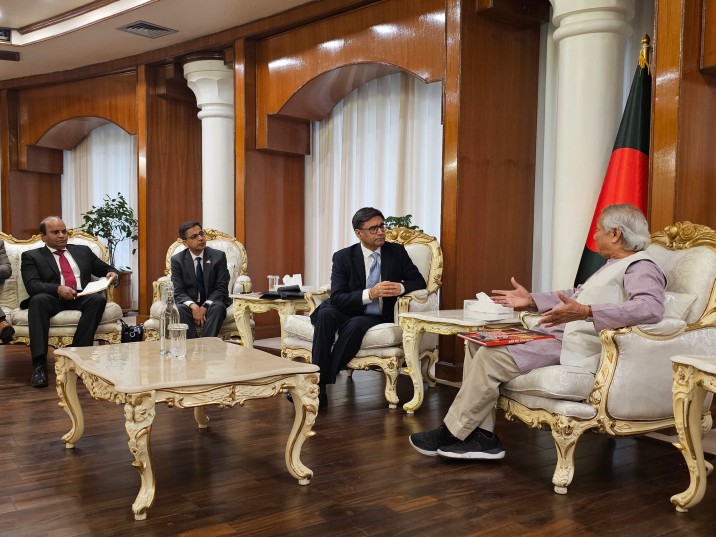
Indian Foreign Secretary Vikram Misri with Bangladesh Chief Adviser Muhammad Yunus. Image credit @CApress_sec
With Jamaat-e-Islami surging ahead of BNP, Bangladesh’s February 12 vote could redraw South Asia’s geopolitical map
By NIRENDRA DEV
New Delhi, February 7, 2026 — Bangladesh’s February 12 election is no longer a routine contest between familiar rivals. It has become a referendum on the country’s political future—and a strategic puzzle for India. Early momentum has given Jamaat-e-Islami an unexpected edge, unsettling the long-assumed dominance of the Bangladesh Nationalist Party (BNP) and pushing the country into a moment of political redefinition.
Jamaat’s rise lies in its ability to seize the “first-mover advantage” in a fractured political field. While BNP entered the race as the presumptive favourite, Jamaat has cleverly positioned itself as the untested alternative—promising clean administration, discipline, and prosperity. In an electorate fatigued by decades of rule alternating between BNP and the Awami League since the 1990s, that pitch has struck a chord.
Electorally, Jamaat has played the surprise card with precision. By branding itself as a party that has “never been given a chance,” it has tapped into public frustration with entrenched political elites. This narrative has further weakened BNP, which now finds itself defending legacy baggage rather than projecting novelty.
Bangladesh today is not merely at a crossroads; it is at a redefining stage—one that carries implications far beyond its borders. India, China, the United States, and even Russia are closely watching the outcome, aware that Dhaka’s next government will influence South Asia’s strategic balance.
Historically, Jamaat struggled to win over Bangladeshis proud of their language, culture, and musical heritage—spaces where political Islam found limited resonance. But the post–Sheikh Hasina vacuum has altered political instincts. The fall of an established order has created room for narratives once pushed to the margins.
Jamaat’s campaign rests on two core claims: that it is less corrupt than its rivals, and that it is more disciplined than BNP, making it better suited for cohesive governance. Whether voters fully buy this promise will be known only after the ballots are counted.
Three Post-Election Scenarios
The implications of the February 12 verdict can be mapped across three broad scenarios—each with different consequences for Chief Adviser Mohammed Yunus and for India.
First, if BNP secures a clear majority on its own, Yunus’ days in office are numbered. He would likely be forced to step down within months as a strong BNP government consolidates power.
Second, if Jamaat emerges with a majority, Yunus is expected to remain—but only briefly. His presence would offer a transitional face of continuity and reassurance, both domestically and internationally, while Jamaat settles into power.
Third, a hung parliament could paradoxically strengthen Yunus. In a fractured mandate, he could become the central balancing figure, gaining leverage as parties negotiate power-sharing arrangements.
An additional wildcard is the military. The future role of Army Chief General Waqar Zaman remains uncertain, and his stance could significantly influence how smoothly—or turbulently—any transition unfolds.
Signals from the Political Players
BNP Chairman Tarique Rahman has sought to steady nerves by reaffirming that his party’s foreign policy would prioritise Bangladesh’s national and people’s interests. He reiterated this pledge while unveiling the BNP manifesto in Dhaka, signalling continuity rather than rupture in external relations.
Meanwhile, Jamaat-e-Islami Ameer Dr Shafiqur Rahman has upped the political ante by inviting Tarique Rahman to a live public debate on their respective visions and manifestos. In a Facebook post, Shafiqur underlined that political legitimacy in Bangladesh can only flow from a free and fair election, warning that any outcome lacking transparency would fail to command public trust.
The challenge for India is stark. If Jamaat gains power, New Delhi will have to choose between ideological discomfort and strategic pragmatism. Engagement, not isolation, may prove the safer path—especially as China and other global players are quick to fill diplomatic vacuums.
For Mohammed Yunus, survival hinges less on ideology and more on arithmetic. His best scenario lies in a fractured verdict where he becomes indispensable. His worst arrives with a decisive BNP win.
For India, the election is a reminder that Bangladesh’s politics are no longer predictable. And in a neighbourhood where unpredictability often invites external influence, New Delhi’s response will need to be calibrated, cautious—and fast.
(This is an opinion piece. Views expressed are author’s own.)
Bangladesh Elections: Jamaat’s Gender Pitch and the Risks Ahead
Follow The Raisina Hills on WhatsApp, Instagram, YouTube, Facebook, and LinkedIn




About The Author