Hong Kong at 29: A Handover Anniversary Split Between Celebration and Scrutiny

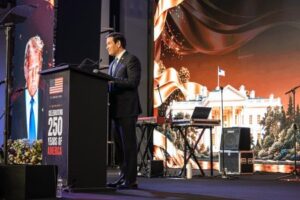
Celebrations took place for the 29th anniversary of Hong Kong’s return to China. (Image China MFA on X)
By TRH World Desk
29 years since the handover, and Hong Kong tells two different stories: flag-raising ceremonies and 29%-off lunch deals on one side, a damning Taiwan government report and a press-freedom ranking of 140th on the other. Our commentary breaks down the widening gap.
New Delhi, July 1, 2026 — Hong Kong turned 29 years old as a Chinese special administrative region on July 1, 2026 — and the city’s own coverage of the day captured just how differently that milestone reads depending on where you’re standing.
The official story: flags, festivities, and finance
In Hong Kong itself, the day opened with ceremony. A flag-raising event at Wan Chai’s Golden Bauhinia Square kicked off celebrations, with Chief Executive John Lee Ka-chiu and other officials attending before Lee delivered his annual handover speech, laying out priorities for his fifth year in office alongside a ceremony marking the 105th anniversary of the Communist Party of China.
The commercial mood matched the civic one: the city rolled out discounts, shopping perks and giveaways to mark the anniversary, with restaurant chains offering a 29 percent discount to match the occasion, and residents got free tram rides for the day.
There was a policy undertone to the festivities, too. Hong Kong’s finance sector was watching for a Beijing “gift” timed to the anniversary, following a pattern from 2012 and 2022 when the central government unveiled measures spanning cross-border business, offshore yuan and IPO rules, with expectations this year centered on folding real estate investment trusts into the mainland-Hong Kong trading connect.
That’s the anniversary Hong Kong’s government-facing coverage wants told: a stable, functioning, business-friendly city marking a milestone with normal civic pageantry.
The counter-narrative: autonomy under pressure
Outside that frame, a starkly different assessment was circulating on the very same day. Taiwan’s Mainland Affairs Council released a report timed to the anniversary arguing that legislative and judicial checks and balances in Hong Kong have become dysfunctional under a Beijing policy of national-security-first, executive-led governance, with the Hong Kong government replicating the Chinese Communist Party’s stability-maintenance model across political, educational, social, economic and judicial domains. The report in the Taiwanese media also noted that rallies marking May Day, June 4th and July 1st remain banned, alongside continuing cases of censorship targeting press freedom and artistic creation.
That assessment lines up with what press freedom monitors have documented for several years running. Freedom House’s most recent country report on Hong Kong points to the steady disappearance of organized political opposition: the pro-democracy Civic Party dissolved in 2023, the Democratic Party — Hong Kong’s oldest and largest pro-democracy faction — confirmed its own dissolution in December 2025, and the League of Social Democrats announced it was disbanding in June.
On media specifically, independent outlets have closed or left the territory, journalists have been prosecuted under security laws, and prominent media owner Jimmy Lai was convicted in December 2025 of foreign collusion and sedition.
Lai’s case has become something of a symbol in Western and Taiwanese coverage of the anniversary. He was sentenced to twenty years in prison in early 2026 after a panel of judges found him guilty of charges including foreign collusion, sedition, fraud and unauthorized assembly, and the broader crackdown has had measurable effects on the newsroom itself: Reporters Without Borders estimates at least nine hundred journalists have lost their jobs since the 2020 national security law took effect.
Hong Kong Free Press, one of the independent outlets still operating in the city, has kept a running account of the same period. Its timeline notes that the city now ranks 140th on the Reporters Without Borders global press freedom index, down from 73rd in 2019, even as Chief Executive John Lee maintains that press freedom remains intact. It also documents the practical mechanics of the shift: three companies linked to the now-defunct Apple Daily were reclassified as “prohibited organisations” after being removed from the corporate registry.
Hong Kong officials reject this framing directly. Justice Secretary Paul Lam has argued in local media that the press has no need to worry about breaking the law as long as it complies with basic ethics China’s foreign ministry has said press and speech freedoms have been fully protected under Hong Kong law since the handover, pointing to a rising number of international media outlets and journalists based in the city.
Working journalists quoted by Radio Free Asia weren’t convinced: one former broadcast executive argued that Article 23 restricts speech so broadly that it’s easy for media to cross red lines simply by reporting the news, while a veteran commentator said that outlets once reliant on foreign sourcing have shifted operations to Singapore because it’s now safer to cover both Hong Kong and the mainland from there.
Reading the gap
What’s notable isn’t that Hong Kong and its critics disagree — that’s been true for years. It’s how little the two narratives now overlap. The SCMP’s anniversary coverage runs on shopping deals, flag ceremonies and finance-sector speculation.
The Taipei Times, RFA, Freedom House and Hong Kong Free Press are, on the same news day, cataloguing party dissolutions, journalist attrition and a press freedom ranking that’s fallen roughly 70 places in under a decade.
Both sets of facts are true simultaneously, and that’s arguably the real story of Hong Kong at 29: a city where the official calendar of anniversaries, discounts and financial “gifts” continues on schedule, while the institutional scaffolding — independent press, opposition parties, unrestricted public assembly — that once distinguished Hong Kong from the mainland continues to narrow.
Beijing and the Hong Kong government describe this as stability and rule of law reasserting themselves after 2019’s unrest; critics in Taipei, Washington-based watchdogs and exiled Hong Kong journalists describe it as the negotiated 50-year “one country, two systems” framework eroding well ahead of its 2047 expiry.
Readers weighing the two accounts have reason to take both seriously: the celebratory coverage reflects a real and observable civic mood in parts of Hong Kong, while the critical coverage is grounded in verifiable, countable developments — court sentences, index rankings, party filings — rather than speculation. Neither side is manufacturing its facts; they’re selecting which facts constitute the story.
Follow The Raisina Hills on WhatsApp, Instagram, YouTube, Facebook, and LinkedIn




About The Author