From Forge to Foreign Policy: A Common Man’s Message to Modi
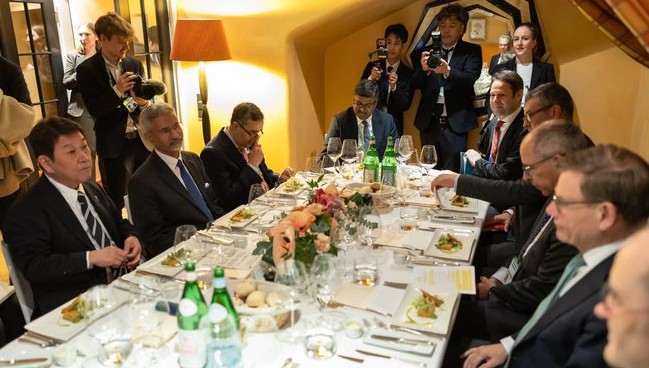
EAM S. Jaishankar at a G-4 meeting of India, Germany, Japan and Brazil to discuss reformed multilateralism in Munich in Germany (Image Jaishankar on X)
The Modi government faces scrutiny on strategic autonomy — From New Delhi to Munich
By MANISH ANAND
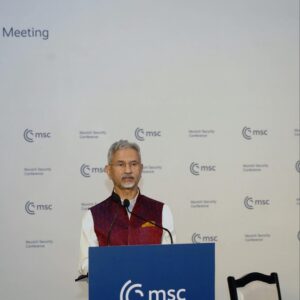
New Delhi, February 15, 2026 — On the sidelines of the Munich Security Conference, External Affairs Minister Subrahmanyam Jaishankar had to explain “India’s strategic autonomy.” Jaishankar was also asked — Can India exercise strategic autonomy now in making its energy choices?
Jaishankar was grilled in Germany where the world leaders spoke on geopolitics and the changing world order. US Secretary of State Marco Rubio told the Munich Security Conference that “it was foolish for the people who believed in rules-based old-world order.” A month ago, Canadian Prime Minister Marck Karney invited an avalanche of commentaries worldwide when he told the World Economic Conference at Davos that the rules-based world order was a convenient myth.
“The companies look for costs and economics and they make decisions,” Jaishankar said, in response to the question of India still exercised strategic autonomy in energy purchases. In the aftermath of US President Donald Trump announcing a trade deal with India, revised to an interim deal later, Prime Minister Narendra Modi-led dispensation faces probing scrutiny within the country, as well as abroad, on India’s strategic autonomy.
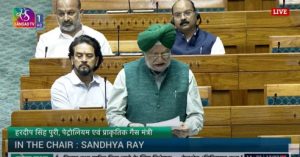
Leader of the Opposition in the Lok Sabha Rahul Gandhi in his Budget discussion speech claimed that “Trump weaponized energy” against India with the trade deal. Trump in his Truth Social post has claimed that the US will monitor India’s energy purchases. That was stated when he announced repeal of 25 percent punitive tariffs on India for buying Russian oils.
Independent Rajya Sabha MP Kapil Sibal in his press conference on Saturday said that strategic autonomy has been a hallmark of India’s in foreign policy. Sibal argued that the India-US trade deal just wrecked the strategic autonomy pivot of India.
“Strategic autonomy has been a consensus approach across the political spectrum in India, and that’s how the Indian foreign policy has evolved,” Jaishankar said in Munich. But he quickly dismissed the energy issue to a choice exercised by oil companies of India.
In the wake of the US slapping punitive tariffs on India for buying Russian oil, Syed Akbaruddin, former spokesperson of the Ministry of External Affairs (MEA), had written an article in a foreign publication, arguing “why should India be punished for the decisions of two private companies.” Akbaruddin in his article mentioned Reliance Industries and Nayara buying Russian oils. “Why should the US punish 1.4 billion people for the decisions of the two companies,” asked Akbaruddin in his article.
The MEA continues to argue that India will seek diverse basket for energy needs. Reports said that Reliance Industries has now got the license for Venezuelan oils.
The commoners wonder why 1.4 billion people are dragged into the strategic autonomy play in buying oils. The prices of petrol and diesel have been frozen for ages. That India bought Russian oil at a discount of $16 per barrel never made petrol and diesel cheaper. For the record, the retail prices of petrol and diesel are market linked!
But even an ironsmith knows the meaning of strategic autonomy in foreign policy. A month before the 2019 Lok Sabha elections, an ironsmith on the outskirts of Bulandshahr in Uttar Pradesh — who just wore loincloth as he worked his tools — said: “Modi ji ki Videsh neeti achchi hai (Modi’s foreign policy is good).”
India-US Trade Deal: Modi Faces Heartburn in Core Support Base
Follow The Raisina Hills on WhatsApp, Instagram, YouTube, Facebook, and LinkedIn




About The Author