Elon Musk’s AI Vision: Why He Predicts an ‘Age of Abundance’ Instead of Mass Unemployment
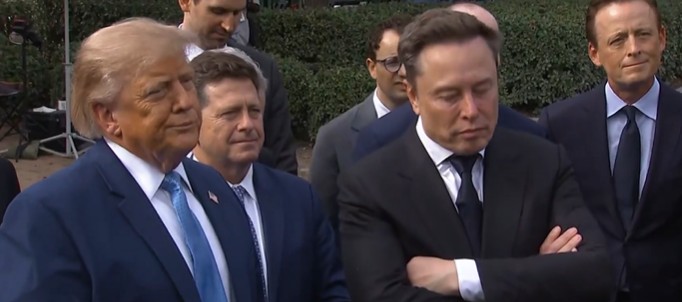
Musk says AI and robots could deliver universal high income and better healthcare (Image video grab)
By TRH Tech Desk
Musk says AI and robots could deliver universal high income and better healthcare, but the transition from human labour remains a major economic question.
New Delhi, September 30, 2026 — Elon Musk offered an unusually optimistic vision of the artificial intelligence revolution at the White House on Tuesday, arguing that the rise of super-intelligent machines could ultimately take humanity into an “age of abundance” rather than an era of mass unemployment.
Speaking to reporters alongside US President Donald Trump after technology leaders signed the White House Accord on Super Intelligence, Musk was asked what would happen to jobs if increasingly capable AI systems and robots displaced human workers.
His answer was strikingly optimistic.
“I think it is worth highlighting the positive benefits of AI super intelligence,” Musk said. In his view, the most likely outcome is “an age of abundance” in which society could move beyond universal basic income towards “universal high income.”
Musk argued that the transformation of work should not necessarily be viewed as the destruction of employment. Jobs, he said, have always changed with technology.
He pointed to the evolution of computing as an example. There was once a large workforce employed in buildings doing calculations manually, he noted, while digital computers now perform those tasks. Few people, he suggested, would want to return to such work simply because it once provided employment.
His larger argument is that AI could change the nature of work rather than merely eliminate it.
“Jobs are going to change. Jobs are always changed,” Musk said.
The more consequential part of his argument concerns healthcare. Musk said that the combination of robots and super intelligence could eventually provide everyone in the world with medical care better than that available today, including to the wealthiest people.
That vision, however, leaves a difficult question unanswered: what happens during the transition?
The technological revolution may create new industries and services, but workers displaced before those opportunities emerge would still face economic uncertainty. The challenge is therefore not simply whether AI creates wealth, but how that wealth is distributed and whether societies can help people adapt.
The White House accord signed this week attempts to address a different part of the problem: safety.
The voluntary agreement, signed by major technology leaders including Musk, commits participating companies to four layers of controls and audits: internal controls, an internal oversight team, independent external evaluation and an independent board committee. The framework specifically refers to risks involving cybersecurity, biosecurity, chemical threats and unintended access to technical systems.
The accord also leaves open the possibility that these safeguards could eventually be incorporated into laws or regulations.
The significance of Musk’s intervention is therefore larger than a prediction about jobs. It reflects a fundamental debate over how humanity should approach increasingly powerful machines: whether to see them primarily as a threat to existing economic structures or as infrastructure for an entirely different economic future.
Musk is betting heavily on the latter.
His “age of abundance” may sound distant today. But the question confronting governments, businesses and workers is already immediate: if machines become dramatically more productive than humans, how should society organise work, income and opportunity?
That may ultimately be the defining economic question of the AI era.
AI Is Taking Jobs — But India Could Be the Biggest Winner of the Artificial Intelligence Boom
Follow The Raisina Hills on WhatsApp, Instagram, YouTube, Facebook, and LinkedIn




About The Author