Dharmendra Pradhan’s Resignation: A Rare Reminder That Public Pressure Still Matters
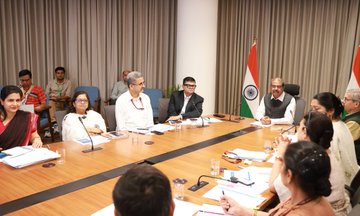
Education minister Dharmendra Pradhan holds review of the progress of various initiatives announced through a series of Budget announcements.(Image Pradhan on X)
By Rajeshwar Jaiswal
Rajeshwar Jaiswal argues that Dharmendra Pradhan’s resignation marks only the second ministerial exit in 12 years of the Modi government and demonstrates how sustained public pressure over the NEET crisis ultimately forced political accountability.
Motihari (Bihar), July 27, 2026 — The resignation of Dharmendra Pradhan from the Union Cabinet is significant not merely because he headed the Ministry of Education. It is significant because, in the twelve years of the Narendra Modi government, he became only the second Union minister to leave office under intense public pressure.
The first was M.J. Akbar, who resigned as Minister of State for External Affairs in October 2018 after multiple allegations surfaced during the global #MeToo movement. His resignation stemmed from accusations of personal misconduct and came relatively quickly as the controversy gathered momentum.
Dharmendra Pradhan’s exit belongs to an entirely different category.
His resignation was not about an individual’s conduct. It was about governance, institutional credibility and the future of millions of students. The nationwide anger over examination irregularities, especially the NEET paper leak controversy, steadily evolved into one of the biggest public challenges faced by the Modi government in its third term.
Pradhan was no ordinary minister. He had long been regarded as one of Prime Minister Narendra Modi’s most trusted political lieutenants. As Petroleum Minister, he successfully implemented the flagship Ujjwala Yojana. As Education Minister, he oversaw the rollout of the National Education Policy (NEP) 2020. Few ministers combined political influence with administrative experience as effectively as he did.
Yet even such political capital proved insufficient when public confidence in the examination system collapsed.
The protests that eventually forced political action did not emerge overnight. Initial demonstrations remained limited in scale. Student groups, including the Cockroach Janata Party (CJP), attempted to mobilise support, but the movement struggled to gain nationwide traction. Social activist Sonam Wangchuk later lent his support, helping sustain public attention, but the turning point came only when opposition parties entered the campaign and transformed scattered protests into a broader political movement.
As demonstrations spread across multiple states, the political costs of inaction steadily increased.
Governments in parliamentary democracies routinely face criticism from the opposition. That alone rarely compels ministerial resignations. What changes the political equation is sustained public mobilisation that extends beyond party lines and begins influencing the wider national conversation.
The Modi government eventually appears to have concluded that retaining Pradhan carried greater political risks than replacing him. The decision reflected a familiar principle of democratic politics: governments can ignore criticism for only so long before public sentiment demands accountability.
Could this resignation have come earlier?
There is a strong argument that it should have. Had political responsibility been accepted soon after the NEET controversy erupted, both the minister and the government might have contained the damage. Instead, prolonged delays allowed frustration to deepen, transforming an administrative crisis into a larger political challenge.
Dharmendra Pradhan’s resignation therefore represents more than the departure of an Education Minister. It underscores the importance of timely political accountability. It also reminds governments that while administrative failures may initially appear manageable, public trust—once eroded—is far more difficult to restore.
The comparison with M.J. Akbar also illustrates an important distinction. One resignation arose from allegations concerning personal conduct. The other emerged from widespread public dissatisfaction over governance. Both entered the political record, but for fundamentally different reasons.
History may ultimately remember Dharmendra Pradhan’s resignation not simply as the fall of a senior minister, but as evidence that organised public pressure, particularly when centred on issues affecting young people and their future, continues to shape democratic accountability in India.
From NEP Vision to NEET Crisis: The Rise and Fall of Dharmendra Pradhan
Follow The Raisina Hills on WhatsApp, Instagram, YouTube, Facebook, and LinkedIn




About The Author