Women’s Quota Bill in Focus, But Delimitation Is the Flashpoint
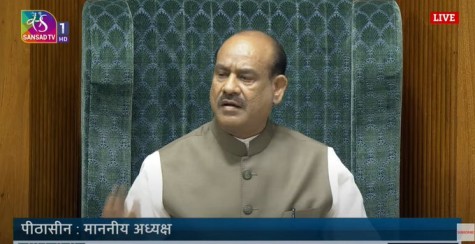
Lok Sabha Speaker Om Birla on Wednesday! (Image Sansad TV)
As Parliament of India meets for a special session, a proposed “hybrid model” by Revanth Reddy may offer a middle path on the contentious delimitation debate
By NIRENDRA DEV
New Delhi, April 15, 2026 — The April 16–18 special session of Parliament of India is officially billed as a step toward implementing 33% reservation for women in the Lok Sabha. But beneath the legislative focus on the Nari Shakti Vandan Adhiniyam lies a far more contentious issue — the looming delimitation exercise.
While the ruling National Democratic Alliance has broadly rallied behind the government’s agenda, the opposition finds itself in a nuanced position: supportive of women’s reservation, yet wary of the implications of delimitation.
At the centre of this debate is a proposal by Revanth Reddy, who has urged Prime Minister Narendra Modi to adopt a “hybrid model” for redrawing constituencies. Reddy argues that a purely population-based approach would unfairly penalise southern states that have successfully implemented population control measures.
The government is considering increasing Lok Sabha seats from 543 to around 850 by amending Article 81 of the Constitution. This expansion is seen as a precursor to implementing women’s reservation from 2029. However, the redistribution of seats — governed by Articles 82 and 170 — has triggered fears of a North-South political imbalance.
Southern leaders, including M. K. Stalin, have warned of strong resistance if delimitation disproportionately increases the political weight of high-population northern states. Projections suggest that states like Uttar Pradesh could see seats rise from 80 to 140, and Bihar from 40 to 73, while southern states may see comparatively modest gains.
Reddy’s hybrid model attempts to address this imbalance by incorporating not just population, but also economic contribution and developmental performance into the formula. The idea is to ensure that states contributing significantly to national growth are not politically disadvantaged.
The debate is further complicated by the freeze on seat allocation since 1976, which was extended to encourage population stabilisation. Any revision now risks reopening long-settled federal equations.
Some experts have suggested alternative balancing mechanisms. One such idea is to rationalise representation in the Rajya Sabha, where states currently have unequal seat distribution. Equalising or rebalancing Upper House representation — as seen in federal systems like the United States — could offset disparities arising from Lok Sabha redistribution. However, this would require extensive constitutional amendments and face practical challenges, especially for smaller states.
The government, for its part, has sought to reassure stakeholders. Home Minister Amit Shah has repeatedly stated that southern states will not be disadvantaged and that population data alone will not determine outcomes.
Politically, the timing of the exercise is sensitive. The special session is being held even as elections loom in states like West Bengal and Tamil Nadu, adding another layer of complexity. Opposition parties, including the Indian National Congress, have demanded that the women’s reservation bill be delinked from delimitation and taken up independently.
Clearing the delimitation framework will require a constitutional amendment, needing a two-thirds majority in both Houses of Parliament and ratification by at least half of the states — a threshold the government is confident of crossing.
Yet, the larger question remains unresolved: can India reconcile demographic realities with federal fairness?
As Parliament convenes, the women’s quota bill may dominate headlines. But it is delimitation — the “elephant in the room” — that will shape the future contours of India’s political power.
Nari Shakti Bill: Parliament Prepares for Historic Gender Reset
FAQ
What is the delimitation exercise in India?
Delimitation is the process of redrawing parliamentary and assembly constituencies based on population and other factors.
Why is delimitation controversial?
It may increase representation of high-population northern states, raising concerns of political imbalance with southern states.
What is the hybrid model proposed by Revanth Reddy?
It suggests combining population with economic and developmental indicators to allocate seats more fairly.
How is the Women’s Reservation Bill linked to delimitation?
The government argues that reservation for women can be effectively implemented only after constituencies are redrawn.
What is the opposition’s stance?
Opposition parties support women’s reservation but want delimitation handled separately.
Follow The Raisina Hills on WhatsApp, Instagram, YouTube, Facebook, and LinkedIn




About The Author