Delimitation in India: Past to Future, A Parliament Reset Ahead
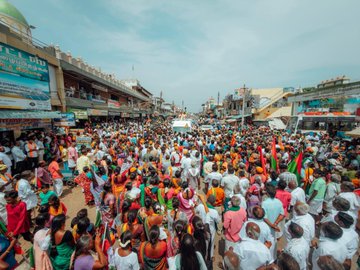
A BJP roadshow in Tamil Nadu Assembly elections (Image BJP on X)
From 1952 to the post-2026 reset: how India redrew its electoral map—and what lies ahead
By Pradeep Kumar Panda
Bhubaneswar, April 14, 2026 — Delimitation is one of the most consequential yet least understood processes in Indian democracy. It involves redrawing parliamentary and assembly constituencies to ensure equal representation as populations shift. Mandated by Articles 82 and 170 of the Constitution, it is carried out by an independent Delimitation Commission appointed by the President, whose decisions are final and beyond judicial or legislative review.
At its core lies a simple idea: one person, one vote. In practice, however, delimitation has been deeply shaped by politics, demography, and federal balance.
The Early Years: 1951–1973
India’s first delimitation was conducted in 1951 through a presidential order ahead of the first general elections, creating about 489 Lok Sabha constituencies. The First Delimitation Commission (1952), chaired by Justice N. Chandrasekhara Aiyar, formalised the process using the 1951 Census and fixed Lok Sabha seats at 494, while introducing proportional reservations for Scheduled Castes (SCs) and Scheduled Tribes (STs).
The Second Commission (1963), based on the 1961 Census and following the linguistic reorganisation of states, increased Lok Sabha seats to 522 and rationalised constituency boundaries. The Third Commission (1973), using 1971 Census data, expanded Lok Sabha strength to 543 — a figure that remains unchanged today — and updated SC/ST reservations. This would prove to be the last major expansion of parliamentary seats.
The Freeze: 1976 and Its Aftermath
In 1976, during the Emergency, the 42nd Constitutional Amendment froze the allocation of Lok Sabha and assembly seats based on 1971 Census data. The logic was to avoid penalising states that had successfully controlled population growth, particularly in southern India.
However, the consequences were far-reaching. As populations shifted over decades, constituencies became increasingly unequal. By the 1990s, some had over three million voters while others had fewer than 50,000 — undermining electoral parity. The 84th Amendment (2001) extended the freeze until after the first census post-2026, allowing only limited internal boundary adjustments.
The Fourth Commission: 2002–2008
The Fourth Delimitation Commission, chaired by Justice Kuldip Singh, operated under this freeze. It retained the total of 543 Lok Sabha seats and the 1971-based inter-state distribution, but redrew constituency boundaries using 2001 Census data to address internal imbalances and update SC/ST reservations.
Its orders came into effect in 2008, with Karnataka being the first state to vote under the new boundaries. However, delimitation in several northeastern states and Jharkhand was deferred due to security concerns.
Special Cases: Jammu & Kashmir and Assam
Since 2008, two notable exercises have taken place. In Jammu & Kashmir, after the abrogation of Article 370, a separate commission chaired by Justice Ranjana Prakash Desai used 2011 Census data to increase assembly seats from 83 to 90 and introduce ST reservations for the first time. The new map was implemented in the 2024 assembly elections.
In Assam, a delimitation exercise completed in 2023 retained 126 assembly seats but significantly redrew boundaries and increased SC/ST reservations. The process was politically contentious, with allegations of demographic manipulation, and its outcomes were used in the 2024 Lok Sabha and 2026 assembly elections.
Current Status: A Frozen Map
As of April 2026, India’s electoral map largely reflects the 2008 exercise. Lok Sabha seats remain at 543, constituency boundaries are based on the 2001 Census, and inter-state seat allocation is still tied to 1971 population figures. Nearly five decades after the freeze, representation continues to rest on outdated demographics.
The Next Delimitation: A Structural Shift
The next delimitation, expected after the first census conducted post-2026 (likely 2027), is set to transform India’s political landscape. Projections suggest Lok Sabha seats could rise to around 800 or more, a change linked to the implementation of the Women’s Reservation Act.
The implications are profound. Northern states such as Uttar Pradesh, Bihar, Madhya Pradesh and Rajasthan have seen faster population growth and stand to gain significantly in parliamentary representation. In contrast, southern states that achieved lower fertility rates through sustained social investment risk losing relative influence.
This revives the core dilemma that led to the 1976 freeze — balancing population-based representation with incentives for demographic control. But the stakes are now much higher.
Additional challenges include urban-rural disparities, tribal representation, and decisions over which census data will guide the transition. With limited judicial oversight, the process remains politically sensitive.
Delimitation has always been about more than technical boundary drawing. It determines the distribution of political power in a federal democracy. The upcoming exercise will not just redraw maps — it will redefine representation in India for decades to come.
Delimitation to Retain States’ Ratio of Strength in Lok Sabha: RSS
FAQ
Q: What is delimitation in India?
A: Delimitation is the constitutional process of redrawing the boundaries of Lok Sabha and state assembly constituencies to ensure equal representation based on population. It is carried out by a Delimitation Commission under Articles 82 and 170 of the Constitution, using the latest census data.
Q: How many times has India conducted national delimitation since independence?
A: India has conducted four national delimitation exercises — in 1952, 1963, 1973 and 2002–08. No exercises were held after the 1981 and 1991 Censuses due to the freeze imposed by the 42nd Amendment in 1976.
Q: Why were Lok Sabha seats frozen at 543?
A: The 42nd Constitutional Amendment (1976) froze total seats at 1971 Census figures to prevent southern states — which had achieved better population control — from losing parliamentary representation to faster-growing northern states. The 84th Amendment extended this freeze until after the first census post-2026.
Q: What is the north-south divide in delimitation?
A: Northern states like UP and Bihar have grown faster than southern states since 1971. A population-based delimitation will increase the north’s parliamentary weight, while southern states — which invested in family planning — face reduced relative representation despite better demographic outcomes.
Q: When is the next delimitation in India?
A: The next national delimitation is mandated after the first census conducted post-2026 — most likely the Census of 2027, delayed from 2021 due to COVID-19. It is expected to be the most transformative exercise since independence, potentially increasing Lok Sabha seats to around 816.
Q: What is the connection between delimitation and women’s reservation?
A: The Nari Shakti Vandan Adhiniyam (Women’s Reservation Act, 2023) requires a delimitation exercise before 33% reservation for women in Lok Sabha and state assemblies can come into force — making the post-2026 delimitation a prerequisite for women’s reservation implementation in the 2029 elections.
Follow The Raisina Hills on WhatsApp, Instagram, YouTube, Facebook, and LinkedIn




About The Author