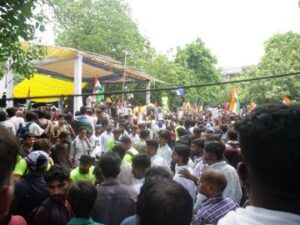
The Roar of the Cockroaches: How Big Is CJP’s Support Base?
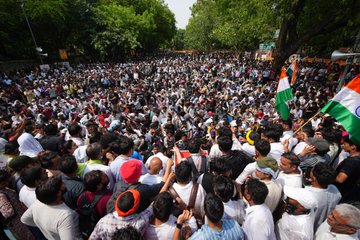
Hundreds gathered near Parliament as the Cockroach Janata Party staged a protest targeting the Modi government (Image CJP on X)
By AMIT KUMAR
The turnout at Jantar Mantar suggests the organisation commands support beyond online spaces, but questions remain about whether it can convert protest energy into sustained political influence.
New Delhi, June 7, 2026 — Cockroach Janata Party (CJP) on Saturday demonstrated that the outfit has genuine support base. Almost 250 to 350 protestors turned up on the Jantar Mantar Road, at a stone’s throw from India’s parliament. They not only hit out at Prime Minister Narendra Modi, but also targeted the Indian media.
Abhijeet Dipke, the founder of the CJP, arrived at the protest venue to a strong support from youngsters. Ladakh-based activist Sonam Wangchuk, fresh from the release from his arrest for leading protests in the hills, lent his weight to the venue.
Dipankar Bhattacharya of the CPI (ML) also turned up at the protest site. The venue sported an amalgamation of activists and protestors with diverse affiliations.
Union Minister for Education Dharmendra Pradhan faced the ire of the protestors. They wanted him to be sacked. From NEET-UG paper leaks to the CBSE Onscreen Marking System, the protestors roasted the Modi government for the alleged collapse of the Indian education system.
Dipke made a forceful speech at the venue. He packed punches. “This government has been doing just Hindu-Muslim politics for the last 12 years,” he said. Dipke gave signs that the CJP could walk the path of the Aam Aadmi Party — launching a political journey after a civil society movement.
The Bharatiya Janata Party (BJP) watched the protests with curiosity. B. L. Santhosh, the BJP general secretary (organisation), in a post on X sought to label the protest as a Congress and the AAP play on the street. Delhi Police maintained a calculated calm. “No FIR has been registered against any of the protestors,” the city police said in a statement amid rumours to the contrary.
Protestors singled out the mainstream media for their anger, calling out them with label of “Godi Media.” They also ridiculed some of the media persons for “testing their general knowledge.”
Protestors displayed their pin codes and e-mail ids on their placards. Protest broadcasts on the internet were amplified by independent commentators with no links to the media. YouTubers were present in strength.
A side commentary broke out with claims that the CJP protest at the Jantar Mantar exposed the inability of the Opposition to truly raise issues confronting the common people of India.
Political observers discussed the permission for protests at Jantar Mantar, denied to many in the past. “It’s better if the steam is let out,” said a veteran political observer, suggesting that “the Modi government doesn’t want confrontations with a group that claims to represent the GenZ.”
Follow The Raisina Hills on WhatsApp, Instagram, YouTube, Facebook, and LinkedIn




About The Author