Bollywood’s Changing India: From Hindu Stereotypes to The Kashmir Files and Dhurandhar
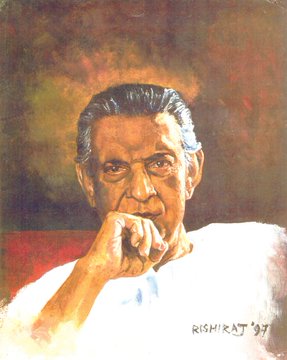
A portrait of Satyajeet Ray (Image X.com)
By NIRENDRA DEV
From Phalke and Satyajit Ray to The Kashmir Files, Uri and Dhurandhar, Hindi cinema’s portrayal of religion, caste, nationalism and politics has changed dramatically over the decades
New Delhi, September 7, 2026 — Nearly 80 years after Independence, it is worth asking a rather uncomfortable question: How has Hindi cinema portrayed India’s religious communities, castes, politicians and social institutions over the decades?
It is a long period in the life of a country. It is equally a long period for an industry that has grown into one of India’s biggest cultural and economic enterprises.
The journey takes us back to Dhundiraj Govind Phalke, popularly known as Dadasaheb Phalke, whose films based on Hindu religious figures helped lay the foundations of Indian cinema.
Phalke’s Raja Harishchandra and Lanka Dahan became major successes. Moving images of Hindu gods and mythological characters on the screen, battling evil and delivering moral messages, immediately struck a chord with audiences.
Yet cinema evolved.
There came the era of Raj Kapoor, Guru Dutt, Bimal Roy, Hrishikesh Mukherjee, Satyajit Ray and many others. Hindi cinema gradually moved beyond mythology to explore the aspirations, frustrations and contradictions of middle-class India.
But alongside this evolution came another phenomenon: the portrayal of India’s religions, castes and communities through recurring stereotypes.
What did an IIM Rohtak study find?
A study attributed to IIM Rohtak Director Dheeraj Sharma, examining Bollywood films made between 1960 and 2010, has been cited for its findings on how different communities were represented on screen.
Among the reported findings were:
- 58% of corrupt politicians had Brahmin surnames.
- 62% of corrupt businessmen had Vaishya surnames.
- 88% of Sikh characters were portrayed as laughable.
- 74% of Muslim characters were portrayed as strongly religious and honest.
- 78% of promiscuous female characters had Christian names.
The figures, if cited, need to be understood as an analysis of film characters and cinematic representation, not as a description of the real-world behaviour of any religious or caste group.
But the broader question remains relevant: Why did particular stereotypes become so familiar to generations of Indian film audiences?
And why was the Hindu character so often represented as a corrupt politician, a dubious businessman, a criminal in saffron robes or an orthodox priest, while characters belonging to minority communities were frequently given more sympathetic roles?
The Muslim character as the good Samaritan
Hindi cinema developed a particularly recognisable template.
The Muslim character was often the generous neighbour, loyal friend, sympathetic police officer, honest tailor, benevolent old man or self-sacrificing figure who came to the aid of the protagonist.
In Sholay, for instance, the village imam is portrayed as a deeply emotional and morally serious character willing to make a tremendous personal sacrifice.
Similarly, the number 786 acquired a distinctive cinematic symbolism.
In Deewaar, Amitabh Bachchan’s character questions God and rejects conventional religious belief. Yet, in one of the film’s memorable coincidences, the number 786 on a bullet box helps save his life.
Cinema was, of course, using symbolism.
But symbolism repeated over decades can eventually become a cultural vocabulary.
And where was the Hindu character?
The contrasting stereotype was sometimes equally predictable.
A Hindu holy man, temple priest or saffron-clad character could be presented as corrupt or complicit with criminals.
The question is not whether filmmakers had the right to create such characters. They certainly did.
The question is whether the frequency and consistency of such portrayals created an imbalance in the cinematic representation of Indian society.
Cinema has enormous cultural power. Millions of Indians encountered their first images of different communities not through direct social interaction but through films.
That makes representation important.
Sikh characters and the comedy stereotype
Sikh characters also suffered from a familiar cinematic treatment.
The turban and beard became visual shorthand for comic relief. “Sardarji” jokes became part of popular culture, and Sikh characters were often presented as lovable but foolish or comical figures.
There were exceptions, of course.
But stereotypes can survive precisely because they are repeated so frequently that audiences stop noticing them.
The same applies to caste representation.
If a particular caste is repeatedly associated with corruption while another community is disproportionately associated with virtue, cinema is not merely entertaining audiences. It is also constructing a social imagination.
Pakistan on the Hindi screen
The portrayal of Pakistan is another fascinating chapter.
One analysis cited in discussions of Bollywood representation noted that Pakistan featured in 20 films examined, with 18 portraying Pakistanis as welcoming, courteous, open-minded or courageous — a depiction that could differ sharply from the political and security realities between the two countries.
Again, fiction is not journalism.
A filmmaker is not obliged to reproduce geopolitical reality exactly.
But the cinematic representation of India’s neighbour has often reflected the politics of the particular period in which a film was produced.
There was also a period when Pakistani artists could work in India with relatively few barriers.
Zeba Bakhtiar appeared in Heena. Pakistani singer Meesha Shafi worked in Bhaag Milkha Bhaag. Pakistani actor and cricketer Mohsin Khan also appeared in Indian cinema and was married to actor Reena Roy.
Saba Qamar appeared in the critically acclaimed Hindi Medium.
Naseeruddin Shah, meanwhile, acted in the Pakistani film Khuda Ke Liye in 2007, alongside prominent Pakistani performers including Fawad Khan, Shaan and Iman Ali.
Om Puri also worked in Pakistani cinema.
Shilpa Shukla, before becoming widely recognised as Bindiya in Chak De! India, appeared in the Pakistani film Khamosh Pani.
Cinema crossed borders even when politics could not.
The politics of nationalism changes Bollywood
The political climate has changed considerably in recent years.
Today, one of the principal criticisms directed at sections of Hindi cinema is that they are undergoing “saffronisation”.
Yet the history is more complicated.
The patriotic cinema of Manoj Kumar was hardly new. Films built around nationalism, sacrifice and the idea of Bharat have existed for decades.
What has changed is the political environment surrounding such films.
Under Narendra Modi, patriotism has acquired renewed cultural visibility.
Films such as Uri: The Surgical Strike became major commercial successes, while more recent productions such as the Dhurandhar films have openly addressed Pakistan’s intelligence establishment and themes of national security.
Whether one likes this genre or not, it represents a significant change from the dominant cinematic narratives of earlier decades.
Amitabh Bachchan’s KBC: How ‘Kaun Banega Crorepati’ Changed Indian Television
The Kashmir Files and the uncomfortable question
Then came The Kashmir Files in 2022, written and directed by Vivek Agnihotri.
The film presented a fictionalised narrative centred on the persecution and displacement of Kashmiri Pandits.
It brought the subject of the community’s suffering and displacement into the centre of mainstream political and cultural debate.
One question emerging from the film’s narrative was particularly uncomfortable:
“Kya Kashmiri Pandit ko apne ghar jaane ka mauka milega?”
Will the Kashmiri Pandit ever get an opportunity to return home?
And, more fundamentally, what does justice mean for a community that was displaced from its homeland?
For decades, these questions received comparatively limited space in mainstream popular culture.
The emergence of films dealing explicitly with the subject therefore represented a shift in India’s cinematic discourse.
Shah Rukh Khan’s son and the politics of celebrity
Bollywood’s relationship with politics and public morality has also been tested by controversies involving its own stars.
When Aryan Khan, son of actor Shah Rukh Khan, was arrested in connection with a 2021 drugs case, sections of public debate quickly moved beyond the legal proceedings.
Supporters argued that the case was being used to target the actor and his family, while others insisted that the legal process should be allowed to take its course.
The episode demonstrated another feature of contemporary India: the intersection of celebrity, politics, identity and social media can transform a criminal investigation into a national political argument almost overnight.
The controversy eventually became part of a much larger debate about selective outrage, privilege, law enforcement and the politics of celebrity.
Nepotism and the Sushant Singh Rajput debate
The death of actor Sushant Singh Rajput in 2020 opened another Pandora’s box.
The ensuing debate over nepotism, the influence of film families and the opportunities available to outsiders became one of the most intense cultural controversies in contemporary Bollywood.
The issue was not simply whether star children should be allowed to enter the industry.
It was about whether an industry that claims to celebrate talent provides equal opportunities to those without influential family connections.
Bollywood would perhaps prefer to forget much of the controversy.
But the debate fundamentally altered the way many Indians viewed the industry’s internal structures.
Bollywood Strikes Discordant Notes with Animal’s song Arjan Vailli
From Hrishikesh Mukherjee to Satyajit Ray
There was, meanwhile, another side to Indian cinema that should not be forgotten.
Hrishikesh Mukherjee provided a window into the Indian middle class.
His films captured ordinary people’s frustrations, family relationships, humour and aspirations without requiring grand political messaging.
In Kissi Se Na Kehna, for example, everyday social situations become the source of humour.
The period also reflected the language of an India negotiating modernity, tradition and changing social norms.
Comedian Keshto Mukherjee’s famous observation — “Yeh milavat aur banavat ka hi zamana hai” — captured a society increasingly conscious of pretence and appearances.
Then came films such as Shakti Samanta’s An Evening in Paris, which reflected another transformation in Hindi cinema: glamour, modernity, international locations and changing representations of women.
Raj Kapoor, the USSR and India’s cultural diplomacy
Raj Kapoor became an icon not only in India but also across the former Soviet Union.
His films travelled well beyond India’s borders.
Yet in the international cultural hierarchy of the time, Satyajit Ray occupied a different position.
India Today wrote in 2000 that Ray had become a national icon who was showcased to the world “in a way that no Indian art personality ever had been.”
Ray’s films received serious international critical attention, including substantial reviews in publications such as The Times.
Indira Gandhi was also known to organise private screenings of Ray’s films for foreign dignitaries.
This was cinema functioning not merely as entertainment but as India’s cultural diplomacy.
From Phalke to the present
The journey from Dadasaheb Phalke to contemporary Bollywood is therefore not a simple story of progress or decline.
It is a story of changing India.
Phalke used religious mythology to establish a new visual language.
Raj Kapoor carried Indian cinema across borders.
Hrishikesh Mukherjee captured the middle-class imagination.
Satyajit Ray transformed India’s standing in global cinema.
Manoj Kumar turned patriotism into a cinematic vocabulary.
Amitabh Bachchan’s “angry young man” represented the frustrations of another India.
And today’s filmmakers are increasingly confronting terrorism, nationalism, Kashmir, Pakistan, identity politics and ideological conflict.
The charge of “saffronisation” will continue.
So will the counterargument that earlier Bollywood was itself shaped by ideological preferences, including particular approaches to secularism, minority representation and caste.
Perhaps the more useful question is not whether Bollywood was ever completely neutral.
It was not.
Cinema has always reflected the politics, anxieties and aspirations of its time.
The real question is whether today’s Indian film industry can create a more balanced representation of the extraordinary complexity of Indian society — where a Muslim character need not always be the noble friend, a Sikh need not always be comic relief, a Christian need not automatically be the benevolent saviour, and a Hindu need not routinely be the corrupt priest or politician.
India is too complicated for such stereotypes.
And perhaps Indian cinema, after more than a century, is finally beginning to understand that.
Follow The Raisina Hills on WhatsApp, Instagram, YouTube, Facebook, and LinkedIn




About The Author