Mulayam’s 1999 Move Echoes as Akhilesh Skips INDIA Meet Amid SP-Congress Seat-Sharing Row

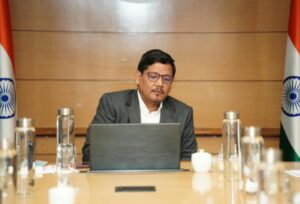
Samajwadi Party chief Akhilesh Yadav’s absence from the INDIA bloc meeting in New Delhi has drawn attention to unresolved seat-sharing discussions with the Congress ahead of the 2027 Uttar Pradesh Assembly elections. (Image Akhilesh on X)
By NIRENDRA DEV
Samajwadi Party chief Akhilesh Yadav’s absence from the INDIA bloc meeting in New Delhi has drawn attention to unresolved seat-sharing discussions with the Congress ahead of the 2027 Uttar Pradesh Assembly elections. The episode has also revived memories of his father Mulayam Singh Yadav’s crucial stand during the government-formation crisis of 1999.
New Delhi, October 1, 2026 — The Samajwadi Party-Congress alliance in Uttar Pradesh is facing another test, with SP chief Akhilesh Yadav skipping the INDIA bloc meeting in New Delhi on September 30 amid continuing differences over the proposed seat-sharing arrangement for the 2027 Assembly elections.
Akhilesh has cited pre-scheduled political commitments for his absence. The Congress, for its part, has said the Rajya Sabha nomination process was the reason he could not attend in person, while SP leaders were present at the opposition gathering.
The timing has nevertheless attracted attention because the two parties have yet to finalise their seat-sharing formula for Uttar Pradesh. Congress state in-charge Rajendra Pal Gautam has publicly spoken of the party seeking at least 150 of the state’s 403 Assembly seats. The SP on the other hand wants the Congress to limits its expectations.
Akhilesh, meanwhile, has reiterated that the SP intends to contest the 2027 election in alliance with the Congress. However, the precise arrangement remains unresolved, per a pattern seen in several elections in the last two decades.
Akhilesh’s absence and the seat-sharing question
The immediate issue is not whether the SP-Congress alliance exists, but how it will be structured for the next Uttar Pradesh election.
Congress leaders have spoken publicly about the number of constituencies they want to contest, while SP leaders have pushed back against those demands.
The public exchange has added pressure to negotiations that have not yet produced a formal seat-sharing agreement.
The Congress’s demand for at least 150 seats has emerged as one of the central points of discussion.
The two parties therefore face a familiar coalition challenge: reconciling their respective organisational ambitions before the election campaign gathers further momentum.
A 1999 parallel: Mulayam Singh Yadav and Sonia Gandhi
The current friction has also prompted comparisons with a very different political moment involving Akhilesh’s father, Mulayam Singh Yadav.
In April 1999, Prime Minister Atal Bihari Vajpayee’s government lost a confidence vote by one vote, triggering an attempt to form an alternative government. Congress president Sonia Gandhi met then President K.R. Narayanan.
Gandhi famously said she had the support of 272 MPs and expected to secure more. However, Mulayam Singh Yadav, whose Samajwadi Party had 20 MPs, ultimately declined to support a Congress government led by Gandhi.
Mulayam instead proposed CPI(M) leader Jyoti Basu as a possible alternative and argued that the parties involved should collectively decide who would lead the government.
The episode ended without the Congress forming a government. India subsequently went to the polls later in 1999, and the NDA secured a majority, with Vajpayee returning as prime minister.
From Mulayam’s 1999 stand to Akhilesh’s 2026 calculations
The circumstances are clearly different.
In 1999, Mulayam’s decision was taken during an immediate government-formation crisis at the Centre, when the numbers in the Lok Sabha determined whether an alternative government could be formed.
In 2026, Akhilesh’s absence from the INDIA bloc meeting comes during preparations for a state election that is still months away. The immediate disagreement concerns the division of Assembly constituencies between two parties that have already worked together electorally.
The historical parallel is therefore about political bargaining rather than identical circumstances.
Mulayam’s 1999 position demonstrated how a regional party with a relatively limited number of parliamentary seats could become important in determining the composition of a government at the Centre. In Uttar Pradesh today, the SP remains the larger regional partner in its proposed arrangement with the Congress, making the question of seat distribution central to the alliance’s electoral strategy.
Kharge-Rahul Banter, Priyanka’s Pradhan Remark and Congress’s SIR Battle
Follow The Raisina Hills on WhatsApp, Instagram, YouTube, Facebook, and LinkedIn




About The Author