Women’s Quota, Delimitation Bills Defeated: Major Setback for Modi Govt
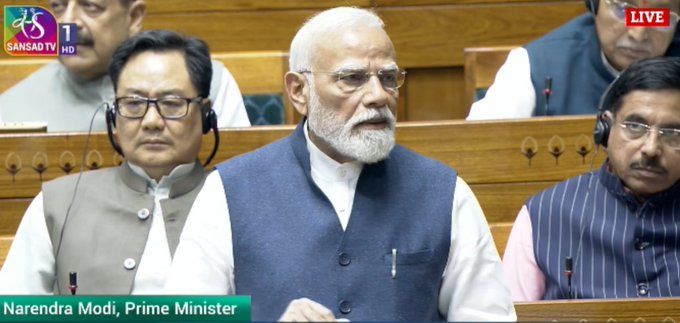
PM Narendra Modi speaks in the Lok Sabha on Women's reservation bill (Image Sansad TV on X)
High-stakes gamble by Centre fails to secure numbers; Opposition claims vindication as political battle intensifies.
By NIRENDRA DEV
New Delhi, April 17, 2026 — In a dramatic turn during the special session of Parliament, the proposed Women’s Reservation and Delimitation Bills were defeated in the Lok Sabha, marking a significant political setback for the government led by Narendra Modi.
The move to table the legislation — despite lacking a two-thirds majority in both Houses — was widely seen as a calculated political risk. The Women’s Reservation Bill, positioned as a cornerstone of the government’s “Naya Bharat” vision, failed to pass amid united opposition resistance, particularly over its linkage with delimitation.
The defeat underscores the limits of legislative ambition without consensus. BJP leaders were aware that delimitation would trigger strong pushback, especially from southern states like Tamil Nadu, where concerns over representation remain politically sensitive. Yet, the government pressed ahead — a decision many now interpret as an attempt to counter regional political narratives, including Mamata Banerjee’s strong appeal among women voters through welfare schemes.
With elections looming in Tamil Nadu and political stakes rising in West Bengal, the fallout from this defeat is expected to reshape campaign strategies. The delimitation issue, in particular, is emerging as a major electoral flashpoint that could benefit regional players like the DMK.
Leader of Opposition Rahul Gandhi launched a blistering attack during the debate, calling the government’s move a “panic reaction.” He alleged that the Prime Minister sought to send two signals — to redraw India’s electoral map and reinforce a pro-women image.
“The magician has been caught — the magician of Balakot, the magician of demonetisation,” Rahul Gandhi said, escalating the political rhetoric inside the House.
Union Home Minister Amit Shah, however, defended the government’s intent, arguing that the Opposition has historically resisted major reforms — from triple talaq to Article 370 — framing the current resistance as part of a broader pattern.
The debate also saw sharp political exchanges beyond policy. Congress MP Priyanka Gandhi Vadra’s earlier remarks invoking Chanakya and Rahul Gandhi’s cryptic “Number 16” reference sparked intense speculation on social media, adding a layer of intrigue to the proceedings.
This is not the first time the Women’s Reservation Bill has faltered. Similar attempts in 1996, 1998, 1999, 2008, and even after its passage in the Rajya Sabha in 2010 failed to translate into law. The latest defeat revives concerns about whether political consensus on women’s representation remains elusive.
Critics argue that repeated delays risk deepening public cynicism. NCP leader Supriya Sule had earlier described the bill as a “post-dated cheque drawn from a crashing bank,” a remark that now resonates more sharply.
As political blame games intensify, the broader impact may be felt beyond Parliament. The failure to pass the bill — despite high-decibel messaging — could dent the government’s reform narrative and reinforce Opposition claims of political opportunism.
For now, the outcome signals a clear message: without cross-party consensus, even the most high-profile reforms can unravel on the floor of the House.
FAQs:
Q1. Why were the Women’s Reservation and Delimitation Bills defeated?
The government lacked the required two-thirds majority and faced united opposition resistance.
Q2. What did Rahul Gandhi say during the debate?
He called the move a “panic reaction” aimed at political messaging rather than real reform.
Q3. Why is delimitation controversial?
It could alter state-wise representation, triggering concerns in southern states.
Q4. Has the Women’s Reservation Bill failed before?
Yes, multiple attempts since 1996 have not resulted in full implementation.
Follow The Raisina Hills on WhatsApp, Instagram, YouTube, Facebook, and LinkedIn




About The Author