The Frozen Lok Sabha: 50 Years of Democratic Distortion
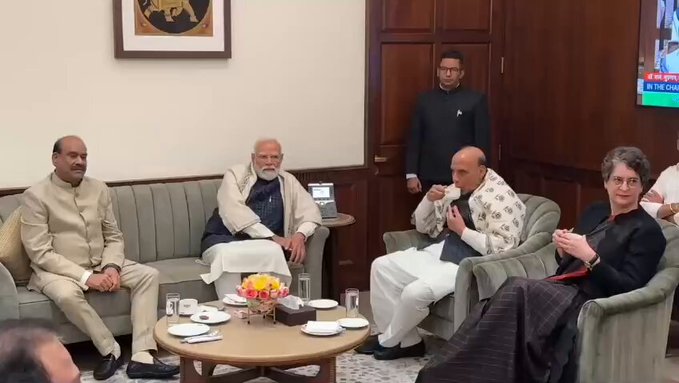
Prime Minister Narendra Modi joins for tea after adjournment of the Winter session of parliament. (Image Lok Sabha Secretariat)
India’s Parliament opened a special session on key legislation, reigniting a fierce delimitation debate. Will redrawing Lok Sabha seats deepen the North-South political fault line?
By MANISH ANAND
New Delhi, April 16, 2026 — A three-day special session of parliament begins today to deliberate on triple consequential legislations which may shape India’s democracy with focus on delimitation debate. Stunned by the timing of the parliament session, the Opposition has slammed Prime Minister Narendra Modi-led government at the Centre for a hurried move to raise the strength of the Lok Sabha.
Discourse has now shifted gears with the North versus South narrative. The binary of regional discords now threatens to hijack the narrative around the delimitation exercise.
Frozen since 1971, the strength of the Lok Sabha — representing Indian democracy’s participative nature — has in itself become a threat the core democratic idea of India that each person will have one vote and the value will also be the same. The 50-year-long freeze solely on account of the political establishment lacking spine to face the truth has empirically distorted Indian democracy.
The value of the vote of a person in Bihar is far less than someone from Tamil Nadu. This is solely because of population. But the North versus South binary seeks to push extra factors in the debate to argue that good governance can explain why a voter in Kerala should have more values at the ballot then someone from Uttar Pradesh. This argument risks justifying that a rich person may be given more value for his voting power. The logic defeats the core idea of democracy that there can be no difference or discrimination on the basis of the economy, caste, religion, or colour.
The delimitation discourse also suffers from argumentations through narrow perspectives. Opponents of population-based delimitation are succumbing to regional biases. They’re driven by the immediacy of the fear that southern states will lose influence in dictating who comes to power at the Centre. But they never had that leverage at any stage in Indian elections since Independence.
Post-Emergency, the Congress was ousted from power in New Delhi despite the Indira Gandhi-led outfit doing exceedingly well in the southern states. The adage that the road to power in New Delhi goes through Lucknow is now a well-established reality of the Indian democracy.
Indeed, the solution lies in reorganisation of states — possibly of equal size and population. But that may prove to be a humongous exercise. The void of purpose will only lead to a din.
(This is an opinion piece. Views expressed are the author’s own.)
Women’s Quota Bill in Focus, But Delimitation Is the Flashpoint
Follow The Raisina Hills on WhatsApp, Instagram, YouTube, Facebook, and LinkedIn




About The Author