Swinging Pendulum: West Bengal 2026 and the Battle for Narrative
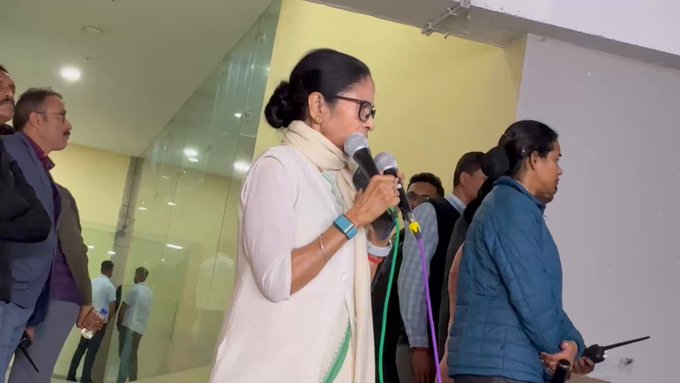
West Bengal CM Mamata Banerjee speaks to supporters during ED raid at I-PAC office (Image AITMC on X)
A high-stakes contest shaped by governance, identity, and corruption allegations—where a BJP win could redefine national politics, and a Mamata Banerjee victory could cement her as a key opposition pivot.
By NIRENDRA DEV
Kolkata, April 10, 2026 — The political pendulum in Bengal has swung before. In 2021, despite a massive campaign, the BJP was halted by the deeply entrenched Trinamool Congress. As 2026 approaches, the central question remains: is Bengal ready for change, or will continuity prevail?
What Will Decide Bengal?
The outcome will not hinge on a single issue. It will be shaped by a combination of factors—global economic pressures, the national performance of the Modi government, and local governance under Banerjee. Voters will weigh economic realities alongside identity, culture, and governance delivery.
A BJP victory would quickly be framed as validation of Modi’s “double engine” governance model. Conversely, failure to capture Bengal may reinforce the perception that hyper-nationalistic politics has limited appeal in a state fiercely protective of its cultural autonomy, linguistic pride, and even culinary identity—where debates over “Maccher Jhol vs vegetarianism” have entered political discourse.
Mamata’s Stakes and National Ambitions
If Banerjee secures a fourth consecutive term—after wins in 2011, 2016, and 2021—her stature in national politics will rise significantly. The question then will be whether she can challenge Rahul Gandhi as a central figure for opposition unity.
Her victory would signal resilience; her defeat could mark the beginning of political decline, much like the collapse of the Left Front in 2011—a shift that even historian Eric Hobsbawm once described as startling.
The Anti-Incumbency Undercurrent
Multiple factors are shaping voter sentiment:
Allegations of misgovernance and lawlessness over 15 years
Economic stagnation compared to rising states like Odisha and Assam
The emergence of the BJP as a credible alternative amid the decline of the Left and Congress
Corruption scandals, including the teacher recruitment scam
The 2022 arrest of former minister Partha Chatterjee and subsequent judicial interventions have amplified perceptions of systemic corruption. In 2025, the Supreme Court upheld the cancellation of over 25,000 teaching appointments, calling the process “tainted beyond repair.”
Changing Voter Psychology
There is also a generational shift underway. Younger, aspirational Bengalis are increasingly disillusioned with ideological rigidity and limited economic opportunities. Welfare schemes like Lakshmir Bhandar may not suffice if voters perceive stagnation.
Ground reports suggest cracks in the TMC’s traditional support base, including minority communities. At the same time, skepticism persists about whether the BJP can govern effectively if it comes to power.
The Leadership Question
Even if the BJP gains electorally, governance will pose a serious challenge. The party lacks a clear state-level leader with the political heft of Modi or the administrative assertiveness of Yogi Adityanath. Leaders like Suvendu Adhikari are prominent but may not yet fit that role.
The Verdict Ahead
West Bengal 2026 is not just a state election—it is a referendum on competing political models: regional identity versus national consolidation, welfare versus governance, and charisma versus organisation.
If Mamata seeks continuity for its own sake, voters may no longer be impressed. But if the BJP cannot translate momentum into trust, the pendulum may yet swing back again.
Voting Ends in Kerala and Assam: Love Jihad Rhetoric Rings Loud
Follow The Raisina Hills on WhatsApp, Instagram, YouTube, Facebook, and LinkedIn




About The Author