Who Will Win Bengal? Exit Polls Show BJP-TMC Dead Heat
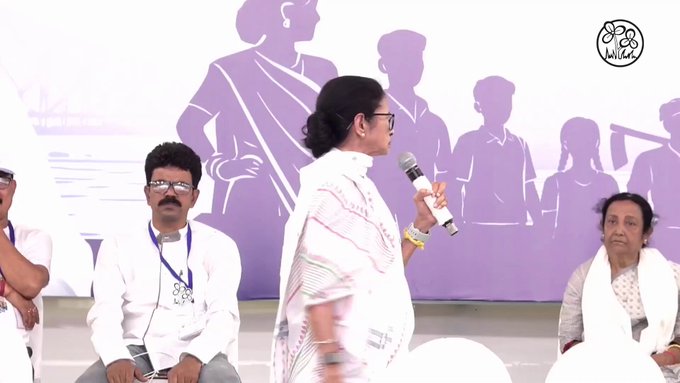
West Bengal Chief Minister Mamata Banerjee erupted in anger at an election rally in Khandaghosh (Image TMC on X)
Political analyst Manish Anand says high voter rejection rate and women’s vote could be decisive as results await on May 4
By TRH Op-Ed Desk
New Delhi, April 30, 2026 — Exit polls for the West Bengal assembly elections have thrown up a razor-thin contest between the Bharatiya Janata Party and the Trinamool Congress, but seasoned political observers are urging voters and commentators alike to treat these projections with considerable scepticism ahead of the May 4 results.
According to exit poll projections, the BJP is estimated to receive approximately 42 percent of the vote share against TMC’s 40 percent — a margin so narrow that it falls well within the standard error range that pollsters themselves acknowledge.
“These exit polls carry a two to two-and-a-half percent error margin. When the difference between BJP and TMC is only about two percent, you can safely conclude this is an extremely close contest,” said Manish Anand, political analyst and host of The Raisina Hills YouTube channel. “Until May 4 results arrive, you should not trust anything about which way West Bengal has gone,” he added.
A Bipolar Contest With Hidden Variables
Anand described the West Bengal election as fundamentally bipolar — a straight fight between TMC and BJP — with Congress and the Left Front failing to register a significant ground presence this time around.
However, he flagged a critical question: which way did the dedicated Left and Congress voters swing? “In 2019, Left Front voters voted for BJP against Trinamool Congress. But that dynamic may not repeat in 2026,” he noted, pointing to the opposition’s united stand against the Women’s Reservation Bill in Parliament as a signal that anti-BJP consolidation among opposition voters has deepened significantly since then.
West Bengal has approximately 150 constituencies, Anand explained, where the demographic profile is considered broadly anti-BJP — making strong BJP performance in those seats structurally difficult, according to political observers tracking the state.
The 9.1 Million Missing Votes
One of the most striking variables flagged by Anand is the Special Intensive Revision of Electoral Rolls, which resulted in approximately 9.1 million votes being deleted from the voter list ahead of the election.
“In some assembly constituencies, 21 percent of votes were cut. Even in Bhabanipur — where Chief Minister Mamata Banerjee and opposition leader Suvendu Adhikari were directly facing each other — 21 percent of votes were deleted,” Anand said. “Despite this, voter turnout came in at around 91 percent. What that signals will only become clear on May 4,” he added.
The Ground Game and Women Voters
Anand drew a sharp parallel between the two main parties’ organizational strength. “Just as BJP is a cadre-based party with workers at the grassroots level, so is Trinamool Congress. This was a street-level fight, and the fact that BJP matched TMC on the ground is itself a significant moral boost for the party,” he said.
Domestic workers from West Bengal employed across the Delhi-NCR region — a commonly referenced informal sample in political circles — largely indicated they would vote for “Didi,” referring to Mamata Banerjee, when asked before returning home to vote.
Anti-incumbency against Banerjee, who has completed three consecutive terms and 15 years as Chief Minister, is acknowledged to be real, particularly among urban voters. “But whether that anti-incumbency exists equally in rural Bengal is a separate question entirely,” Anand cautioned. “Mamata Banerjee commands strong loyalty among rural voters, and the direction of women voters in this election will only be known on May 4,” he added.
A Peaceful Election — Credit Where It’s Due
On one point, Anand was unambiguous: the Election Commission deserves credit for conducting a largely peaceful election in a state with decades of documented political violence. Massive paramilitary deployment and micro-level management kept incidents to a minimum, he said — calling it “an achievement in its own right.”
Results for West Bengal, along with Assam, Kerala, and Tamil Nadu, are due on May 4, 2026.
Who Will Win Bengal 2026? Exit Polls Show BJP Edge, Tight Race
Follow The Raisina Hills on WhatsApp, Instagram, YouTube, Facebook, and LinkedIn




About The Author