Trump Amplifies “India a Hellhole” Rant. New Delhi Is Not Amused.
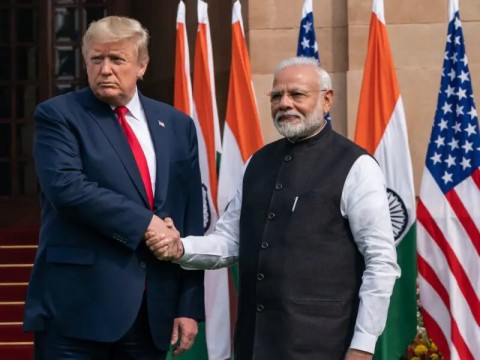
US President Donald Trump & India PM Narendra Modi (Image credit X.com, File)
The US President reposted a racist diatribe targeting Indian and Chinese immigrants on his Truth Social platform. India’s foreign ministry has called the remarks “uninformed, inappropriate and in poor taste” — but the deeper question is whether New Delhi is being too polite.
By TRH Op-Ed Desk
New Delhi, April 23, 2026 — On April 23, 2026 — the same day Spotify was celebrating 20 years of music — the United States government was amplifying something rather less celebratory: a screed describing India, China, and other nations as “hellholes on the planet.”
US President Donald Trump reposted a transcript and video from conservative radio host Michael Savage’s podcast, The Savage Nation, on his Truth Social platform. At the centre of the post was a passage in which Savage, railing against America’s birthright citizenship law, claimed that immigrants exploit the system by arriving “in the ninth month of their pregnancy.” The conclusion, in Savage’s own words: “A baby here becomes an instant citizen, and then they bring the entire family in from China or India or some other hellhole on the planet.”
Trump did not add a disclaimer. He did not distance himself from the language. He simply shared it — and in doing so, placed the weight of the American presidency behind one of the more openly bigoted characterisations of two of the world’s largest democracies and most significant US partners.
The Rant in Full
Savage’s screed, delivered in the context of Supreme Court arguments over birthright citizenship, was not a slip of the tongue or a moment of unguarded frustration. It was an extended, deliberate attack on Asian immigrants — and on the countries they come from.
Beyond the “hellhole” remarks, Savage described Indian and Chinese immigrants as “gangsters with laptops” who had done more damage to America than “all the mafia families put together.” He characterised the lawyer arguing in favour of birthright citizenship before the Supreme Court — a Chinese-American woman — as “very smart, very evil, and very devious.” He lamented that “English is not spoken here anymore,” and suggested that Asian immigrants, unlike European ones, have shown “almost no loyalty” to the United States.
This was the content that the President of the United States chose to amplify to his tens of millions of followers. Not by accident. Not by oversight. By repost.
India’s Response: Measured, But Pointed
New Delhi responded on the same day through Ministry of External Affairs spokesperson Randhir Jaiswal. The statement was crisp and calibrated: “We have seen the comments, as also the subsequent statement issued by the US Embassy in response. The remarks are obviously uninformed, inappropriate and in poor taste. They certainly do not reflect the reality of the India-US relationship, which has long been based on mutual respect and shared interests.”
The US Embassy had already moved to limit the damage, putting out a message stating that Trump believes India is a “great” country led by a “good friend of mine” — without specifying where or when Trump made those remarks. The optics of a president calling a country great while simultaneously amplifying a post describing it as a “hellhole” appeared to escape no one.
India’s opposition Congress party was less restrained than the government, demanding an official protest from Prime Minister Narendra Modi’s administration and calling the remarks “extremely insulting and anti-India.”
Sibal’s Warning: Don’t Underestimate the Signal
Former Indian Foreign Secretary Kanwal Sibal, a veteran diplomat who rarely wastes words, offered what may be the most clear-eyed assessment of the situation. Writing on X, Sibal acknowledged that the MEA was right not to “take too much notice of this post.” But he added an important caveat: completely ignoring it, he said, might not be wise either — given what he called “racist rants from the MAGA base already directed at Indians.”
Sibal’s proposed formulation was characteristically precise: New Delhi, he suggested, might convey that it is for “the US leadership to decide whether giving attention to such extreme views contributes to better understanding between the people of our two countries.”
It is a diplomatic knife wrapped in velvet. The message is clear: India is watching. And India’s public is watching too.
The Diplomacy of Looking Away Has Its Limits
Let us be precise about what happened here. The President of the United States — not a fringe blogger, not an anonymous X account — chose to place his platform behind language that describes the world’s most populous democracy as a “hellhole.” He did this a day after falsely claiming in a CNBC interview that no other country in the world offers birthright citizenship. In reality, around three dozen nations do — including Canada, Mexico, and most of South America. The factual error wasn’t corrected. The repost was not walked back.
The Indian government’s response, while dignified, leaves something on the table. The phrase “uninformed, inappropriate and in poor taste” is the diplomatic equivalent of a polite cough. It says nothing false. But it also says nothing urgent. And urgency may be what this moment requires.
Here is the uncomfortable truth that India’s foreign policy establishment must confront: the “Modi-Trump friendship” framing that has dominated bilateral optics for over a year is not a shield. Personal chemistry between leaders is not the same as institutional respect. A president who genuinely valued that relationship would have thought twice — or at least once — before hitting “repost” on a tirade that calls the Indian people imports from a hellhole.
What is also striking is the pattern. This is not the first time the MAGA ecosystem has directed contempt at Indian immigrants. H-1B visa holders have been targeted by Trumpworld influencers. Indian-American tech workers have been singled out in online campaigns. Savage himself acknowledges he “used to be a great supporter of Indians” — apparently, that support has an expiry date, and it expires when they stop being useful to a particular political narrative.
Kanwal Sibal is right that India cannot afford to be entirely silent. The “hellhole” post will circulate. It will be screenshotted, shared, and seen by Indian voters, Indian professionals, Indian students looking at US universities, and Indian parents whose children hold H-1B visas. Public opinion is not shaped only by official policy — it is shaped by perception. And the perception being broadcast, by the American president himself, is that Indians are unwelcome guests from an inferior civilisation.
The Modi government has invested enormous political capital in the idea that a close relationship with Trump is in India’s national interest. That proposition may still be defensible — bilateral trade, defence cooperation, and strategic convergence on China all remain real. But it becomes harder to sell domestically when the American president’s Truth Social feed reads like a grievance monologue from a bar stool at a 1970s diner.
India does not need to manufacture a crisis. But it does need to register — clearly, on the record, and without diplomatic ellipsis — that some things are not acceptable. That calling a civilisation of 1.4 billion people a “hellhole” is not a matter of political opinion or free speech to be shrugged away. That the India-US relationship, if it is to mean anything, must be built on something more durable than the gap between one repost and the next denial.
The US Embassy’s scramble to assert that Trump thinks India is “great” is telling. It suggests that even within the administration, someone understood the scale of the miscalculation. The question for New Delhi is whether “someone in the administration gets it” is sufficient — or whether India should make its position loud enough that no one can pretend otherwise.
Follow The Raisina Hills on WhatsApp, Instagram, YouTube, Facebook, and LinkedIn




About The Author