Nuclear Umbrella, World War III, and Iran’s Resilience Decoded
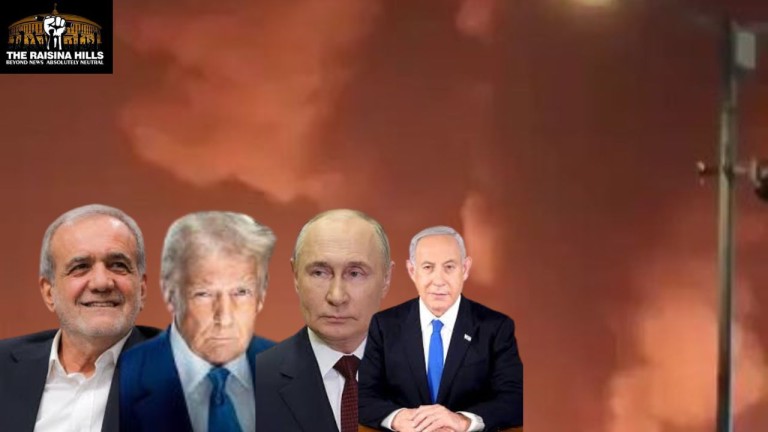
US-Iran-Israel Conflict (Image TRH)
Russia’s Nuclear Umbrella for Iran Is a Myth — And World War III Remains Unlikely: Manish Anand
By TRH World Desk
New Delhi, March 8, 2026 — As the United States and Israel escalate their military campaign against Iran — now striking civilian infrastructure including a major oil storage refinery that triggered large-scale fires — the question of whether Russia would extend nuclear protection to Tehran has entered mainstream strategic debate. Geopolitics analyst Manish Anand, in a special episode of The Raisina Hills, has addressed the question directly — and his answer cuts through the speculation with clinical precision.
No Formal Nuclear Umbrella Exists Between Russia and Iran
“There is no formal, official agreement between Russia and Iran under which Russia can provide a nuclear umbrella to Iran,” Manish Anand told his audience. He explained the concept clearly: a nuclear umbrella, as seen under NATO’s Article 5, is a security guarantee by which a nuclear power commits to defending a non-nuclear ally — including through nuclear response — if that ally faces an existential attack. The Soviet Union once extended such guarantees to Warsaw Pact members through the CSTO framework. Russia and Iran have no equivalent arrangement.
What exists instead, Anand argued, is a transactional military relationship. Iran has supplied Russia with Shahed drones — the same drones now striking Israel, Bahrain, Saudi Arabia, Qatar, and the UAE in large numbers — while Russia has provided Iran with military technology and support since 2022. “It is essentially a military supplier relationship, not a defence alliance,” he said.
Would Russia Enter the War if Israel or the US Used Nuclear Weapons?
Anand was equally unambiguous on escalation risk. “Russia is bogged down in the Ukraine war. Under no circumstances will Russia enter into direct confrontation with the United States — not conventionally, and certainly not in a nuclear scenario,” Anand said. He drew a parallel with China, noting that Beijing sent only a third-level official to sign the condolence register at the Iranian embassy following the death of Iranian Supreme Leader Ayatollah Khamenei — the same protocol level India adopted when Foreign Secretary Vikram Misri visited the Iranian mission in New Delhi. “Both China and India’s responses signal the same thing: neither is willing to be drawn into this conflict.”
Gulf Nations Will Stay Out — The Shia Factor Explains Why
On regional escalation, Anand pointed to the large Shia Muslim populations across Gulf states as the decisive constraint. “Whether it is Iraq, Saudi Arabia, or Bahrain — the Shia population in all these countries is enormous. Iran is their religious leadership. No Gulf nation wants to provoke that constituency,” stressed Anand. He confirmed that reports of UAE military strikes on Iranian positions were fake news, subsequently denied by Abu Dhabi officially.
World War III: Hypothetical, Not Imminent
“The possibility of a third world war is very remote,” Anand said. “The two major powers — China and Russia — will not join this war, either in support of Iran or against America. The Gulf military powers will not join either,” he added. He noted that Europe itself is fractured: France and Germany are aligned with the US-Israel position, but Spain is openly opposed, and UK Prime Minister Keir Starmer has signalled that Britain does not regard the war as justified — a significant rupture in the historically close US-UK strategic partnership.
Trump’s Real Problem: Oil at $90 and the Strait of Hormuz
Anand closed with what he called the war’s most consequential pressure point for Washington. Oil prices have already crossed $90 per barrel. If the Strait of Hormuz remains blocked for further weeks, the economic shock will intensify domestic opposition to the war inside the United States. “Trump could find himself in a very difficult position. The pressure on him to end this war quickly and bring America out will grow significantly — both from the economic impact and from voices within the country,” argued Anand.
Nine days in, Iran has lost its air force, navy, and significant military leadership. Yet Tehran’s public posture remains defiant. “That, in itself,” Anand observed, “is a moral factor for Iran’s leadership — that they are still standing against such overwhelming military force.”
Iran-US-Israel War: After 4,500 Strikes, Who Is Actually Winning?
Follow The Raisina Hills on WhatsApp, Instagram, YouTube, Facebook, and LinkedIn




About The Author