Rupee Rout: India’s Economy Faces Its Worst Storm in a Decade
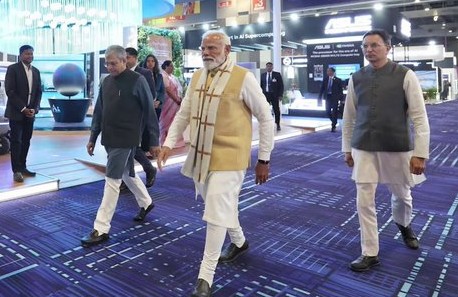
Prime Minister Narendra Modi at Bharat Mandapam to unveil the AI Impact Summit (Image Vaishnaw on X)
Geopolitics Analyst Manish Anand Warns Iran War, FII Exodus, and India’s Strategic Oil Failures Could Push Inflation Beyond 18 Months
By TRH Op-Ed Desk
New Delhi, March 18, 2026 — The Indian rupee has hit a record low of ₹92.60 to the dollar — and it is still falling. The Reserve Bank of India has pumped an estimated $15–20 billion into the market in a single week to defend the currency. It has not been enough.
“The rupee is weakening so sharply that dark clouds are gathering over the Indian economy,” warns Manish Anand, geopolitics analyst and host of The Raisina Hills. “The challenges India will face in the coming months are enormous.”
The Iran War Is Now India’s Crisis
The Iran-America conflict has morphed from a regional military confrontation into a full-blown global oil emergency. With neither side showing willingness to step back — Iran has categorically rejected American ceasefire overtures — Anand warns the war could drag on for several more weeks, with devastating consequences for India.
Reports now indicate that the United States, in conjunction with Israel, is planning to seize Iranian islands in the Persian Gulf — a move that would further disrupt the Strait of Hormuz, through which approximately 25% of the world’s crude oil, fertilisers, and chemicals transit. For India and China, Anand notes, that passage is not optional — it is existential.
“If America and Israel move to occupy Iran’s islands, the Strait of Hormuz will face even greater disruption,” he says, adding: “And the economic crisis bearing down on India will intensify sharply.”
90% of India’s Oil Comes From Abroad — Paid in Dollars
The rupee’s collapse has a direct and brutal arithmetic. Nearly 90% of India’s oil is imported, and all of it is dollar-denominated — even Russian crude, which India has been purchasing in large volumes and paying for in yuan, itself pegged to the dollar.
“When the rupee weakens against the dollar, our losses are enormous,” Anand explains, adding: “With crude already above $100 per barrel, the burden on India’s oil-dependent economy — agriculture, industry, MSMEs — is severe.”
Small and medium enterprises are already under acute stress. Reports indicate that fuel shortages are disrupting supply chains for MSMEs, triggering a wave of selling in their listed stocks. Aviation, transport, and daily household essentials are all set to become significantly more expensive.
The China Contrast — and India’s Planning Failure
The sharpest part of Anand’s analysis is what he calls India’s strategic failure to prepare. China, he points out, anticipated the Iran conflict well in advance and spent the past year aggressively building its strategic oil reserves — stockpiling Russian crude and insulating its economy from exactly the kind of shock now hitting India.
“China saw this coming and secured itself,” Anand says bluntly, adding: ‘India did not take similar steps. Today we are dependent on Iran’s permission for our tankers to pass, or we are appealing to Russia to redirect as much oil to us as possible.”
That redirection, he notes, is already happening — Russian oil tankers originally headed to China are reportedly being diverted toward India on an emergency basis. But it is a reactive measure, not a planned one.
Petrol Price Hike Coming — After Elections
With election dates announced for West Bengal, Tamil Nadu, Kerala, and Puducherry, Anand is blunt about the political calculus at play. The BJP-led central government, he argues, will hold petrol and diesel prices steady through the election cycle. But once voting concludes in late April, a steep hike is virtually inevitable.
“After the elections, a very heavy increase in petrol and diesel prices is coming,” he says, adding: “Crude oil prices are not going to fall quickly. Even if the war ends, normalising the situation will take at least six months — and many production centres have been damaged.”
18 Months of Inflation — A Warning
The combined impact — a weak rupee, high crude, FII outflows, and damaged global supply chains — leads Anand to a sobering conclusion.
“Inflation may not last six or eight months,” he warns, adding: “It could persist for a year, eighteen months, or even longer. And when inflation grips an economy, every section of society suffers — but the poorest bear the heaviest burden.”
Approximately one crore Indian workers are employed across the Gulf region. Their remittances form a significant pillar of India’s foreign exchange earnings. Anand warns that the regional instability will affect those flows too — adding yet another pressure point to an already stressed economy.
“A weak rupee is not in India’s interest,” he concludes, adding: “And the fact that it is this weak tells you that somewhere, India’s economic policymakers have not planned as they should have.”
(Based on Manish Anand’s monologue for The Raisina Hills, recorded March 18, 2026. Manish Anand is a geopolitics analyst and commentator on Indian foreign and economic policy.)
Trump Wanted to Split Russia, China. Instead He Is Binding Them
Follow The Raisina Hills on WhatsApp, Instagram, YouTube, Facebook, and LinkedIn




About The Author