How the Red Carpet vs Bullet Changed Anti-Naxal Campaign
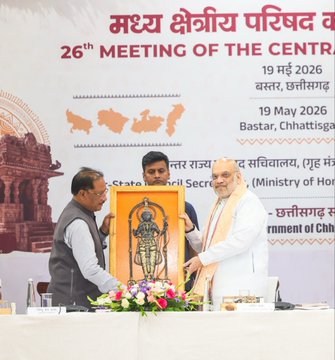
Home Minister Amit Shah in Jagdalpur in Chhattisgarh for internal security meeting. (Image Amit Shah on X)
By KUMAR VIKRAM
India’s anti-Naxal campaign evolved from a security-only approach into a dual framework of rehabilitation and force. This opinion piece examines the “Red Carpet vs Bullet” strategy and its impact on Naxal violence and tribal regions.
For decades, Naxalism cast a dark shadow over large parts of tribal India. It brought violence, fear, and grief to countless families while choking off roads, schools, hospitals, and any real chance of progress in some of the country’s most remote and vulnerable regions.
Ordinary villagers—often caught in the middle—paid the heaviest price. What was needed wasn’t just force, but a wiser, more humane approach: one that drew a clear line between those who could still be brought back to normal life and those who chose to keep spreading bloodshed. Under Union Home Minister Amit Shah, this balanced thinking took shape in a practical strategy often described as “Red Carpet versus Bullet.”
The “Red Carpet” is exactly what it sounds like—an open, dignified door for those who want to leave the jungle and return to their families and communities. A thoughtful rehabilitation policy was put in place, offering genuine support: financial help, monthly stipends, jobs, housing, and education for children. Even Naxalites already in jail were given a chance to surrender and rebuild their lives. Special teams made up of family members and trusted local elders were formed to quietly reach out and help people come over.
The response has been heartening. In Chhattisgarh alone, more than 1,000 Naxalites laid down arms in a single year in 2024. Entire squads, including senior members, walked out together. Many women who once lived as cadres are now running the Bastar Cafe—an inspiring symbol of self-reliance and new beginnings. Others have joined local security units as “Bastar Fighters,” proudly protecting the very villages and people they once feared.
On the other side stands the “Bullet” – a clear message that those who refuse to give up violence will be dealt with firmly. Security forces have been given complete operational freedom and strong political backing. Modern equipment, sniper rifles, anti-spike boots, WHAP vehicles, Heron drones, and prompt air ambulance support have been provided to them. Specialised units such as CRPF, CoBRA, and District Reserve Groups (DRG) conducted intelligence-based operations with precision. A series of meticulously planned operations—such as Operations Octopus, Double Bull, Thunderstorm, Bhimbarg, Chakrbandha, and the landmark Black Forest—delivered decisive blows to Naxal strongholds, dismantling key infrastructure, neutralising cadres, and effectively crippling the movement across several affected states.
Harivansh recalls ‘why I shouldn’t become Naxalite’ letter to editor
This dual policy created strong psychological clarity. Security personnel knew they have full support from the top leadership, while cadres understanding that there is a respectful path back if they choose peace. The impact is evident in the numbers: surrenders and arrests now far outnumber those neutralised in encounters. In 2024 and 2025, thousands of Naxalites laid down arms, compared to far fewer killed in operations—breaking the backbone of the organisation and weakening its hold over tribal youth.
The Union Government has maintained a firm and unwavering stance throughout. Between 2024 and March 2026, 706 Naxals were neutralised, 2,218 arrested, and 4,839 surrendered—underscoring the effectiveness of this approach. It has categorically ruled out unconditional dialogue, making it clear that talks are possible only with those willing to renounce violence.
Those who continue to attack security forces, farmers, tribals, and civilians have been met with decisive force. This strategy has also led to the systematic neutralisation of top leadership, including CPI (Maoist) General Secretary Basavaraju and commander Hidma, along with several long-time operatives, while other senior leaders have surrendered and returned to the mainstream.
The collapse of the Naxal leadership has led to a dramatic decline in violence and the resulting loss of life and property. There was a time when IED explosions, ambushes, or landmine attacks made headlines almost every other day.
Today, such incidents are rare, often not occurring for months at a stretch. Even when isolated attacks take place, security forces respond swiftly and effectively. The slight rise in violence reported in some areas like Sukma and Bijapur during 2022-23 was not a setback but rather a sign of progress — our forces had begun penetrating deep into the Maoists’ previously untouched core strongholds, forcing more direct confrontations. This clearly showed that the extremists were no longer safe even in their once-secure hideouts.
With the nation now achieving the goal of Naxal-mukt Bharat, the “Red Carpet vs Bullet” approach stands as a powerful example of firm yet compassionate governance. It has dramatically reduced violence while touching hearts by offering a dignified, hopeful path back to normal life for those willing to leave the armed struggle. The strategy has helped lift the long shadow of fear and red terror from tribal lands, opening the door to lasting peace, genuine security, and real progress for the communities that have suffered for far too long.
(This is an opinion piece. Views expressed are the author’s own.)
Amit Shah’s Big Attack: ‘Naxalism Spread Because of Left Ideology’
Follow The Raisina Hills on WhatsApp, Instagram, YouTube, Facebook, and LinkedIn




About The Author