Why Rahul Gandhi’s ‘I Don’t Need Your Permission’ Line Matters
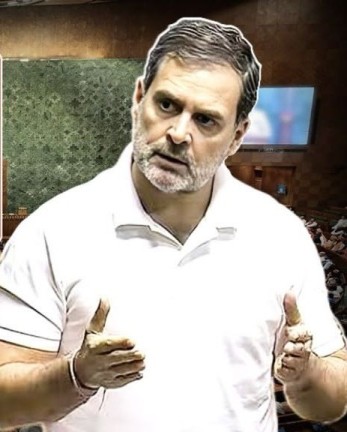
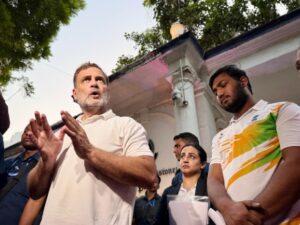
Leader of Opposition in the Lok Sabha Rahul Gandhi (Image INC India)
From Meira Kumar’s Indulgence in 2011 to the Suspension of Eight MPs in 2026 — How Lok Sabha’s Lakshman Rekha Kept Getting Crossed
By NIRENDRA DEV
New Delhi, March 18, 2026 — The suspension of eight opposition members was revoked in the Lok Sabha on Tuesday, but not before a sharp war of words between the opposition and treasury benches over the maintenance of decorum in the House. The phrase “crossing the Lakshman Rekha” — the ethical boundary — figured prominently in the debate, and rightly so.
Opposition members pledged to maintain decorum going forward and demanded equal speaking time as the treasury benches. But the episode reopened a much older wound: the long, uncomfortable history of parliamentary norms being bent — and broken — with impunity.
The Suspension That Sparked It All
Eight opposition MPs — Congress’s Amarinder Singh Raja Warring, Gurjeet Singh Aujla, Hibi Eden, Dean Kuriakose, Prashant Padole, C. Kiran Kumar Reddy, and Manickam Tagore, along with CPI(M)’s S. Venkatesan — were suspended on February 3 for the entire budget session. The trigger was an uproar after Leader of Opposition Rahul Gandhi was allegedly stopped from speaking during the Motion of Thanks to the President’s Address.
What followed was revealing. During the debate, Rahul Gandhi told the Speaker directly: “I am the Leader of the Opposition. I don’t need your permission.”
The remark stunned many seasoned parliamentarians. A former Speaker from a northeastern state, who declined to be named, was blunt in his assessment: “I wish Rahul was more educated about this. He spoke like a college boy, not an elected member of the House who has been in Parliament since 2004.”
A Pattern, Not an Aberration
This was not the first time Rahul Gandhi’s conduct in Parliament raised serious questions — and not the first time a Speaker looked the other way.
In August 2011, at the height of Anna Hazare’s anti-corruption agitation, Rahul Gandhi was allowed to deliver what amounted to a televised address to the nation during Zero Hour — a parliamentary slot meant strictly for raising urgent issues of public importance, with a three-minute time limit. Rahul spoke for fifteen minutes.
The late Sushma Swaraj, then Leader of the Opposition, was unsparing in her criticism. On August 27, 2011, she asked the House pointedly: “Was Rahul Gandhi’s speech a Zero Hour intervention or an address to the nation?”
“Zero Hour mein Rashtra ke naam sandesh nahi diya jata,” she said — Zero Hour is not meant for addresses to the nation.
The then Speaker Meira Kumar chose not to react. The norms were relaxed. The Lakshman Rekha was crossed — and nothing happened.
It was not an isolated incident under her watch. On another occasion, a scuffle broke out between Samajwadi Party MPs and Sonia Gandhi in the House. Meira Kumar was Speaker then too. Again, little came of it.
What Zero Hour Was Always Meant to Be
Zero Hour as a parliamentary institution came into existence when Janata Dal leader Rabi Ray of Odisha was Lok Sabha Speaker in 1989. Its purpose was straightforward: to allow elected members to raise urgent matters requiring the immediate attention of the House and the government.
The dictionary defines ‘zero hour’ as “the critical moment.” In parliamentary parlance, it refers to the time between the end of Question Hour and the commencement of the day’s regular business — typically around noon in the Lok Sabha, after the laying of papers, when members are permitted to raise issues of public importance.
It was never designed as a platform for political speeches or prime-time addresses to the nation.
Former Speaker Somnath Chatterjee, never one to mince words, once called Zero Hour ‘the torture hour for the Chair.” On one occasion he told a Samajwadi Party member directly: “You cannot threaten the Chair.”
When the Chair Showed Anguish
In a rare and memorable moment, Speaker Sumitra Mahajan — the first Lok Sabha Speaker under Prime Minister Narendra Modi — made an unprecedented offer on November 30, 2016. As Parliament remained deadlocked over the demonetisation debate, she appealed to all members from the Chair: “Shunya se hum brahmand tak ja saktey hain” — from zero, we can reach the entire universe — invoking the spirit of Zero Hour to break the impasse.
Biju Janata Dal MP B. Mahtab — now a BJP lawmaker — read the moment correctly. “It is a caution to every member who is present in this House,” he said, acknowledging the Speaker’s visible anguish that neither side could agree on the terms for a debate.
On March 17, Samajwadi Party MP Dharmendra Yadav offered a similar note of restraint when he rose to support the resolution revoking the suspensions: “On behalf of the party and my leader Akhilesh Yadav, we will never cross the dignity of the House.”
It was the right sentiment. Whether it holds — and whether all sides of the aisle honour it equally — remains, as always, the real question.
(This is an opinion piece. Views expressed are author’s own.)
Amit Shah Vs Rahul Gandhi: History Answers Opposition Questions
Follow The Raisina Hills on WhatsApp, Instagram, YouTube, Facebook, and LinkedIn




About The Author