Third Fuel Price Hike in Nine Days: Government Defends Move
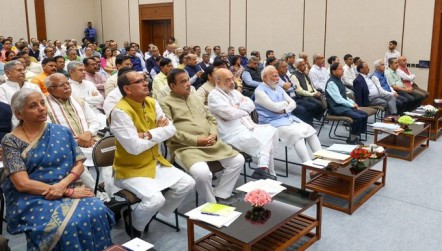
Prime Minister Narendra Modi at the meeting of the Council of Ministers on Thursday. (Image Modi on X.)
By AMIT KUMAR
The Modi government says fuel prices were protected for 76 days despite global oil disruptions. But after three hikes in nine days, questions are growing over timing, transparency and consumer impact.
New Delhi, May 23, 2026 — After the third increase in petrol and diesel prices within just nine days, the Modi government has circulated a detailed note to the media defending the move. The central argument: India shielded consumers from global oil shocks for 76 days and even after three revisions, the cumulative increase remains among the lowest in the world.
But the note, while heavy on global comparisons and political counterattacks, also raises difficult questions about timing, transparency and the burden ultimately falling back on consumers.
According to the government document, the three rounds of revisions on May 15, 19 and 23 increased petrol prices by a cumulative ₹4.74 per litre and diesel by ₹4.82 per litre. The note argues this amounts to roughly a 5% increase and remains significantly below the hikes seen globally.
The government says India held fuel prices “essentially unchanged” through the first 76 days of the Hormuz disruption while other countries passed on sharp increases to consumers.
However, critics argue that comparing Indian fuel prices with Europe, Hong Kong and advanced economies obscures a crucial reality: Indian incomes remain far lower.
The note compares India with countries ranging from Germany and France to Pakistan and Nepal, asserting that India still has one of the lower pump price levels among non-subsidising economies. Pakistan and Nepal, it notes, have crossed ₹135 per litre while India remains between ₹95 and ₹118 depending on states.
Yet one of the most striking features of the document is how quickly it shifts from economics to politics.
A major section focuses on state-level VAT, directly naming Congress, INDIA bloc, AAP and allied state governments as responsible for higher pump prices. The note argues that opposition-governed states impose higher taxes while BJP-governed states keep prices lower.
It goes further, stating that the narrative that “the Centre overtaxes fuel” collapses when state taxation data is examined.
The political messaging is hard to miss.
The government also defends itself by highlighting excise cuts during both the Russia–Ukraine war and the Hormuz crisis, claiming the exchequer absorbed around ₹30,000 crore in revenue losses through recent tax reductions. It further points to the redemption of UPA-era oil bonds worth over ₹1.3 lakh crore.
But consumers do not experience fiscal architecture at the pump; they experience the price displayed on the meter.
And that brings the debate back to the central question: if the government could hold prices for 76 days despite the crisis, why did increases have to come in three phases within nine days?
Was it delayed pass-through? Mounting OMC losses? Or deferred adjustments after a prolonged freeze?
The government calls it an “architecture of consumer protection.” Critics may call it the return of postponed costs.
Either way, after three hikes in nine days, the political debate over fuel prices is back at the centre of India’s inflation conversation.
Kamal Haasan Seeks CM Summit, Fuel Tax Cuts Amid Iran Crisis
Follow The Raisina Hills on WhatsApp, Instagram, YouTube, Facebook, and LinkedIn




About The Author