The Pen, The Mountain, and the Many Quiet Returns
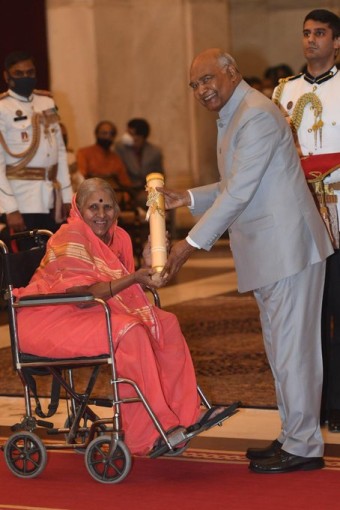
Sindhutai Sapkal with Ram Nath Kovind, former President of India. (Image Modi on X)
From folklore to real lives, stories of Dashrath Manjhi, Anand Kumar and Sindhutai Sapkal reveal how kindness shapes society beyond visible rewards
By P. SESH KUMAR
New Delhi, May 2, 2026 — At the entrance of the Meenakshi Amman Temple, in Madurai, Tamil Nadu, the evocative tale of Periyasamy and the “Murugan Pen Store” captures the imagination — a moving narrative where a small act of generosity returns multiplied, almost miraculously, after decades.
While this story resonates deeply, it belongs more to the realm of moral storytelling than documented reality. Yet, beyond this poetic fiction lie real lives that embody the same spirit with greater depth and authenticity. From Dashrath Manjhi carving a mountain for others without expectation, to Anand Kumar transforming the destinies of underprivileged students through education, and Sindhutai Sapkal nurturing hundreds of abandoned children into responsible citizens — the truth is both quieter and more profound.
These real-life journeys remind us that kindness rarely returns as spectacle; it returns as sustained impact, often unseen, yet deeply enduring. The fictional pen becomes a metaphor for a universal truth: what we give selflessly does not always come back to us-but it always goes somewhere meaningful.
The journeys of these real-life figures have been compelling enough to move from lived experience to the big screen, reinforcing their authenticity in contrast to the more symbolic Murugan pen narrative. The extraordinary struggle of Dashrath Manjhi was brought to life in the acclaimed Hindi film Manjhi: The Mountain Man, where his solitary battle against a mountain became a national metaphor for grit and purpose.
Similarly, the inspiring educational mission of Anand Kumar found cinematic expression in Super 30, portraying how one teacher’s resolve reshaped the destinies of countless underprivileged students.
The deeply moving life of Sindhutai Sapkal was adapted into the Marathi biographical film Mee Sindhutai Sapkal, capturing her transformation from abandonment to becoming a mother to hundreds.
These films, grounded in documented lives, stand as powerful cultural validations that while reality may lack the neat closure of a dramatic “return,” it often carries a far greater and enduring emotional truth.
Lessons
The story of Periyasamy, even if dramatized, distils a timeless insight: small acts, performed without calculation, possess transformative potential. However, real life tempers this idealism with a harder, more honest truth-most acts of kindness do not circle back to the giver in visible or material form. They disperse, like seeds carried by the wind, taking root in places we may never see.
The life of Dashrath Manjhi teaches that impact need not be witnessed to be real; service can outlive recognition. Anand Kumar demonstrates that investing in human potential yields compounding returns-not in sudden windfalls, but in generational upliftment. Sindhutai Sapkal shows that the truest wealth lies not in repayment, but in relationships that redefine the very idea of family.
The “Murugan moment”-where beneficiaries return in gratitude-is rare, almost cinematic. But its rarity does not diminish the value of the act; rather, it highlights its purity. Kindness is not a contract. It is an offering.
In governance, in public service, in everyday life, this distinction is critical. If we act only where returns are visible and immediate, we shrink the moral horizon of society. But if we act with the quiet conviction of sowing-knowing that outcomes may be delayed, diffused, or entirely unseen-we participate in building something far larger than ourselves.
The final lesson, therefore, is both simple and demanding: give without certainty of return, act without expectation of recognition, and measure success not by what comes back to you, but by what moves forward because of you.
(This is an opinion piece. Views expressed are the author’s own.)
Follow The Raisina Hills on WhatsApp, Instagram, YouTube, Facebook, and LinkedIn




About The Author