Pakistan’s ‘Cockroach Party’: Spark of a Gen Z Revolution?
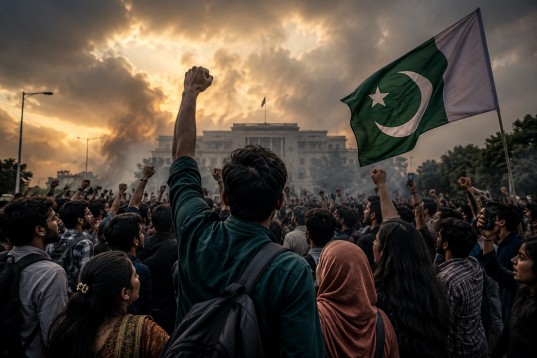
A large crowd of young protesters gathers before a government building at dusk, with raised fists and a Pakistani flag. (A representative image)
By TRH Op-Ed Desk
A viral internet protest movement that toppled governments in Sri Lanka, Bangladesh and Nepal is now gaining traction in Pakistan. Analysts say the conditions for a rupture have never been more ripe
New Delhi, May 2026 — A satirical political movement called the “Cockroach Janata Party” — born in India as a social media protest phenomenon — has found unexpected resonance across the border in Pakistan. Copycat movements and internet communities are mushrooming rapidly in Pakistan. Geopolitics analysts are now asking a pointed question: is Pakistan next in line for a Gen Z-stoked political earthquake?
The India-origin movement’s Instagram following surpassed 20 million in days — eclipsing that of the ruling Bharatiya Janata Party — setting records that stunned political observers. Its anti-establishment energy has now crossed borders. Pakistani internet users are forming their own parallel groups and movements inspired by the template.
“What we’re seeing in Pakistan mirrors the same undercurrent of rage that preceded tectonic political shifts in Sri Lanka, Bangladesh and Nepal,” said Manish Anand, a geopolitics analyst and host of The Raisina Hills YouTube channel. “If any country in South Asia is the next target of a Gen Z movement, it is Pakistan,” he added.
A Playbook Written in Blood and Protest
Anand traced the arc of what he calls the “Gen Z impact” through South Asia’s recent upheavals. In Sri Lanka, catastrophic agricultural policy under then-President Gotabaya Rajapaksa, compounded by post-COVID economic collapse, drove citizens onto the streets. The “Go Gota Go” movement ended with Rajapaksa fleeing the country within days, his entire political dynasty swept from power.
Bangladesh followed. The movement that brought down Prime Minister Sheikh Hasina — in power for nearly three consecutive terms — ignited at Dhaka University, spread through student protests, and reached a point of no return when the army refused to suppress it and police firing killed multiple young demonstrators. Hasina fled to India.
Nepal was third. Long-simmering youth unemployment, Chinese political influence, and fury at VIP culture drove protesters to Kathmandu’s streets, where they burned the centuries-old heritage parliament building. Prime Minister KP Sharma Oli fell from power. The movement’s own icon subsequently became Nepal’s Prime Minister.
“Bangladesh, Nepal, Sri Lanka — three South Asian countries were swept by this wave,” Anand noted. He added, saying: “And the movement doesn’t stop at South Asia. We’re seeing it in Africa, Latin America, Hungary — where Viktor Orbán’s decades-long grip on power has been broken — and in Britain, where Keir Starmer’s Labour Party has been routed in local elections by the anti-immigration Reform UK.”
Pakistan’s Five Fault Lines
Anand systematically laid out why Pakistan carries every precondition for a similar rupture.
Economic fragility: Pakistan has required IMF bailout packages every two to three years. “Pakistan’s economy is artificially kept on life support with American backing,” Anand said, adding: “That is not a foundation — that is a dependency.”
Youth unemployment: Official economists have long flagged Pakistan’s youth joblessness as critically high, with no structural solution in sight.
Energy crisis: Rolling power cuts continue to devastate ordinary households across multiple provinces, stoking daily grievances that accumulate into political fury.
Food insecurity: Despite Punjab — Pakistan’s breadbasket wheat province — underpinning the national economy, food access remains precarious for millions.
The Imran Khan factor: The incarceration of Pakistan’s most popular political figure remains a live wound. “Imran Khan won Pakistan the 1992 Cricket World Cup. He is the icon of Pakistani youth,” Anand said. “The army’s decision to jail him and keep him there has generated enormous anger. Sometimes change takes time — but the frustration for that change is clearly building.”
Underpinning all of it, Anand argued, is the structural abnormality of Pakistan’s civil-military relationship. “Pakistan is the only country in the world where, as some policy experts say, the army owns the nation,” he said. “True democracy has never arrived. Economic prosperity has been denied. And people increasingly know why,” he added.
From Screens to Streets
The pattern of Gen Z movements, Anand stressed, follows a consistent trajectory: “It starts on the internet and arrives on the streets.” The Cockroach Party trend in Pakistan, he argued, is not mere mimicry — it is a symptom of the same systemic failures that preceded every other uprising in the regional wave.
Whether Pakistan’s establishment can absorb the pressure — or whether it becomes the next domino — may be the defining geopolitical question of 2026 in South Asia.
‘Cockroach Janta Party’ and The Frustration India Refuses to Hear
Follow The Raisina Hills on WhatsApp, Instagram, YouTube, Facebook, and LinkedIn




About The Author