Oil at $140 by February, $500 by 2030? Report Warns of Post-Iran Price Shock
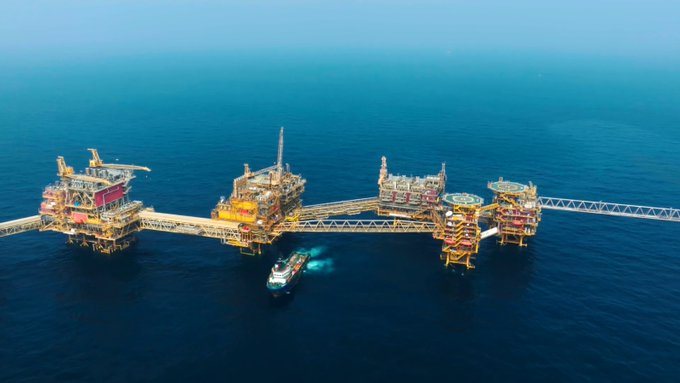
Oil price trajectory is predicted to remain elevated until 2032. An offshore ONGC oil station in the Arabian Sea. (Image ONGC on X)
By S. JHA
Currency Research Associates estimates that 1.675 billion barrels of oil went undelivered over 26 weeks after the Iran war began, arguing that reserve replenishment and production constraints could fuel another major oil price surge.
Mumbai, October 22, 2026 — The global oil market could face a second wave of price pressure even after the immediate disruptions associated with the Iran war ease, as countries seek to replenish depleted reserves and oil production struggles to return to pre-war levels, according to a report by Currency Research Associates dated October 15, 2026.
The report, titled Review of Emerging Trends: Oil After Iran, presents a stark outlook for energy markets. It argues that the volume of oil that went undelivered during the conflict could create substantial additional demand as countries rebuild their inventories. It also suggests that oil prices could rise to $140 per barrel by the end of February under a particular gold-to-oil ratio scenario, while raising the possibility of prices reaching $500 by 2030.
These are projections from the report, not established forecasts or inevitable outcomes. Nevertheless, its central argument deserves attention: the consequences of a prolonged supply disruption may continue long after the immediate crisis has passed.
1.675 Billion Barrels Missing From Deliveries
According to Currency Research Associates, approximately 1.125 billion barrels of oil went undelivered during the first 15 weeks after the Iran war began. A further 550 million barrels were not delivered over the following 11 weeks, taking the cumulative total to 1.675 billion barrels over 26 weeks.
The report calculates this as an average shortfall of approximately 9.2 million barrels per day, equivalent to almost 9% of the daily global oil consumption of 105 million barrels in 2025.
The distinction between undelivered oil and permanently lost production is important. The report says stockpiles were used to replace the missing supplies, creating the prospect of additional demand when countries replenish those inventories.
Its calculation suggests that replacing 1.675 billion barrels over one year would require additional demand of approximately 4.6 million barrels per day. Spread over two years, the requirement would be around 2.3 million barrels per day, falling to 1.5 million barrels per day over three years.
Such replenishment would compete with ordinary consumption for available supplies. If production cannot respond sufficiently, the resulting imbalance could place upward pressure on prices.
However, the actual impact would depend on how quickly countries rebuild inventories, how much demand adjusts to higher prices and how much additional production becomes available.
Why the Report Sees a Risk of Higher Oil Prices
Currency Research Associates argues that supply constraints could become more consequential because production growth is not guaranteed.
The report says five countries account for half of global oil production. It contends that peak oil is emerging in the United States, while production in Saudi Arabia and Russia has been declining since their respective peaks in 2018. It also points to China’s domestic oil production being consumed internally and Iranian oil being off the market.
The report’s broader argument is that restoring global supply to pre-war levels could prove difficult just as countries seek to rebuild their reserves.
It cites OPEC estimates of global oil demand reaching 105.7 million barrels per day in 2026 and 108.3 million barrels per day in 2027. Against that backdrop, additional demand from inventory replenishment could tighten the market further.
The critical uncertainty is whether producers can increase supply fast enough to meet both regular consumption and restocking requirements. A faster recovery in production, the return of disrupted supplies or weaker demand could reduce the pressure described in the report.
From $95 to $140: The Gold-to-Oil Ratio Argument
One of the report’s more immediate projections is based on the relationship between gold prices and oil prices.
Currency Research Associates describes West Texas Intermediate (WTI) crude at $95 per barrel as relatively cheap when compared with gold and oil’s long-term price trends. It puts the gold-to-oil ratio at 43, meaning gold is priced at roughly 43 times the price of a barrel of oil.
The report argues that the ratio could decline to 30 over the following four months. If gold were trading at $4,200 per ounce, a ratio of 30 would imply an oil price of $140 per barrel.
The arithmetic is straightforward: $4,200 divided by 30 equals $140.
But the calculation is a scenario, not proof that crude oil must rise to that level. The gold-to-oil ratio can change because of movements in either asset, and historical relationships do not guarantee future price movements. The projection depends on both the assumed gold price and the anticipated decline in the ratio.
The report also argues that oil could reach $500 per barrel by 2030, drawing on the possibility of prolonged supply pressure and a historical comparison with oil’s rise since 2020. That is an especially aggressive long-term scenario and should not be interpreted as a consensus market forecast.
Why India Should Pay Attention
For India, a sustained rise in crude oil prices would carry significant economic implications because the country depends heavily on imported oil.
Higher crude prices can increase the cost of imported energy, put pressure on the rupee and raise transportation and production costs. Depending on the extent and duration of the increase, these pressures can feed into inflation and affect household purchasing power.
The government would also face difficult choices over the extent to which higher international prices are passed through to domestic consumers, absorbed by oil companies or offset through changes in taxes and other policy measures.
A sustained oil rally could therefore have implications beyond the energy sector, influencing monetary policy, corporate margins, government finances and financial-market sentiment.
The report’s inventory-replenishment argument is particularly relevant to import-dependent economies. Even if immediate supply disruptions ease, a prolonged effort by countries to rebuild reserves could keep demand elevated. For India, that would mean the end of a supply crisis would not necessarily translate into an immediate return to lower oil prices.
At the same time, the impact would depend on the actual trajectory of crude prices, the rupee-dollar exchange rate, domestic pricing decisions and the pace of global supply recovery.
Bond Yields, Gold and Equity Markets
Currency Research Associates also sees implications for other asset classes. The report argues that bond yields may have peaked in the short term and could decline by 50 basis points, supporting a rise in the euro, a surge in the yen and further gains in gold and silver.
It also warns that the long-term bearish outlook for equities worldwide has intensified.
These projections suggest a market environment in which energy supply risks, interest-rate expectations and changing investor preferences could interact. But the report’s views on bonds, currencies, precious metals and equities are separate market calls and should be evaluated on their own assumptions rather than treated as automatic consequences of higher oil prices.
For investors, the distinction between a plausible risk scenario and a reliable trading signal remains essential.
The Real Test Comes After the Immediate Crisis
The most consequential argument in Oil After Iran is not simply that crude could rise to an extraordinary price. It is that the effects of a major supply disruption may persist through the process of rebuilding inventories.
If supply recovers quickly and demand weakens, the pressure could ease. If production remains constrained while countries replenish reserves, the market could face a prolonged period of tighter supply and higher prices.
The report’s $140 and $500 projections represent increasingly ambitious scenarios rather than certainties. Its underlying warning, however, is clear: the global oil market may not return to normal merely because the immediate disruption ends.
How India’s Refineries Are Refining US Ties as Trump Seeks a China Hedge
Follow The Raisina Hills on WhatsApp, Instagram, YouTube, Facebook, and LinkedIn




About The Author