India’s Audit Watchdog Gets Stronger in 2026 — But Is It Fair Now?
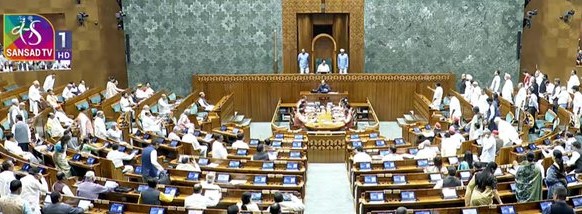
Parliament on Monday witnessed Opposition uproar (Image Sansad TV)
The Corporate Laws Amendment Bill 2026 transforms NFRA with new funding, enforcement powers and corporate status — yet the due-process flaw the Delhi High Court exposed in 2025 remains dangerously unresolved.
By P. SESH KUMAR
New Delhi, April 5, 2026 — The proposed 2026 amendments to the Companies Act are the boldest attempt yet to recast the National Financial Reporting Authority (NFRA) from a regulator that could investigate and punish on paper into one that can fund itself, issue directions, frame regulations, compel registration, widen the net of “misconduct,” and punish non-compliance far more sharply.
But this muscular makeover arrives after a bruising phase in which NFRA’s legitimacy was tested not only by the profession it regulates, but by the Delhi High Court itself. In February 2025, the Court upheld NFRA’s constitutional foundation, yet struck at the way it had actually functioned, holding that the same institutional arm could not investigate, form near-conclusive views, and then decide to prosecute on the strength of its own prior findings. That was the regulator’s real embarrassment: not lack of power, but lack of procedural architecture.
The 2026 Bill addresses several structural weaknesses-corporate status, funding, staffing flexibility, regulations, registration, and stronger enforcement tools. Yet on the single most explosive issue raised by the Delhi High Court-the separation of investigation and adjudication-it offers only an indirect and incomplete answer. The result is a Bill that is impressive in breadth, but still vulnerable at its constitutional pressure point. Also, this remains a proposal, not enacted law: the Corporate Laws (Amendment) Bill, 2026 was introduced in the Lok Sabha on March 23, 2026 and referred the same day to a Joint Parliamentary Committee.
NFRA was born out of a deep distrust of pure professional self-regulation. Its own 2023–24 annual report is unusually candid: the older regulatory apparatus under the Chartered Accountants Act, 1949 had, in the government’s view, failed to maintain the required discipline and accountability, and multiple official processes-from the Standing Committee on Finance to the Companies Law Committee, and later judicial observations in S. Sukumar-pointed toward an independent audit regulator on the model of modern external oversight systems.
The Delhi High Court’s February 7, 2025 judgment traces that lineage in some detail, noting that Parliament deliberately moved away from leaving standard-setting, oversight, and discipline entirely within the profession’s own walls. In that sense, NFRA’s original political and regulatory logic was never mysterious: India wanted an audit referee who was not wearing the auditor’s jersey.
Yet NFRA’s first years exposed a mismatch between ambition and institutional design. It had mandate, publicity, and the halo of reform, but not the full machinery of a mature regulator. Its 2023–24 annual report shows that it remained grant-funded, receiving ₹38.50 crore from government in that year, spending ₹35.25 crore, and refunding part of the salary grant. The same report shows a severe manpower gap: total sanctioned strength was 69, but only 30 officers were in position against a sanctioned officer cadre of 53. Even by March 31, 2025, the 2024–25 annual report shows only 32 officers against that 53-officer sanctioned cadre.
That is not a minor administrative inconvenience; it is the classic story of a regulator being asked to police India’s most sensitive public-interest audits with a skeleton crew.
The second problem was legal architecture. The 2018 Rules spoke the language of divisions and differentiated functions. Rule 10 sent professional-misconduct matters to the division dealing with enforcement; Rule 11 said that if the Authority believed sufficient cause existed, the matter would go to the concerned division for issuance of a show-cause notice; Rule 14 said matters relating to investigation, monitoring, enforcement and disciplinary proceedings would be examined through one of the divisions. In other words, the framework already gestured toward internal separation.
The Delhi High Court, however found that, in practice, NFRA’s Executive Body authored audit quality review reports containing findings that appeared to verge on the conclusive, and then that same body proceeded to initiate disciplinary action on the strength of those very reports. The Court held that this violated the division of functions contemplated by the Act and Rules, lacked neutrality, and created a real possibility of bias and predetermination.
It upheld Section 132 and the NFRA Rules in principle, but quashed the impugned show-cause notices and final orders because NFRA had not honoured the structural separation embedded in its own scheme.
That judgment matters because it reframed the NFRA debate. Until then, the public argument was often about whether NFRA was too aggressive. The Court’s message was different: NFRA could be powerful, but only if it was procedurally fair. That is precisely why the 2026 Bill deserves close reading. On several fronts, it is a serious response to genuine operational gaps. The Bill would convert NFRA into a body corporate with perpetual succession, power to contract, hold property, and sue or be sued. It would clarify the Chairperson’s superintendence powers and permit delegation by the executive body, aiming to reduce paralysis in day-to-day functioning.
NFRA Enforcement Crisis: Why Audit Watchdog Is a Paper Tiger
It would allow NFRA to engage experts and professionals across law, economics, audit, and business. It would create the NFRA Fund, financed by grants, fees, and other receipts, thereby reducing dependence on annual government hand-holding. It would empower NFRA to levy fees, make regulations, publish draft regulations for comment, and review them periodically. Taken together, these changes move NFRA closer to the infrastructure of a modern sectoral regulator rather than a fragile appendage of the Ministry.
The Bill also tries to fix enforcement asymmetry. It expands Section 132(4)(c) beyond only monetary penalty and debarment by adding advisory, censure or warning, mandatory professional training, and referral to the Central Government for further action. This is important because the old framework was more brittle than many commentators admit. In fact, Rule 11 had earlier allowed “caution,” but the parent statute was far narrower and did not clearly spell out a calibrated ladder of remedies.
The Bill therefore gives NFRA something more credible than the old all-or-nothing feel of major punishment. It also broadens the explanation of “professional or other misconduct” to include contraventions of the Companies Act, rules, or regulations within NFRA’s remit. That is a major jurisdictional widening.
Through proposed Section 132A, it would require auditors of NFRA-covered entities to intimate registration details and file prescribed information and returns. Through Section 132C, NFRA would gain SEBI-style direction powers in the public interest. Through Section 132D, it would be able to impose penalties after an inquiry, with appeal rights to the Appellate Tribunal for those specific penalty orders.
But then comes the hard question: does the Bill solve the Delhi High Court’s due-process objection? Only partially, and not convincingly enough. The Court’s grievance was not that NFRA lacked statutory words like “inquiry” or “hearing.” It was that the same institutional actors moved from oversight review to quasi-prosecutorial satisfaction to disciplinary action, and did so through documents carrying an air of finality. Proposed Section 132D says NFRA may, after holding inquiry in a prescribed manner and after giving a reasonable opportunity of being heard, impose penalties under Sections 132A and 132C. Proposed Section 132J allows regulations on the manner of investigation.
These are useful additions, but they do not expressly require a firewall between investigative staff, the body recommending action, and the decision-maker. Nor do they create an independent hearing officer, an internal adjudicatory wing insulated from investigative staff, or an express recusal rule. Indeed, the Bill simultaneously omits old Section 132(3A) and expands delegation powers under new Sections 132(3C) and 132(3D), which could make the institution more flexible—but also more centralized—unless the subordinate rules build real Chinese walls. In plain English, the Bill strengthens the regulator’s muscles without fully redesigning its nervous system.
That is where international comparison becomes illuminating. The PCAOB in the United States does not merely trust good intentions; it writes separation into procedure. Its rules say enforcement and investigative staff may not participate in or advise on the decision in proceedings where they are the interested division, except as witness or counsel, and hearing officers may not be supervised by investigative or prosecutorial personnel.
The PCAOB’s hearing officers are also institutionally and physically separated from regulatory divisions. The UK’s Financial Reporting Council similarly uses staged decision-making: a Case Examiner channels matters, the Conduct Committee decides whether to open investigations, the Enforcement Division investigates, Executive Counsel pursues the case, settlements are subject to independent review, and contested cases can go to an independent Tribunal. These systems are not immune from criticism, but they reveal a basic lesson: modern audit oversight is strongest when procedural separation is explicit, not implied.
There is another irony in the Bill. It creates stronger coercive power-including proposed imprisonment up to six months for an individual who fails to comply with an NFRA order or pay a penalty within the stipulated period-before it conclusively resolves the structural fairness concerns that triggered judicial rebuke. That sequencing is risky. A regulator whose procedures are under constitutional scrutiny should first build unimpeachable adjudicatory safeguards and only then ask Parliament for sharper teeth. Otherwise, every new sanction invites not respect, but a fresh round of litigation.
Some gaps therefore remain stubborn. The Bill does not expressly separate audit-quality review from disciplinary initiation. It does not require that the officer or division that authored an inspection or review report be excluded from the decision to launch proceedings. It does not establish a distinct adjudication panel, hearing officer cadre, or independent review committee.
It does not mandate disclosure rules against ex parte communications. It does not provide a settlement code, publication protocol, or standard-of-proof framework. It creates a self-funding model through fees, but without a clear accompanying accountability framework for how those fees are calibrated. It also empowers the Central Government to issue written policy directions and even supersede the Authority in specified situations, which means NFRA’s independence will remain real but qualified. In short, the Bill cures many administrative weaknesses, yet leaves the deepest legitimacy issue to delegated legislation and institutional self-restraint.
A Quiet Court Order Just Shook India’s Audit and NFRA Regime
The way forward is therefore plain, even if politically inconvenient. India should not settle for a stronger NFRA; it should demand a fairer NFRA. The Joint Parliamentary Committee would do well to write into the Bill itself an express separation-of-functions clause modelled broadly on PCAOB practice: investigative staff cannot advise on adjudicatory decisions; the body that approves inspection findings cannot decide whether those same findings justify prosecution; disciplinary hearings must be presided over by an independent officer or panel; and final orders should emerge only from an adjudicatory unit insulated from the investigative chain.
The FRC model offers another lesson: independent review and tribunal-style determination improve credibility, not merely optics. NFRA should also get a statutory staffing roadmap, multi-year funding visibility, transparent fee principles, and a codified enforcement manual. Without these, India may end up with an audit regulator that is stronger in headlines than in court.
The central truth is this: the 2026 Bill is not cosmetic. It is a serious attempt to rescue NFRA from being underpowered, understaffed, and overly dependent. But it is not yet the complete constitutional repair job that the Delhi High Court’s February 2025 judgment demands. It answers the question of capacity more persuasively than the question of neutrality. Until that second question is answered in black-letter law rather than hopeful regulation, NFRA will remain what it has increasingly become since 2025-not merely an enforcer under construction, but an institution on trial.
(This is an opinion piece. Views expressed are author’s own.)
NFRA at a Crossroads: Can India’s Audit Regulator Regain Trust?
Follow The Raisina Hills on WhatsApp, Instagram, YouTube, Facebook, and LinkedIn




About The Author