Nepal PM’s Governance Model Holds Up Mirror to India

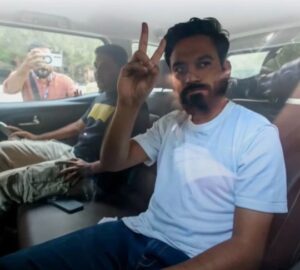
Kathmandu Mayor Balen Shah! (Image X.com)
A political analyst’s monologue asks — when a younger democracy is reforming faster, what is India’s political class waiting for?
By TRH Op-Ed Desk
New Delhi, April 17, 2026 — In the 2001 Bollywood blockbuster Nayak, actor Anil Kapoor plays an ordinary man who becomes Chief Minister for a day and dismantles a corrupt political system from the inside. For millions of Indians, that film was never just cinema — it was an aspiration, a quiet longing for a politics that actually served the people.
Nearly a quarter century later, that longing has found a real-world parallel — not in India, but across the border in Nepal.
“Nepal’s Prime Minister Balen Shah looks like Anil Kapoor’s character has literally come alive in Nepali politics,” said Manish Anand, political analyst and host of The Raisina Hills YouTube channel, in a striking commentary that has resonated well beyond its platform. “A PM of the common people. A cabinet that genuinely feels like it is made of common people.”
The contrast Anand draws is pointed. Shah — who previously served as Mayor of Kathmandu and rode a youth-backed political revolution to power — has instituted a set of governing norms that would sound radical in the Indian context. Ministers’ children will study in government schools. There will be no separate VIP routes blocking public roads. No caste-based politics. No red-beacon motorcades. No entitlement of office.
“He is walking among people, meeting them on the streets — no VIP treatment,” Anand noted. “All cabinet ministers are between 30 and 50 years of age, and every single one of them holds at minimum a graduate degree. These are educated people who live among the public.”
Shah is also expected to visit India soon. Prime Minister Narendra Modi has extended an invitation, which has been accepted. Nepal’s Foreign Minister has already met External Affairs Minister S. Jaishankar, making the diplomatic groundwork complete. Yet, Anand argues, the transformative message Shah carries is barely registering in Indian public discourse.
“What he is doing will appeal to the common man — not just in Nepal, but in India too,” Anand said, adding: “But there is very little discussion about it here.”
The monologue pivots sharply to India’s own political culture. With nearly eight decades of independence, India still finds its democracy mired, in Anand’s words, in the “swamp of caste politics.” He cited the Jharkhand government’s recent decision to introduce 27% OBC reservation in local body elections — a move that delayed municipal polls for 34 months — as symptomatic of a deeper problem.
“SC and ST communities have reservation in legislative processes — Parliament and state assemblies. There is no such provision for OBCs. But the attempt now is to push caste-based reservation into political processes as well,” Anand said. “The narrative around reservation shows no sign of ending.”
He raised a question that is rarely asked aloud in political circles: when one family has benefited from reservation, should the same advantage pass from generation to generation indefinitely? “The creamy layer income limit is set so high that nearly 95% of eligible people qualify — in that situation, the idea of social justice through reservation remains incomplete,” he argued.
Anand reserved particular sharpness for the culture of political privilege in India. “In India, a politician who has been both an MLA and an MP draws pension from both — the assembly and Parliament. Nobody questions it. Nobody reforms it. Because politicians see themselves as a separate class, a special class — not as servants of the people.”
He closed with a question that hangs in the air. “In any Indian state — Delhi, a northeastern state, anywhere — can even one politician set this kind of example? We leave that question with you.”
Nepal’s democracy is only a few decades old. India’s is approaching eighty years. The younger democracy, it seems, is moving faster.
Anatomy of an Apocalypse: Nepal’s Gen Z Revolt and Sudden Collapse
Follow The Raisina Hills on WhatsApp, Instagram, YouTube, Facebook, and LinkedIn




About The Author