Why Governance Alone Doesn’t Win Elections: Key Lessons
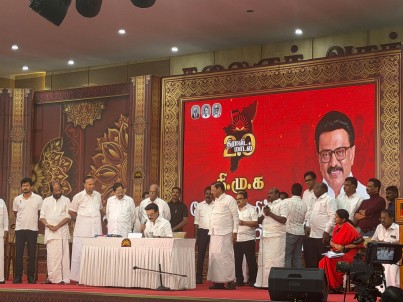
Tamil Nadu CM MK Stalin unveils DMK manifesto. (Image TRH)
Political analyst Manish Anand breaks down the electoral outcomes that have upended conventional wisdom about governance and vote banks
By TRH Op-Ed Desk
New Delhi, May 7, 2026 — The results from Tamil Nadu and West Bengal have sparked a fundamental debate in Indian politics: does good governance guarantee electoral success, and does misgovernance inevitably lead to defeat? Political analyst Manish Anand, in a detailed monologue on the YouTube channel The Raisina Hills, argues that the reality is far more layered than a simple governance report card.
West Bengal: When Women Stopped Believing
Mamata Banerjee’s Trinamool Congress suffered a stunning defeat in West Bengal, and Anand traces its roots to a collapse of trust among her most loyal constituency — women voters.
“Mamata Banerjee’s biggest support base was women. Her scheme giving ₹1,500 per month was hugely popular. But the BJP promised to increase that amount — and people believed them,” Anand said.
The tipping point, he argues, was the RG Kar rape and murder case, in which a female MBBS doctor was brutally assaulted and killed. Mamata’s perceived reluctance to act decisively — and what many saw as a priority to shield the police administration — shattered her carefully cultivated image as a protector of women.
“The way Mamata Banerjee did not take the RG Kar case proactively and showed more interest in protecting the police administration — that broke the illusion women had about her,” Anand observed. The BJP compounded this by fielding candidates directly connected to the RG Kar and Sandeshkhali cases, sending a powerful symbolic message to female voters.
Anand also highlighted a structural economic grievance. West Bengal government employees are still receiving the Sixth Pay Commission benefits — while the rest of India awaits the Eighth. “The educated class, the bhadralok of West Bengal, had made up their mind that only a change of government would improve their economic condition,” he noted. The BJP’s promise of dramatic change fell on fertile ground.
Tamil Nadu: Growth Without Equity
Tamil Nadu presents a more paradoxical case. The state outperforms Gujarat — long celebrated as the BJP’s governance model — on virtually every economic parameter, including per capita income and economic growth. Yet MK Stalin and the DMK lost ground to actor-politician Vijay’s TVK party.
Anand’s diagnosis is sharp: development concentrated in cities is not development at all, politically speaking. “The benefits of growth were limited to big cities like Chennai. In rural Tamil Nadu, people were still dependent on free ration and ₹5 idli-dosa schemes,” he said. “If you are feeding people dosas for ₹5 and calling it an achievement, it also signals that your government has failed to eliminate inequality.”
The dynastic politics factor also proved damaging. Stalin appointed his son Udayanidhi Stalin as Deputy Chief Minister — and Udayanidhi had already brought his own son into politics. Three generations of the same family in active Tamil Nadu politics struck voters as excess. “People felt the DMK’s family politics had gone too far, and they needed an alternative,” Anand said.
That alternative arrived in Vijay — Tamil Nadu’s answer to a mass star entering politics. Vijay’s promise of gold for girls at marriage, his packed weekend rallies drawing lakhs, and his cross-generational appeal among youth created an irresistible wave. Anand compares his debut to that of MG Ramachandran, calling him only the second actor to win so decisively in a first electoral outing.
The Verdict: Governance Matters, But It’s Not Everything
Anand’s conclusion is nuanced. “Misgovernance can definitely make you lose an election. But even with good governance, if social inequality persists, if youth unemployment continues, and if your development model is limited to a few cities — there are serious leakages in your governance,” he said.
Electoral outcomes, he argues, are shaped by the intersection of governance quality, emotional triggers, economic aspirations, anti-incumbency, and the availability of a credible alternative. Tamil Nadu and West Bengal together prove that neither good economics nor a loyal vote bank is a permanent shield — when people want change, they find a way to vote for it.
(Manish Anand analyses Indian politics on YouTube channel The Raisina Hills.)
Modi at 75 Isn’t Slowing Down — BJP’s Surge Signals 2029 Play
Follow The Raisina Hills on WhatsApp, Instagram, YouTube, Facebook, and LinkedIn




About The Author