Why Vijay Failed to Secure Tamil Nadu Chief Minister Invitation
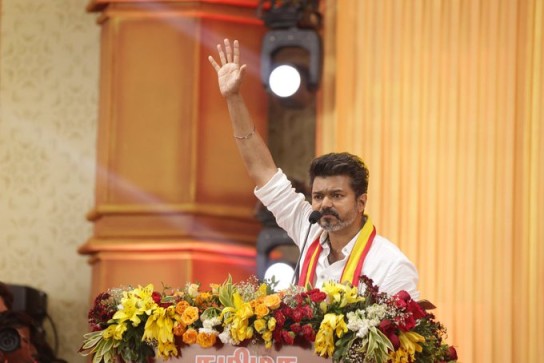
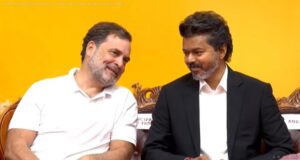
Image credit X.com @TVKTrends
In an exclusive interview with Manish Anand on The Raisina Hills YouTube channel, constitutional expert R. Narayanan explained why Tamil Nadu Governor Rajendra Arlekar’s decision to not invite TVK leader Vijay to be sworn in as Chief Minister is constitutionally sound — and why Vijay’s political inexperience may have cost him a critical opportunity.
By TRH political Desk
New Delhi, May 7, 2026 — Tamil Nadu’s political landscape remains deeply uncertain after Governor Rajendra Arlekar declined to invite TVK leader Vijay to be sworn in as Chief Minister, citing that Vijay does not command a majority in the 234-member Tamil Nadu Legislative Assembly.
Speaking to senior journalist Manish Anand on The Raisina Hills YouTube channel, constitutional expert R. Narayanan defended the Governor’s decision, arguing it was fully consistent with the letter and spirit of the Indian Constitution.
“Under Article 163 of the Constitution, the Chief Minister is appointed by the Governor. Before inviting someone to be sworn in, the Governor must satisfy himself that the person commands a majority in the Assembly,” Narayanan explained. “This is not a political act — it is a constitutional obligation.”
Narayanan clarified that the Governor holds both constitutional and situational discretion in such matters, and that no one can question the exercise of that legitimate discretion without valid reason.
Vijay Short of Majority Despite Congress Support
Tamil Nadu’s fractured mandate has left no single party with a clear majority. TVK emerged as the single largest party but fell well short of the 118-seat halfway mark needed to form a government. Even with the declared support of Congress — which won approximately five seats — Vijay remains at least six to ten MLAs short of a working majority.
Narayanan was unequivocal that majority can only be proven on the floor of the Assembly. “The Supreme Court has made it absolutely clear — you cannot prove majority outside the Governor’s House, inside the party office, or on the street. It can only be demonstrated on the Assembly floor,” he said.
Vijay’s Tactical Mistake: Expert’s Blunt Assessment
Narayanan did not mince words about what he called a significant political miscalculation by Vijay. “Mr. Vijay has not been properly advised before going to the Governor. He should have done his homework. He should have secured 118 MLAs before entering Raj Bhavan,” he said plainly.
He drew a sharp contrast — had Vijay secured well over 118 seats, the Governor would have been the first to send an invitation, rather than waiting for Vijay to call on him. “The invitation should have come from the Governor, not the other way around,” Narayanan noted.
Anti-Defection Law, Protem Speaker, and the Gray Areas
With the Assembly yet to be formally constituted and no Protem Speaker appointed, Narayanan flagged a legally complex gray area around potential defections from DMK’s smaller alliance partners toward TVK. He noted that while the 91st Constitutional Amendment Act of 2003 removed the one-third split provision, a two-thirds merger with another party remains legally permissible.
However, he warned that any such moves before a Speaker is appointed attract anti-defection proceedings, and that the Supreme Court has previously intervened to revive entire Assembly proceedings in such situations.
President’s Rule: A Possibility if Deadlock Continues
Asked whether President’s Rule could be imposed if no coalition emerges, Narayanan confirmed it was a legitimate option — but stressed that the Governor must first give all parties adequate time to explore government formation. He firmly ruled out fresh elections as “against the spirit of democracy” and “totally nonsensical” given that people have just voted.
Bottom Line: A Fluid Situation That Demands Political Maturity
Narayanan concluded that the deadlock ultimately exposed Vijay’s political inexperience. “Hardened politicians never act in haste,” he said. “The homework of coalition-building must be done before elections, not after.”
Tamil Nadu now watches and waits as its Governor, its aspiring Chief Minister, and the state’s fractious political alliances navigate one of the most complex constitutional moments in the state’s recent history.
Why TN Guv’s Delay Over Vijay Is Triggering Constitutional Debate
Follow The Raisina Hills on WhatsApp, Instagram, YouTube, Facebook, and LinkedIn




About The Author