The Mercenarisation of Indian Elections
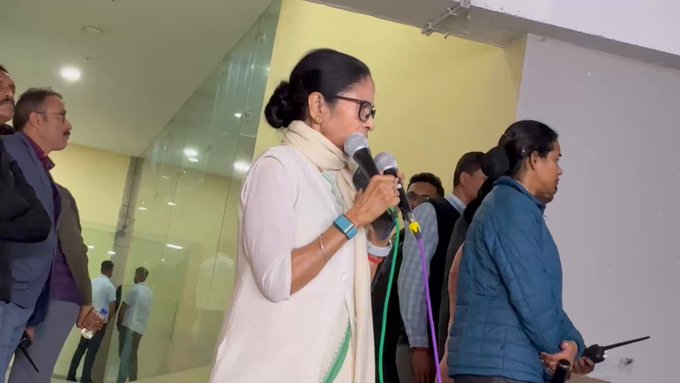
West Bengal CM Mamata Banerjee speaks to supporters during ED raid at I-PAC office (Image AITMC on X)
The Samajwadi Party’s reported decision to part ways with I-PAC after the Bengal elections has reignited debate over whether outsourced poll management can replace ideological commitment and grassroots political organisation.
By SIDHARTH MISHRA
New Delhi, May 10, 2026 — One of the more telling political aftershocks of the recent assembly elections in West Bengal has not emerged from Kolkata, but from Uttar Pradesh. The Samajwadi Party has decided to terminate the services of political consultancy firm I-PAC for the 2027 Uttar Pradesh Assembly elections. The official explanation offered was financial that is the party did not possess the enormous resources needed to sustain the consultancy arrangement. However, beneath that explanation lies a deeper churn within Indian politics, a growing discomfort with the rise of poll management firms and their influence over democratic processes.
The Bengal elections exposed the vulnerabilities of a political model increasingly dependent on professional electoral consultancies. During the run-up to the polls, the offices of I-PAC were raided by central enforcement agencies, and its principal strategist was arrested in a money laundering case. The optics were striking. Even more dramatic was the coincidence that bail came on the very day the election results were announced, results that saw I-PAC’s principal client, the All India Trinamool Congress, suffer a crushing defeat.
It’s being pointed out that Mamata Banerjee had to personally broadcast SOS messages to party workers, urging them not to abandon polling and counting booths, as panic had spread among the paid “volunteers” associated with the consultancy network after the arrest of their top leadership. Whether exaggerated or not, the episode has triggered a larger debate on can outsourced political machinery truly substitute the emotional commitment and ideological loyalty of grassroots cadres?
Perhaps sensing this fragility, the Samajwadi Party appears to have drawn its own conclusions. The party founded by Mulayam Singh Yadav and now led by Akhilesh Yadav, historically relies on a deeply embedded network of caste leaders, local workers, and ideological loyalists. Such workers may lack the polish of data analytics presentations or the glamour of social media war rooms, but they possess something that professional consultants often cannot manufacture, the organic social connection.
Ironically, the contradictions surrounding poll consultancies are visible across the political spectrum. In Tamil Nadu, I-PAC worked for the Dravida Munnetra Kazhagam, while its founder and former chief strategist Prashant Kishor was associated with actor-politician Vijay and his political venture, the Tamilaga Vettri Kazhagam. Such overlaps underline the transactional nature of modern political consulting. Ideology becomes secondary; electoral victory becomes the sole commodity.
Political consultancy firms entered the Indian electoral landscape in a major way around 2014, coinciding with the transformation of electioneering into a highly centralised, technology-driven exercise. Data analytics, booth mapping, social media management, targeted messaging, influencer campaigns, and perception management became indispensable parts of campaigning. Elections increasingly resembled corporate marketing exercises rather than ideological battles.
There is no denying that these firms brought professionalism and efficiency. They modernised communication, improved voter outreach, and forced even traditional parties to adapt to changing technologies. Yet, the unintended consequences have been profound.
The first casualty has been the political cadre itself. For decades, Indian democracy functioned through networks of committed workers who dedicated their lives to a cause. Whether it was the communists in Bengal and Kerala, the socialists in Uttar Pradesh, the Dravidian cadres in Tamil Nadu, or the cadre ecosystem of the Bharatiya Janata Party and the Rashtriya Swayamsevak Sangh, ideological workers formed the backbone of mobilisation.
These workers were not employees. They were believers. The arrival of consultancy-driven politics altered this equation. Cadres have been gradually replaced by paid volunteers, event managers, survey teams, and temporary digital workers. Campaigns became contract-based exercises rather than collective political movements. Many long-serving workers across parties quietly began to feel alienated, watching outsiders with laptops and presentations suddenly dictate electoral strategy.
This shift also transformed the financial character of elections. Poll management companies are expensive operations. Their rise has inevitably increased the dependence on massive campaign financing and opaque funding channels. In many ways, the explosion of “slush funds” in electoral politics parallels the rise of professional political consulting.
Democracy did become more data-driven, but also significantly more capital-intensive. Yet politics, especially in India, cannot entirely be reduced to spreadsheets and algorithms.
For the ordinary political worker, elections are not merely a tactical exercise, they are a festival. The old Times of India tagline describing elections as the “dance of democracy” captured this spirit perfectly. Polls are moments of participation, emotional investment, and collective identity. Workers spend sleepless nights mobilising voters not because they are paid by the hour, but because they believe in their party, their leader, or their ideology.
That emotional umbilical cord between leadership and cadre is difficult to outsource. Poll management firms often weaken precisely that relationship. Leaders begin relying more on consultants than on their own organisational structures. Feedback increasingly comes through surveys rather than direct interaction with workers. Politics becomes mediated through dashboards and analytics instead of human contact.
Yet, there is another side to this debate. In contemporary India, it is nearly impossible for opposition parties to take on the formidable electoral machinery of the BJP without some degree of professional support. The BJP today combines perhaps the world’s largest ideological cadre network with sophisticated technological and consultancy support systems. Its strength lies not merely in using poll management techniques, but in integrating them into a deeply committed ideological ecosystem.
That distinction is crucial. The consultancy structures aligned with the BJP often operate within a broader ideological framework. They are not merely mercenary operators hired for a season. In many cases, their leadership and workers share a common political worldview with the party they support. This creates a cohesion absent in many opposition campaigns where consultants are external service providers rather than ideological stakeholders.
The lesson emerging from Bengal and the Samajwadi Party’s apparent course correction may therefore not be that political consultancy firms are irrelevant. Modern elections will continue to require technology, data analysis, and professional campaign management. Nevertheless, parties that entirely substitute committed cadres with contractual volunteers may ultimately weaken their own foundations.
Democracy cannot survive on consultancy alone. Elections are won not merely by managing perceptions, but by sustaining human relationships, ideological conviction, and organisational trust. Political technology can amplify a movement, but it cannot manufacture political soul.
(This is an opinion piece. Views expressed are the author’s own.)
Lights, Camera, CM: Kollywood Turns Up for Vijay’s Historic Oath
Follow The Raisina Hills on WhatsApp, Instagram, YouTube, Facebook, and LinkedIn




About The Author