Makkah Drone Attack Puts Pakistan’s Defence Pact With Saudi Arabia to Its First Major Test
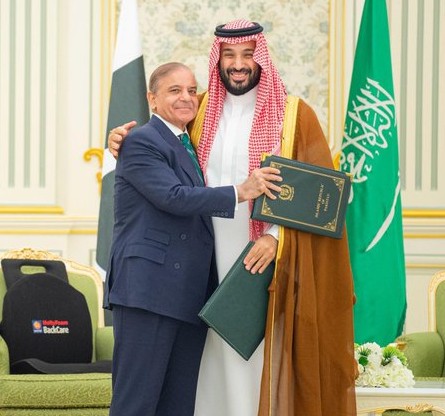
Saudi Arabia and Pakistan signed a Strategic Mutual Defense Agreement (Image X.com)
By TRH World Desk
A Houthi-linked drone incident near Islam’s holiest city is putting fresh pressure on Pakistan and Türkiye to clarify how far the new Makkah Joint Defence Agreement extends.
New Delhi, September 16, 2026 — The reported interception of a Houthi drone south of Makkah has suddenly transformed the newly signed Makkah Joint Defence Agreement between Saudi Arabia, Pakistan and Türkiye from a diplomatic declaration into a potential test of regional military commitments.
Saudi Arabia says its air defences destroyed a Houthi drone before it entered restricted airspace over Makkah. The Saudi-led coalition has described the security of the holy city and the protection of pilgrims as a “red line”. The Houthis, however, have rejected the allegation that they attempted to target Makkah.
The timing is significant.
Pakistan Prime Minister Shehbaz Sharif condemned what he described as the attempted drone attack in the strongest terms, praised the Saudi armed forces and reaffirmed that Pakistan stands “shoulder to shoulder” with Saudi Arabia in defending its sovereignty, territorial integrity and the security and sanctity of the Haramain Sharifain.
At the same time, Sharif called for restraint and dialogue, signalling the difficult balance Islamabad now faces between its strategic commitment to Riyadh and the risk of becoming directly involved in another regional war.
Former Pakistan ambassador to the United States Hussain Haqqani has raised the central question on X: does the reported attack on Makkah create circumstances for activating the Makkah Joint Defence Agreement, and could Pakistan and Türkiye eventually become militarily involved against the Houthis?
That question goes to the heart of the new security architecture.
Pakistan, Saudi Arabia and Türkiye signed the Makkah Joint Defence Agreement on August 7. The agreement says that an armed attack against any one of the three states shall be regarded as an attack against all three and calls for enhanced defence cooperation and collective deterrence.
But Islamabad has already indicated that the agreement is not an automatic military-response mechanism.
Pakistan’s Foreign Ministry said last week that the pact is an umbrella agreement and that mechanisms and frameworks still need to be established before its operationalisation. It also noted that Pakistan already has bilateral defence cooperation with Saudi Arabia, including the deployment of personnel for training and logistical purposes.
This is likely to become the central issue in the coming days.
Will Pakistan send troops against the Houthis?
The answer, based on Islamabad’s publicly stated position so far, is not yet.
Pakistan has condemned the Houthi attacks and reaffirmed its commitment to Saudi Arabia, but there has been no announced decision to deploy combat forces against the Houthis under the Makkah pact. Reuters reported on September 10 that Pakistan had not discussed a military response under the agreement despite the escalating Houthi attacks on Saudi territory.
The Makkah incident nevertheless changes the political pressure.
An attack on Saudi oil infrastructure can be treated primarily as a strategic and economic security issue. An alleged attack near Makkah carries a fundamentally different political and religious significance across the Muslim world.
That could make it harder for Pakistan to maintain a purely rhetorical commitment if attacks close to the holy city continue.
Yet there is another complication: the Houthis have denied targeting Makkah. Consequently, any decision by Islamabad to invoke collective-defence provisions would involve questions about attribution, the nature of the attack and whether the incident falls within the agreement’s intended military scope.
Türkiye faces the same dilemma
Türkiye is also under pressure because Ankara is the third signatory to the pact.
The agreement was designed around collective deterrence, but the three countries have different strategic interests and different levels of exposure to the Yemen conflict. The pact’s creation of a framework for cooperation does not necessarily establish a standing joint military command or prescribe an automatic battlefield response to every attack.
Recent reporting indicates that the agreement is still being institutionalised, with the three countries working on mechanisms to give the pact operational substance.
For Riyadh, however, the strategic calculation is becoming more complicated.
The Houthis have expanded attacks against Saudi targets as fighting in Yemen has intensified. The conflict also intersects with the Red Sea and Bab el-Mandeb, critical routes for energy and international shipping.
A sustained Houthi campaign therefore creates pressure not only on Saudi territorial security but also on the credibility of the new trilateral defence arrangement.
Mecca Pact vs IMEC: Is America Building a New Front to Counter China?
Follow The Raisina Hills on WhatsApp, Instagram, YouTube, Facebook, and LinkedIn




About The Author