Karnataka Finances Under Strain: The Questions the SFAR Report Fails to Answer
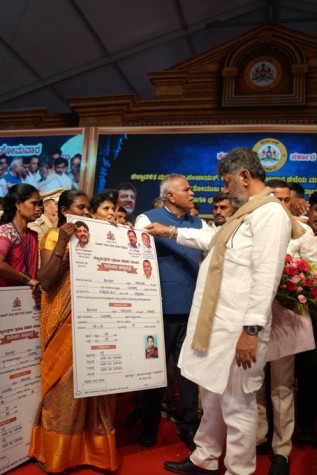
Karnataka’s State Finances Audit Report (SFAR) presents a detailed picture of the state’s finances, but its own data point to deeper concerns (Image Shivakumar on X)
By P. SESH KUMAR
From Personal Deposit accounts and March spending to welfare guarantees and revenue erosion, the audit report contains the numbers. What it lacks, critics argue, is the final arithmetic connecting them.
New Delhi, August 10, 2026 —Karnataka’s State Finances Audit Report (SFAR) presents a detailed picture of the state’s finances, but its own data point to deeper concerns than its conclusions acknowledge. From rising Personal Deposit account balances and March-end spending to revenue arrears, surrendered savings and mounting committed expenditure, the report reveals a widening gap between money appropriated, money spent and money that actually reaches beneficiaries. The bigger question is whether the audit has connected these figures into a clear assessment of Karnataka’s fiscal trajectory.
There is one sentence in this report that should not have survived the second draft. Introducing its assessment of the five guarantees, the report says that the social benefits were learnt “from the media coverage”, and proceeds to list financial inclusion, women’s empowerment, food security, youth support and household relief.
Let us consider what that asymmetry does. The cost of Gruha Lakshmi is established to two decimal places from grant registers and appropriation accounts. The benefit of Gruha Lakshmi is established from the newspapers. Every subsequent judgement in the chapter–that the schemes strain the exchequer, that they crowd out capital formation, that they should be rationalised or better targeted –rests on a cost figure of forensic quality and a benefit figure of no evidentiary quality at all. A finance ministry official could dismiss the entire analysis on that single sentence, and would be entitled to.
This is where the State Finances Audit Report (SFAR) should have reached across the corridor. Karnataka’s own audit offices have produced, in recent years, performance audits on primary educational institutions, on public health infrastructure and the management of health services, on the functioning of the Bengaluru Metropolitan Transport Corporation and on the conservation of protected monuments, alongside a continuing stream of compliance audits of departments and public sector undertakings. The BMTC audit is directly relevant to the Shakti scheme’s Rs 5,615 crore; the health infrastructure audit speaks to whether the nutrition and local-body budgets that were squeezed had slack to give; the education audit bears on the opportunity cost of a universal cash transfer. None of that work is cited. The SFAR is written as though the rest of the Indian Audit and Accounts Department did not exist.
The fix is not difficult and requires no new mandate. A standing paragraph in Chapter 1–call it “Evidence from performance and compliance audit”– could carry, for each major expenditure head, the most recent audit finding on whether the money bought the outcome. Where no performance audit exists, say so; that absence is itself information for the House. Where the executive’s own outcome data exist and were not verifiable, say that too. Anything is better than a footnote to the press.
The Bharatmala Files: Rebadged Roads, Rising Costs and Parliamentary Silence
Money that is spent without being spent
The most under-explored theme in the report is the growing gap between expenditure as recorded and expenditure as incurred, and here the report supplies more evidence than it uses.
Personal Deposit (PD) accounts closed the year at Rs 29,770.45 crore across 97 administrators, having received Rs 12,926.77 crore from the Consolidated Fund during the year, of which Rs 6,026.22 crore went in during March 2025 alone. The balance in these accounts has grown from Rs 3,989.23 crore in 2020-21 to nearly Rs 30,000 crore in four years. That is 8.7 per cent of the State’s total expenditure and just over one per cent of GSDP, appropriated by the Legislature, debited to the Consolidated Fund, counted as spent, and sitting in an account outside it.
Alongside that sit the surrenders. Chart 2.5 puts the year’s savings at Rs 22,476 crore, of which Rs 16,547 crore was surrendered and Rs 10,448 crore of that on the last day of March; a separate paragraph records that savings of Rs 10,546.42 crore across 21 grants were never surrendered at all. Take those figures together and roughly nine-tenths of the year’s savings was either withheld from the reallocation process entirely or released on 31 March, when reallocation is arithmetically impossible. The report says only that 73 per cent of savings were surrendered and that surrendering on the last day serves no purpose. The stronger statement–that the Appropriation Act’s in-year flexibility mechanism has effectively ceased to function–is available on its own figures. It is also worth noticing that the two figures do not reconcile: Rs 10,546.42 crore never surrendered plus Rs 16,547 crore surrendered comes to Rs 27,093 crore against total savings of Rs 22,476 crore, a gap of Rs 4,617 crore that the chapter never explains and that appears to arise from measuring one against gross savings and the other against savings net of excesses. A reader cannot be expected to work that out unaided.
And the rush. Thirty-five and a half per cent of the year’s expenditure fell in the January-to-March quarter, 18.94 per cent in March alone and Rs 10,093.17 crore on 31 March itself. A uniform run-rate would put those at 25 per cent, 8.3 per cent and about Rs 940 crore. The report reproduces General Financial Rule 62(3)–rush of expenditure in the closing months is a breach of financial propriety– and then describes the skew as “pronounced” and moves on. It does not ask the obvious question, which is whether the Rs 6,026.22 crore that entered PD accounts in March and the Rs 10,093.17 crore spent on the final day are substantially the same money.
Add to this the Rs 7,588.39 crore of expenditure and Rs 3,203.05 crore of receipts buried in the omnibus Minor Head 800; the 58 per cent of savings for which controlling officers in 22 of 28 grants gave no specific reason, covering Rs 6,066.68 crore; the 6 capital grants where the deviation from budget exceeded a 100 per cent; and the Rs 53,907.98 crore of revenue arrears, equal to more than 30 per cent of a full year’s own tax revenue, against which the tax departments finalised 7,780 of 26,289 evasion cases and raised demands of Rs 472.46 crore. Individually these are compliance observations. Together they describe a budget execution system in which the number voted, the number spent and the number that reached a beneficiary are three different numbers, and the report never says so in one breath.
Eight recommendations, and a Committee six years behind
A hundred and eighty-eight pages, three chapters, thirty-six tables, forty-two charts and eighteen appendices produce eight recommendations. Two of them are that the State should mobilise more revenue and complete its projects faster.
That is not a drafting quibble. Recommendations are the only part of an audit report that can be tracked, and a recommendation that the State “should consider mobilizing additional resources” cannot be tracked because it cannot be failed. Compare the specificity of the report’s own findings—Rs 21.85 crore not transferred to the National Securities Depository, a Rs 61.65 crore unreconciled difference between the Accountant General’s records and the Treasury’s on pension contributions, sixteen annual accounts of nine autonomous bodies outstanding with the Bangalore Water Supply and Sewerage Board’s pending since 2021-22, forty-one cases of misappropriation involving Rs 149.83 crore of which fourteen have been pending more than a decade– with the vagueness of what is asked in response.
And then the accountability chain. The last SFAR actually discussed by the Karnataka Public Accounts Committee was the one for 2019-20, taken up in July 2022, with the Committee’s recommendation placed before the House in February 2023. Action Taken Notes for the 2022-23 and 2023-24 reports were still awaited when this report went to press. So the auditor delivers in twelve months and the legislature reads six years late. Any honest account of the time lag in Indian state finance accountability has to place the blame where the report’s own paragraph 3.13 places it, and the report deserves credit for printing that paragraph rather than burying it.
This is the point at which the PEFA framework stops being a fashionable acronym and becomes useful. PEFA indicator 31 measures legislative scrutiny of audit reports on four dimensions–timing, hearings, recommendations and transparency–and on the evidence of paragraph 3.13, Karnataka would score at or near the bottom on the first and third. The report already borrows PEFA vocabulary: paragraph 2.3 is headed “Budget Marksmanship” and opens with a section called Expenditure Composition Outturn, which is PEFA indicator 2 almost verbatim. What it borrows is the language, not the discipline. PI-2 requires a three-year functional and economic deviation calculation with a defined scoring calibration; the report instead groups grants into deviation bands and offers no score, no trend and no comparison. The gap between the two is the gap between a metric and a mention.
What an average reader would actually want
Let us ask who reads this report. A legislator with forty other documents, a journalist on deadline, a research assistant in a think tank, a rating analyst, a citizen with a grievance about an unbuilt road. It is also a harsh truth that almost none of the Accountant General’s officers or even CAG’s officers (other than a handful who were functionally required to prepare it) would have either the inclination or interest to read the report. Almost none of them will reach page fifty-eight, and page fifty-eight is where the Rs 6,333.29 crore sits.
Four changes would make the difference, and none needs an amendment to anything.
The first is a one-page fiscal scorecard at the front, before the preface, carrying no more than fifteen numbers, each with the current year, the previous year, the five-year trend arrow and the all-States comparator.
On Karnataka’s 2024-25 figures that page would read:
(i) revenue deficit 1.01 per cent of GSDP after all audit adjustments including write-backs;
(ii) fiscal deficit 3.17 per cent on the same basis against a ceiling of three;
(iii) total liabilities on the statutory definition 24.49 per cent against a cap of twenty-five;
(iv) own revenue 6.71 per cent of GSDP against 7.74 a decade ago;
(v) total non-borrowing receipts 8.96 per cent against 11.37;
(vi) committed expenditure and subsidies 77 per cent of revenue receipts against 44 in 2015-16;
(vii) interest to revenue receipts 14.55 per cent (the report itself offers 14.53 in one table and 14.72 in its conclusion, which is a small but telling failure of the same aggregation discipline);
(viii) capital outlay and loans 18.79 per cent of total expenditure;
(ix) return on Rs 74,325 crore of investments 1.31 per cent against a borrowing cost of 6.93;
(x) expenditure incurred without prior legislative authority Rs 10,296.88 crore, or three per cent of total expenditure;
(xi) excess expenditure awaiting regularisation of Rs 9,563.96 crore across five years;
(xii) savings surrendered before the final day of the year, 27 per cent of the total;
(xiii) March expenditure 18.94 per cent of the year against a benchmark of 8.3;
(xiv) closing balance in Personal Deposit accounts 8.7 per cent of total expenditure;
(xv) and revenue arrears 30.4 per cent of own tax revenue.
Fifteen lines. A minister could be questioned on any of them within a minute of opening the document, which is precisely the argument against including them and precisely the argument for it.
The second is that every one of those indices needs a stated benchmark and a stated direction of travel. An index without a benchmark is a fact; an index with one is a verdict. The report already benchmarks the deficits against the all-States aggregate. It should benchmark the rest, and it should benchmark against comparable States rather than the all-States average, which is dragged down by fiscally distressed jurisdictions and flatters Karnataka. On the peer question, the comparison that matters is with Tamil Nadu, where committed expenditure consumed 85.58 per cent of revenue receipts in the same year, and with Kerala, where interest alone takes about a fifth of revenue–not with Bihar.
The third is jargon. Quantum spread, Domar gap, growth-interest differential, primary revenue balance, DDR heads, NDC bills, augmentation of provision by re-appropriation: each of these is defensible and each is opaque. The remedy is not to remove them but to put a plain-English consequence clause after each: the Domar gap is favourable, “which means the economy is still growing faster than the interest on the debt, so the debt ratio can fall without any change in policy”; the debt stabilisation quantum was negative Rs 13,395 crore, “which means it cannot”.
The fourth is that the report should say what changed since last year and what the auditor got wrong. A short chapter recording which of the previous year’s recommendations were implemented, which were repeated and for how many consecutive years, and where the previous year’s analysis has since been overtaken, would do more for the report’s authority than another appendix.
Management information, published quarterly
The deeper limitation is not the report; it is the annual cycle. A document published once a year about a year that ended twelve months ago cannot be management information, however good it is.
The Accountant General (Accounts and Entitlements) already compiles the monthly civil accounts from which almost every figure in this report is derived. Karnataka’s Khajane-II treasury system already carries expenditure by grant, head and drawing officer in near real time. Nothing prevents the publication, within thirty days of each quarter, of a short and unglamorous bulletin carrying five things:
(i) expenditure against grant by department with the March-loading forecast implied by the current run-rate;
(ii) the closing balance and age profile of Personal Deposit accounts;
(iii) the stock of pending utilisation certificates and abstract contingent bills by department;
(iv) movements in off-budget borrowing and guarantees; and
(v) the running total of expenditure incurred through executive orders without prior appropriation.
Every one of those is derived from data the Accountant General holds by the fifteenth of the following month. The SFAR would then become what an annual report should be–the verified, analysed and audited settlement of a story the House had already been following– rather than the first time anyone hears it.
Three PEFA indicators map directly onto that bulletin: PI-28 on in-year budget reports, PI-9 on public access to fiscal information, and PI-10 on fiscal risk reporting. A State that published it would be able to demonstrate compliance rather than assert it. And a SFAR that appended a formal PEFA-style scorecard–thirty-one indicators, scored, with the basis for each score and the previous assessment alongside — would give the legislature something no volume of Indian-format tables currently gives it: a single comparable number that moves.
India’s Infrastructure Boom Meets the Monsoon Test: Where Did the Accountability Go?
The counter-case, put as strongly as I can
Four defences deserve to be heard, and two of them are good.
The first is that the SFAR is not an attest report. It carries no audit opinion, expresses no assurance and is not the certification of the Finance Accounts, which is a separate exercise. On that view, restating deficits and then testing compliance against the restated figure might exceed the report’s own frame. My answer is that the report already restates the deficits– that is what paragraph 1.5.2 is– and having restated them once, declining to restate them again for the write-back is a choice, not a constraint.
The second is the template. The format of these reports is prescribed centrally so that eighteen general States can be compared, and an Accountant General who invents new tables for Karnataka destroys the comparability that gives the series its value. This is a serious point and it is why the answer here is not “let Bengaluru write differently” but “let Headquarters change the template for everyone”– and specifically, that the compliance table in every State’s report should draw its numerator from the post-audit figures in the same chapter, automatically.
The third is that the guarantee schemes are policy and policy is not auditable. This is the weakest of the four. The report does not audit the policy; it audits its financing, its classification and its consequences for capital formation, which is entirely proper and which it does well. What it lacks is not licence to comment on benefits but evidence of them, and that gap is an audit-planning failure, not a constitutional one.
The fourth is capacity. Two Principal Accountants General share the State’s audit workload, the SNA and SPARSH architecture changes every year, and departmental data arrive late or not at all–the report notes flatly that one of four tax departments simply did not furnish information on refund cases, and that thirteen of forty-six policy initiatives reviewed could not be reported on because departments did not respond. All true. None of it explains why a correction printed on page fifty-eight does not appear on page forty-eight, which costs nothing and requires no additional staff.
Quick Deterioration of Finance
Karnataka’s SFAR is a competent report about a State whose finances are deteriorating more quickly than its own report is willing to conclude. The five guarantees are affordable this year and are not obviously affordable for many more; the debt ratio is comfortable on a definition the State’s own statute does not use; the deficit targets were met with money left over from the last decade; and the underlying erosion–the two and a half percentage points of GSDP that Karnataka no longer collects– is charted on page forty-one and priced nowhere.
What separates this from the West Bengal case is instructive. Bengal’s problem, as I argued at the time, was nerve: the auditor printed every figure needed to condemn the State’s finances and declined to add them up. Karnataka’s problem is narrower and more fixable. The nerve is largely there–the guarantees chapter, the executive-order paragraph, the PD account findings and the frank admission about how the deficit target was met are all the work of people willing to say uncomfortable things. What is missing is the last mechanical step: the arithmetic that carries a correction from the paragraph where it is discovered to the table where it matters, and a front page that tells a busy reader which fifteen numbers to worry about.
That is a template problem, and templates can be rewritten in a season. It is worth doing, because the alternative is the one the report itself describes in paragraph 3.13–a document signed in March, tabled in the season, read by a committee six years later, answered by a note that never arrives. Three hundred and fifty-seven days of audit work deserve a better fate than that.
Karnataka State Finances Under the CAG Lens: The Fiscal Arithmetic That Does Not Add Up
Follow The Raisina Hills on WhatsApp, Instagram, YouTube, Facebook, and LinkedIn




About The Author