‘God Is Not on America’s Side’: Iran President’s Son Speaks
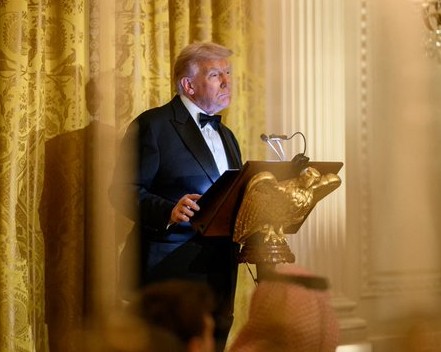
US Presdent Donald trump at a welcome ceremony for Saudi Arabia Crown Prince Mohammed bin Salman. (Image The White House on X)
As Yousef Pezeshkian’s private diary surfaces and Tehran denies Trump’s peace claims with a missile barrage, one verdict is hardening: the key to ending this conflict sits in Tehran, not Washington
By NIRENDRA DEV
New Delhi, March 28, 2026 — A private diary. A missile barrage. A president who claims victory while his own polls collapse. And an adversary with every incentive to keep fighting.
This is where the US-Iran war stands — and the picture it paints is not the one Donald Trump is selling.
The diary that changes the narrative
Circulating widely on social media, entries attributed to Yousef Pezeshkian — son of Iranian President Masoud Pezeshkian — offer a rare and unsettling window into the Iranian leadership’s inner world during wartime.
The younger Pezeshkian is unambiguous about moral legitimacy. “Yes, we have faults. We have made mistakes. We are not infallible,” he writes. “But our mistakes are not at a level that justifies America and Israel in this war or makes us guilty. I say with certainty that God is not on America’s side.”
He pushes back against the core American narrative point by point: “Which side lies? Was Iran seeking a nuclear bomb? Did Iran want to attack America? Did the government kill 40,000 people? When one side constantly lies, why trust them?” — the last question a seeming reference to the violent crackdown on anti-government protests, where death toll estimates range from thousands to over 35,000.
But crucially, Pezeshkian also reflects the genuine strategic debate unfolding within Iran. “What is seriously disputed is how long we should fight? For ever? Until the complete destruction of Israel and the withdrawal of the US? Until the complete destruction or surrender of Iran?” he writes. “We must review the end-of-war scenarios. Which scenario is more likely? Which one is desirable for us?”
That question — not Trump’s press conferences — is where the war’s actual endpoint will be decided.
Trump’s tightening trap
Back in Washington, the US President is navigating a landscape that grows more treacherous by the week. As Eduardo Porter writes in The Guardian, Trump’s objectives are in direct conflict with each other. He desperately needs to end the war and bring the fleet home. He desperately needs to unblock oil flows through the Strait of Hormuz — which Iran now controls. And he desperately needs to do both before November’s midterm elections, in which he is already underwater in opinion polls.
Americans opposed this war from the start, and that opposition has hardened as the average price of gas at the pump approaches $4 a gallon. The OECD projects US inflation will surge to 4.2 percent this year — an economic reality that no presidential messaging can override.
When Trump claimed “productive conversations” with Tehran regarding a “complete and total resolution of hostilities,” Iran’s response was swift and kinetic: a wave of missiles into Israel, Iraq, and American allies across the Gulf. Oil rebounded. Stock gains evaporated. The denial was not verbal — it was launched.
Why Tehran won’t blink
Iran’s strategic calculus is, by this point, coherent. As The Guardian analysis notes, Tehran probably concludes that the only credible deterrent against future attacks is demonstrating — repeatedly and visibly — the scale of damage it can inflict in retaliation. Nothing the United States can do changes that calculus short of deploying ground troops, a move that would rupture what remains of domestic political consensus in Washington.
“Markets are figuring out that that will probably be up to Tehran,” Porter writes — a sentence that doubles as both financial analysis and geopolitical verdict.
The human cost inside Iran
Pezeshkian’s diary does not spare his own government. He expresses anger at Iran’s internet blackouts and media censorship. He records his unease at his father’s apology to Gulf states on the receiving end of Iranian missiles.
And he records the human texture of a society under bombardment: a friend who dreamed of a missile strike near his home, moved his family to safety, and watched the dream come true the next day. The house was destroyed.
He writes of grief at the reported death of senior military figure Ali Larijani: “I really didn’t want to believe it. We must not allow the enemy to have another successful assassination. If we cannot stop the Zionists’ assassination machine, we will be defeated.”
Writing the diary itself, he admits, is its own exhaustion. “Sometimes the words and thoughts I want to express become like a mosquito buzzing around my head; when I reach out to catch them, they fly away.”
The verdict
In any war, the side that controls the endgame holds the decisive advantage. Tehran controls the Strait of Hormuz, the missile cadence, the pace of diplomacy, and — as Pezeshkian’s diary makes plain — the internal debate about when and on what terms the fighting stops.
Trump does not get to decide when this conflict ends. That key, as things stand, belongs to Tehran.
Iran Has the Upper Hand — And Trump Knows It: Pakistani Senator
Follow The Raisina Hills on WhatsApp, Instagram, YouTube, Facebook, and LinkedIn




About The Author