India-US FTA Impasse: Why New Delhi Won’t Sign Just Yet
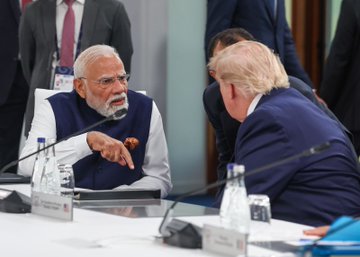
Prime Minister Narendra Modi in a talk with US President Donald Trump at the G7 Summit in Evian. (Image Modi on X)
By TRH World Desk
India-US Trade Deal Is “Done” — So Why Hasn’t New Delhi Signed? Experts Point to a Tariff Trust Deficit
New Delhi, August 9, 2026 — US Vice President J.D. Vance called Prime Minister Narendra Modi. While Modi on X said that he discussed bilateral strategic relations, the spotlight came on the India-US Free Trade Agreement impasse. While experts claim that India-US FTA discussions have already been wrapped up, the signing is stuck. The impasse is attributed to trust deficit in New Delhi with the Trump administration.
“We discussed ways to further deepen India-US Comprehensive Global Strategic Partnership across key areas,” Modi posted on X. Vance has visited India, and he is considered to be Trump administrations’ top contact for Modi.
With November Mid-Term elections in the US looming, Washington is keen to ink the FTA with India. US President Donald Trump facing blowback for his foreign policy and economic policies may hope for an India FTA to sell to the domestic constituency.
But Modi has more immediate concerns to attend to, with a Gen Z protest in New Delhi already blowing away his carefully built image. The Prime Minister, per experts, may also find difficult to gain support for the India-US FTA with the bully image of Trump already having become a liability for Modi in the domestic politics.
Geopolitics watchers on X say the India-US FTA holdup isn’t the substance of the agreement but a guarantee India no longer trusts Washington to honour — just as a Senate-passed sanctions bill raises the stakes further
Nearly a year after tariffs pushed India-US trade relations into crisis, and six months after the two sides announced a framework slashing duties to 18%, the broader Bilateral Trade Agreement (BTA) both governments have been negotiating remains unsigned.
According to Indo-Pacific analysts tracking the talks on X, the deal itself isn’t the problem — India’s confidence that Washington will actually stick to it is.
The clearest articulation of this theory has come from Derek J. Grossman, an Indo-Pacific security analyst and USC professor, who posted on X that “word around New Delhi is the India-US free trade agreement has effectively been finalised for months.”
According to his account, the one thing holding up India’s signature isn’t a leftover negotiating chapter — it’s a guarantee that the agreed 18% tariff rate stays locked in, rather than becoming the starting point for another round of pressure.
That framing tracks with how the current rate came about in the first place. Official US-India statements confirm the United States applies a reciprocal tariff rate of 18 percent under Executive Order 14257, as amended, on originating Indian goods including textiles, apparel, leather, footwear and organic chemicals, a rate reached after a bruising escalation.
Grossman’s diagnosis — that Trump is too unpredictable a negotiating partner to trust without a firmer guarantee — is not a throwaway line; it reflects a pattern index of reversals over the past year. His own earlier posts on X trace the whiplash.
In one, posted before the February framework was finalised, he noted that the coming India-US deal appeared to involve the Trump administration reducing tariffs from 50% to somewhere around 15-16%, in exchange for India reducing its imports of discounted Russian oil and possibly buying more US agricultural products — an outcome that shifted by the time the actual announcement landed at 18%, not 15-16%, underscoring how fluid even “final” numbers have proven to be in this negotiation.
The rate has kept moving since. Independent tariff-tracking data shows that the effective US tariff on Indian goods fell to about 10% after the Supreme Court struck down the IEEPA-based tariffs in February 2026, with the 18% reciprocal rate replaced by a 10% Section 122 baseline tariff — though that baseline was itself ruled unlawful by the Court of International Trade in May 2026 and remains in force only under a Federal Circuit stay pending appeal.
In other words, the “18%” figure India wants locked in has already been legally unsettled once this year through no action by either negotiating team — a legitimate basis, analysts argue, for New Delhi wanting the number pinned down in treaty language rather than left to executive orders and court rulings.
Other commentators on X flagged the same underlying vulnerability weeks before the current standoff came into focus. In a post breaking down the mechanics for a retail investor audience, market commentator Rajesh Kr Sodhani wrote on X that as the deal moved closer to completion, one point had come into sharp focus: Section 301 — the US trade law tool that lets Washington investigate and penalise countries over practices it deems unfair, regardless of any concurrent tariff agreement. That tool remains live and separate from the reciprocal-tariff track, meaning a locked-in 18% headline rate would not, on its own, immunise India from fresh action under a different legal authority — one plausible reason New Delhi is pushing for guarantees that go beyond a single number.
Grossman’s post also flagged a second, more acute threat: a Senate Russia-sanctions bill that could push tariffs on India as high as 100%. That bill is no longer hypothetical. Reporting confirms the US Senate passed the Lindsey O. Graham Sanctioning Russia and Iran Act of 2026 by an 86-11 vote, authorising tariffs of up to 100% on countries buying Russian energy, explicitly naming India alongside China, Slovakia, Hungary and Azerbaijan.
The bill isn’t self-executing — analysis notes under Section 113(a) the President “shall… increase the rate of duty… to a rate of up to 100% ad valorem,” giving flexibility over the eventual tariff level rather than mandating a fixed 100% rate, while Section 115(a) allows the President to waive sanctions or duties if doing so is deemed in the national interest, subject to reporting to Congress — but the discretionary structure is itself part of the leverage problem Grossman’s post implicitly raises: a rate India cannot predict is not a rate India can plan around.
The bill’s next stop adds to the uncertainty. Coverage confirms it now awaits consideration in the House of Representatives, which reconvenes on August 31, with the administration’s own economic team declining to clarify how it would interact with trade talks. Asked directly about the overlap, a senior White House adviser said it was “up to the negotiators” — not him — to determine whether the sanctions bill would affect the trade talks with India, a non-answer that has done little to reassure New Delhi.
Follow The Raisina Hills on WhatsApp, Instagram, YouTube, Facebook, and LinkedIn




About The Author