Beyond Uniforms and Insignia: Why Military Justice Needs Decolonisation
Colonial Mindset Still Shapes Military Discipline, Argues Defence Commentator
By SIDHARTH MISHRA
India’s armed forces have replaced many colonial-era symbols and traditions, but true decolonisation requires reforming the military justice and disciplinary framework that continues to shape the lives of soldiers and officers. The challenge is to preserve discipline while ensuring fairness, accountability and constitutional safeguards.
New Delhi, June 22, 2026 — For the past few years, the Indian armed forces have been consciously attempting to shed their colonial past. From replacing British-era military traditions and insignia to revising ceremonial practices, the effort has been visible and widely appreciated. The recent notification introducing changes in uniforms, ranks, and symbols is another step in that direction. Yet, while much attention has been paid to visible symbols of colonialism, a far more consequential colonial inheritance remains largely untouched—the military justice and disciplinary system.
The true test of decolonisation lies not in changing badges and uniforms but in reforming the rules and regulations that govern the lives of soldiers and officers.
The roots of the Indenisation of the armed forces can be traced back to the period following the First World War when Indians were gradually inducted into the commissioned officer ranks. However, the British Empire never fully trusted its Indian officers. The colonial administration viewed them as “native” officers who needed to be subjected to stricter oversight and discipline than their British counterparts.
As a result, an elaborate system of military laws, disciplinary regulations, and command structures evolved, designed not merely to ensure operational efficiency but also to enforce unquestioning obedience. Dissent, independent thinking, or even professional disagreement were often viewed with suspicion. The objective was clear: maintain control over a colonial force serving imperial interests.
Independent India inherited much of this framework. While the armed forces have evolved into one of the most professional institutions in the country, many of the disciplinary procedures continue to reflect this colonial mind-set. The emphasis remains overwhelmingly on preserving authority and hierarchy, often at the expense of procedural fairness and individual rights.
Over nearly three decades of reporting on defence affairs, I have encountered numerous cases where officers and soldiers found themselves trapped in a disciplinary process that offered little room for their perspective. Often, the punishment extended far beyond the final verdict.
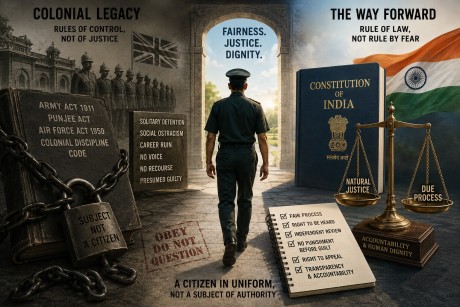
Contrary to popular perception, many serving personnel fear not merely the court martial process but the prolonged period preceding it. Solitary confinement, restrictions on movement, professional isolation, suspension of duties, denial of career progression, and social ostracisation within units can become instruments of punishment long before guilt is established. In some instances, the process itself becomes the punishment.
What makes the situation more troubling is the enormous imbalance of power between the individual and the institution. A young officer questioning an administrative decision, exposing irregularities, or standing up for what he believes is professionally correct can quickly find himself labelled as “difficult,” “non-conformist,” or “lacking military bearing.” Once such a perception takes hold, it can be extremely difficult to overcome.
This is not to suggest that discipline is unnecessary. Military organisations cannot function without strict discipline, especially in operational environments where lives depend on instant obedience and coordinated action. However, there is a crucial distinction between discipline and unquestioned authority. Modern militaries across democratic societies have increasingly recognised this difference.
The recent observations by the Armed Forces Tribunal in a case involving an Indian Air Force pilot once again highlighted concerns regarding procedural fairness. The tribunal reportedly criticised the legality of actions taken against the officer and ordered reinstatement, raising important questions about how disciplinary powers are exercised and reviewed within the services.
Similarly, courts have repeatedly intervened in cases where military authorities were found to have overstepped legal boundaries. In one notable judgment, the Supreme Court restored the honour of an Indian Air Force officer who had spent over three decades fighting his dismissal. The Court questioned the reasoning behind administrative actions taken against him and underscored the importance of fairness and legality in disciplinary proceedings.
These cases are not merely about individual grievances. They point towards a larger institutional challenge.
The existence of the Armed Forces Tribunal itself reflects the recognition that military justice requires independent oversight. Yet, the growing number of disputes reaching tribunals and higher courts indicates that many service personnel continue to feel that internal mechanisms do not adequately address their concerns. Concerns have also been raised by courts regarding delays in implementing tribunal orders affecting military personnel.
The challenge before India’s military leadership is not to weaken discipline but to modernise it. A truly Indian military justice system should draw strength from constitutional values rather than colonial precedents. It should balance operational requirements with principles of natural justice. It should ensure that an accused officer or soldier is not treated as guilty before a fair determination of facts. It should create safeguards against misuse of authority while preserving the chain of command.
Most importantly, it should recognise that loyalty to the institution is not demonstrated through blind obedience alone. Often, the most committed officers are those willing to speak uncomfortable truths, question flawed decisions, and uphold professional standards even at personal cost.
India’s armed forces have successfully indigenised equipment, symbols, and traditions. They are increasingly embracing indigenous technology and strategic thinking. The next phase of reform must focus on institutional culture and legal structures.
Removing colonial insignia from uniforms may boost morale and national pride. But removing colonial-era assumptions from military justice will strengthen the very foundations of the armed forces.
The last vestiges of colonialism do not reside in badges or ceremonial customs. They survive in regulations that continue to view the individual primarily as a subject of authority rather than as a citizen in uniform. If India truly seeks to complete the process of military decolonisation, that is where the reform must begin.
(This is an opinion piece. Views expressed are the author’s own.)
From Dismissal to Realism: What Hasnain’s Pakistan Thesis Means for Indian Strategy
Follow The Raisina Hills on WhatsApp, Instagram, YouTube, Facebook, and LinkedIn




About The Author