From Dismissal to Realism: What Hasnain’s Pakistan Thesis Means for Indian Strategy
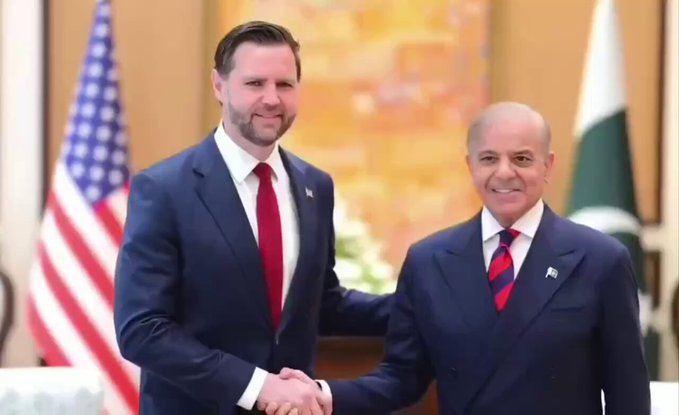
US Vice President JD Vance with Pakistan Prime Minister Shehbaz Sharif in Islamabad. (Image X.com)
By SIDHARTH MISHRA
The Bihar Governor’s remarks on Pakistan’s reported role in facilitating the US-Iran truce challenge a dominant narrative in New Delhi—not by advocating rapprochement, but by warning against strategic complacency.
Key Takeaways
- Hasnain’s argument is rooted in strategic realism rather than reconciliation.
- The article distinguishes between national power and geopolitical relevance.
- Pakistan’s geography and diplomatic networks may have regained significance during the Iran crisis.
- The piece does not challenge India’s post-2019 Pakistan doctrine.
- It suggests India should avoid underestimating Pakistan’s ability to leverage regional crises.
New Delhi, June 16, 2026 — In a very surprising article, Lt Gen Syed Ata Hasnain, Governor of Bihar, has indicated towards Pakistan playing an important role in US-Iran truce. This is for the first time that somebody from the Indian establishment has recognised Pakistan’s role, which is rank opposite of what Indian Foreign Minister S Jaishankar has stated in Parliament. Diplomacy is sometimes also about intelligently shifting stances. Will India soften its stand vis-a-vis Pakistan. Does Hasnain’s article indicate towards it?
Hasnain’s recent article is significant, as it is less a call for India to soften its Pakistan policy and more a warning against allowing political narratives to obscure strategic realities. His core argument is that Pakistan’s internal weaknesses should not blind India to the fact that external powers continue to find Pakistan useful.
The immediate context is the emerging US-Iran understanding in which Pakistan appears to have played a mediating role. Multiple international reports indicate that Pakistan, alongside Qatar, was involved in facilitating negotiations between Washington and Tehran, with Pakistan’s military and political leadership actively participating in diplomatic efforts.
This does seem to sit uneasily with the tone adopted by External Affairs Minister S. Jaishankar over recent months. Jaishankar has repeatedly emphasized that India is not a “broker nation” and has often downplayed Pakistan’s diplomatic relevance, portraying Islamabad as a state whose utility to major powers has sharply diminished.
Hasnain’s article argues that Pakistan has regained a degree of strategic relevance because of regional turbulence. The Iran crisis, the Gulf security architecture, Pakistan’s geography, its links with China, its proximity to Iran and Afghanistan, and its military-to-military channels with Washington have together restored some of the leverage Islamabad had lost after the US withdrawal from Afghanistan.
Lt Gen Syed Ata Hasnain’s assessment of Pakistan’s reported role in the US-Iran truce is unlikely to trigger a shift in India’s Pakistan policy. But it may signal something equally important: a growing recognition within sections of India’s strategic community that Pakistan, despite its economic and political challenges, remains relevant to major powers when regional crises erupt.
In strategic studies, there is a distinction between power and relevance. Pakistan today may not possess the economic or technological weight of India, but it can still become relevant when a crisis emerges in a geography where it occupies a central position. Hasnain appears to be cautioning Indian policymakers against making the mistake that many analysts made after 2021: assuming Pakistan had become permanently irrelevant to American strategy. The events surrounding the Iran crisis suggest otherwise.
Does this signal a shift within the Indian establishment? Probably not in the immediate sense.
India’s Pakistan policy since 2019 has rested on three pillars:
- No structured bilateral dialogue until terrorism concerns are addressed.
- No acceptance of third-party mediation on India-Pakistan issues.
- Expansion of India’s global partnerships independent of Pakistan.
None of these principles are challenged by Hasnain’s article. In fact, one can read the article as reinforcing the need for vigilance rather than reconciliation. The piece reportedly highlights Pakistan’s military modernization, intelligence capabilities, and renewed international engagement. The message is not “Pakistan is back, therefore engage it”; the message is “Pakistan is back on the radar, therefore do not underestimate it.”
Where the article may be important is in signaling a more realistic assessment. For much of the past year, Indian public discourse often oscillated between two extremes: portraying Pakistan either as an existential threat or as a failed state whose strategic utility had evaporated. Hasnain is rejecting the second proposition.
This matters because serious strategic communities rarely operate on slogans. If Pakistan has indeed helped facilitate US-Iran negotiations, then denying that reality serves little purpose. Great powers routinely work with states they otherwise criticize. The United States worked with Pakistan during the Afghan wars despite deep mistrust. It has again worked with it during the Iran crisis. Recognizing that fact does not imply admiration for Pakistan or a willingness to alter core security policies.
Will India soften its stance? Unlikely. What is more likely is a distinction between rhetoric and strategy. Public rhetoric may continue to be tough. Behind the scenes, however, Indian strategic planners will probably take greater note of Pakistan’s ability to leverage crises in West Asia and maintain links with Washington, Beijing, Riyadh, Tehran, and the Gulf monarchies simultaneously.
RSS and Pakistan: Why Hosabale’s Talk Pitch Is Not a Departure
The most interesting aspect of Hasnain’s article is that it reflects a classical realist tradition within India’s strategic community. Realists are less interested in whether a rival is liked or disliked; they are interested in whether that rival retains utility to other powers. From that perspective, the article is not a plea for rapprochement. It is a warning against complacency.
If Pakistan has indeed reinserted itself into a major diplomatic process involving the US and Iran, then India’s challenge is not to deny the development but to understand its implications. Strategic surprises often occur when states begin believing their adversaries have become irrelevant.
Therefore, Hasnain’s article should be read less as a harbinger of an India-Pakistan thaw and more as an attempt to recalibrate Indian strategic thinking. It acknowledges that Pakistan’s international standing may have improved at the margins because of regional crises, but it does not suggest that New Delhi is preparing to abandon its existing Pakistan doctrine.
The likely outcome is not policy softening but policy refinement: a more nuanced recognition that even a troubled Pakistan can remain strategically valuable to major powers when geography and circumstances align.
(This is an opinion piece. Views expressed are the author’s own.)
EU’s Kaja Kallas Triggers Row by Linking Kashmir and Ukraine in Pakistan Statement
Follow The Raisina Hills on WhatsApp, Instagram, YouTube, Facebook, and LinkedIn




About The Author