India’s Infrastructure Boom Meets the Monsoon Test: Where Did the Accountability Go?
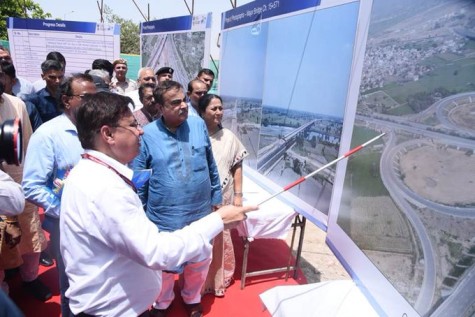
Union Minister Nitin Gadkari inspects DND Expressway work progress. (Image PIB)
By P. SESH KUMAR
Four expressways and highway links faced rain-related failures, raising questions over project appraisal, drainage, quality assurance, maintenance and accountability.
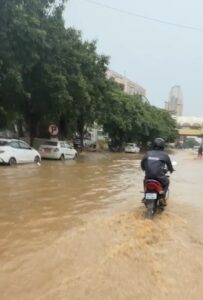
New Delhi, August 9, 2026 — If the CAG’s 2023 report told us how India’s highways are procured, the monsoon of 2026 told us how they are built. The rains arrived, and so did the craters.
Less than three months after the Prime Minister inaugurated the 213-kilometre, six-lane Delhi-Dehradun Economic Corridor on 14 April 2026– built for about Rs 12,000 crore, cutting the journey from over six hours to about two and a half– two alarming potholes opened near Shamli in Uttar Pradesh after the season’s first heavy rain, damaging vehicle rims. NHAI suspended senior officials on the project, issued show-cause notices to the construction and consultancy agencies over construction quality and drainage arrangements, gave three days for an explanation on pain of withheld payments, financial penalties, blacklisting and other contractual measures, and directed repairs at the contractor’s cost at every location on the corridor showing rain-induced erosion.
NHAI also attributed part of the problem to local residents obstructing the cross-drainage plan; the Congress attributed it to corruption.
Around the same time, an eight-foot-wide hole appeared on the Delhi-Mumbai Expressway near Ankleshwar in Gujarat, with damage also reported near Sawai Madhopur in Rajasthan — where NHAI had already terminated the contractor’s agreement in April for repeated failure to meet contractual obligations, suspended residual works and handed the balance to a new builder.
The corridor runs nearly 1,400 kilometres, is estimated at over Rs 1 lakh crore, was partially inaugurated in February 2023 and is now slated for completion in 2027-28.
On 5 July 2026 a seven-metre stretch of the link road joining the Kanpur-Lucknow highway to the Ganga Expressway caved in near Bashiratganj in Unnao after the first monsoon rain washed out the underlying soil; residents complained that slope protection and soil retention had not met prescribed standards.
The 594-kilometre Ganga Expressway had been inaugurated in April.
These are not isolated. In December 2025, after a reinforced soil wall failed at Mylakkadu during national highway works in Kerala, NHAI suspended the concessionaire and the independent engineer from future bids, issued show-cause notices and monetary penalties, sent an expert committee to the site and engaged eighteen geotechnical agencies to test soil at 378 locations along NH-66.
Earlier on the same highway, a collapse at Kooriyad in Malappuram led to the debarment of the contractor and the suspension of the consultant firm and two officials. The pattern goes back further still: after a Gurugram corridor structure collapsed, NHAI demobilised and debarred a senior quality expert and a bridge engineer for two years, issued show-cause notices to the developer, the independent engineer and two design consultants, and constituted a four-member technical committee under a former Director-General (Roads), with its then Chairman promising zero tolerance and long debarment with severe penalties.
Read charitably–and it deserves to be read charitably–this is a system that is responding. Suspensions within days, named contractors, debarments, expert committees, 378 test locations, penalties, and a February 2026 pilot deploying Mobile Quality Control Vans in Rajasthan, Gujarat, Karnataka and Odisha to move from post-construction inspection to real-time on-site assessment.
A decade ago none of this would have been announced, let alone within a week. Read less charitably, it is a system whose entire quality assurance function has migrated from before the concrete is poured to after the photograph goes viral. Every one of these episodes was detected by rain and publicised by a citizen with a phone. Not one, on the public record, was caught by the independent engineer whose contractual purpose was to catch it.
And the arithmetic of accountability remains unbalanced. A debarment falls on a firm; the officers who certified the work are suspended pending inquiry, and what follows is rarely reported. The defect liability period and the fifteen-year maintenance obligation under hybrid annuity contracts mean the contractor pays for the repair, which is right–but the traveller paid the toll, the exchequer paid the annuity, and the corridor’s design life was quietly shortened by a failure nobody has priced.
Value for Money, Properly Construed
Value for money is not cheapness. It is the disciplined answer to four questions, and Indian infrastructure appraisal reliably answers only the first.
Was it needed? Mostly, yes, and emphatically so for freight corridors, port connectivity, and four-laning of the routes that carry 65 per cent of India’s freight. But the Bharatmala audit found no systematic prioritisation and 46 per cent of the length of 11 high-priority corridors unawarded, which means need was asserted rather than ranked. When everything is a priority, sequencing is decided by whatever else decides things.
Was it the least-cost adequate design? Here the record is weakest. A 90 metre right of way sufficient for 14 at-grade lanes was converted into an elevated eight-lane single-pier viaduct at a multiple of the norm, without a detailed project report and without any published options appraisal. A 60 metre span became 120 metres at a cost of Rs 922 crore on contested expert advice. Thirty-five of fifty sampled projects went to tender with no appraisal by the committee constituted to appraise them. The pattern is not extravagance for its own sake; it is the absence of a document that says “here are three designs, here are their costs and benefits, here is why we chose this one”. Without that document, cost cannot be defended and cannot be attacked. It can only be argued about.
Will it last? On the evidence of one monsoon, not uniformly. The signature structures are holding; the approach roads, service roads, link roads, embankments, reinforced soil walls and cross-drainage are not. Anyone who has audited works knows why: the glamour, the supervision and the design attention concentrate on the span, and the earthwork and drainage– which is where roads actually fail– are the residual. Life-cycle costing would price this properly. India specifies capital cost and hopes for the best.
Who pays? This is the question the chart most completely suppresses. NHAI’s outstanding debt stood at about Rs 3.49 lakh crore in March 2022, having more than doubled from Rs 1.22 lakh crore in March 2018, and peaked around Rs 3.5 lakh crore in 2021-22.45 46 Since then there has been a genuine and creditable turnaround: no new borrowing since 2023, prepayment of about Rs 86,000 crore including Rs 50,000 crore of National Small Savings Fund loans, debt down about thirty-two per cent to Rs 2.36 lakh crore with a target below Rs 2 lakh crore by March 2026, and interest costs reduced by eighty basis points.47 The engine of that repair is monetisation: Rs 92,633 crore raised through toll-operate-transfer and InvIT routes to FY2025, Rs 28,307 crore realised in FY2026 against a Rs 30,000 crore target, and highways accounting for an estimated Rs 4.14 lakh crore of the Rs 16.72 lakh crore National Monetisation Pipeline 2.0 for FY26 to FY30.48 49
Monetisation is a legitimate and well-designed instrument, and NHAI has executed it competently. But it should be described accurately: it converts a future stream of toll receipts into cash today. Every rupee of it is a claim on tomorrow’s road user, discounted at a rate set in an auction room. When Bharatmala’s Phase-I cost doubles from Rs 5.35 lakh crore to something above Rs 10 lakh crore, when a 158 per cent of Cabinet-approved funds are sanctioned against 76 per cent of approved length, and when the financing mix shifts from 10 per cent BOT to under 2 per cent, the bill does not disappear. It moves– from the concessionaire to the exchequer, and from the exchequer to the tolled traveller of the 2040s. The orange bars are real. So is the mortgage on them, and the mortgage is not on the chart.
Both Sides, Honestly Weighed
The strongest case for the government is this. The state that inherited 91,287 kilometres of highway in 2014 and 18,387 kilometres of four-lane has more than doubled the latter and added tens of thousands of kilometres of the former; it has taken solar from under three gigawatts to over one hundred and sixty; it has piped water to twelve crore additional rural households; it built India’s first undersea road tunnel and its longest sea bridge and its first dedicated freight corridors. Cost escalation on a decade-long programme in an inflationary land market is not by itself malfeasance. Comparing a normative programme average with the cost of a tunnelled urban viaduct is analytically unfair, and the Ministry said so within four days of the report. The audit itself contained no finding of fraud, made no allegation of criminality, and framed forty-one forward-looking recommendations. And when defects have surfaced, the agencies have suspended, penalised, debarred and tested at a speed and with a specificity that would have been unimaginable in 2010. Every one of those propositions is defensible on the record.
The strongest case against is equally sober. A Cabinet approval that authorises Rs 5.35 lakh crore and 34,800 kilometres, and produces sanctions of one and a half times the money for three-quarters of the length without returning for revised approval, has ceased to be a financial control. Half the programme length was pre-existing. Seventy per cent of a project sample skipped mandated appraisal. Bidders who did not qualify, or who filed falsified documents, were selected. Rs 1.57 lakh crore of other schemes’ money was counted as this programme’s achievement. Road users were charged Rs 132 crore they did not owe at five plazas in one region, and no refund is on record. A Rs 17,840 crore bridge carries under half its forecast traffic. An undersea tunnel needed emergency joint grouting eight weeks after opening. Four newly inaugurated expressways failed within weeks of their first rain. The Public Accounts Committee examined the audit across three sittings and then let it die with a dissolution, without reporting a word. And the officer who supervised the audit was moved fifteen hundred miles within weeks of tabling it.
The synthesis is not a split verdict. It is a diagnosis. India has built a genuinely world-class delivery machine and has not built the appraisal, costing, quality-assurance and accountability machine that a delivery machine of that size requires. The two capabilities are not in tension; the second is what makes the first worth having. A state that can lay 12,000 kilometres of highway in a year and cannot produce the options-appraisal note for its most expensive kilometre is not a corrupt state. It is an unbalanced one.
The Great Infrastructure Claim: Did India Really Build Most of Modern India After 2014?
Lessons
The first lesson is that headline output is the least informative statistic in public works, and the most politically useful–which is exactly why it dominates. The corrective is not to stop counting kilometres but to insist that every kilometre be reported with its cost, its design basis, its forecast and actual utilisation, and its condition. A bar chart that carried those four numbers would be a public accountability document. The one that went viral is an advertisement.
The second is that Cabinet approval has to bind. If a normative per-kilometre cost is only indicative, then the Cabinet approved nothing financially meaningful, and the CCEA’s outlay figure is a press release. If it is meaningful, then sanctioning 158 per cent of it requires revised approval before, not after. The Ministry cannot have the political benefit of a Cabinet-approved outlay and the administrative freedom of an indicative one.
The third is that appraisal skipped is accountability destroyed. The Project Appraisal and Technical Scrutiny Committee exists to create a record of alternatives considered. When 35 of 50 projects reach tender without it, no subsequent audit, court or committee can ever establish whether a cost was justified, because the counterfactual was never documented. This is the single most fixable failure in the whole account.
The fourth is that the independent engineer, as currently constituted, is not independent enough to catch anything. In every 2025-26 failure the defect was found by rain, reported by a citizen and confirmed by a committee constituted afterwards. A supervision regime whose findings never precede the failure is a cost, not a control.
The fifth is that ex-post evaluation is the missing institution. Atal Setu’s traffic shortfall is not a scandal; it is data, and data of exactly the kind that should improve the next forecast. Because no agency is obliged to publish a post-completion review against its own appraisal, no forecast is ever falsified, no forecaster is ever wrong, and the same optimism is available for the next project at no cost.
The sixth is that maintenance and drainage are where roads live and die, and where India systematically underinvests attention. A monsoon that opens holes in four expressways inaugurated within three years is telling us about cross-drainage design, slope protection, soil retention and compaction–the unglamorous three per cent of the cost that determines the other ninety-seven.
The seventh is institutional and the most delicate. The credibility of audit is a national asset with no substitute. Transfers that are administratively routine can still be institutionally corrosive, and a supreme audit institution that has to explain them has already paid a price. A published, rule-bound tenure policy for officers heading major performance audits would cost nothing and settle the question permanently.
Policy Prescriptions
First, make the option appraisal a public document. No project above a threshold–say Rs 1,000 crore — should reach tender without a published note setting out at least three design alternatives, their capital and life-cycle costs, their traffic or usage forecasts, and the reasons for the choice. Had such a note existed for the Dwarka Expressway, there would have been no controversy to have; either the elevated single-pier design was justified on the record or it was not.
Second, hard-wire the Cabinet limit. Sanctions cumulatively exceeding, say, one hundred and ten per cent of an approved outlay should trigger automatic suspension of further award pending revised CCEA approval, with the position reported to Parliament. A financial limit that can be exceeded by 58 per cent without consequence is not a limit.
Third, publish a scheme-wise reconciliation of every rupee claimed as a flagship achievement. The Rs 1.57 lakh crore finding is a bookkeeping problem with a bookkeeping solution: a single public ledger mapping releases to schemes to assets, so that no kilometre is counted twice and no scheme borrows another’s trophies.
Fourth, restore risk to the risk-taker. A programme designed at 10 per cent BOT that delivered under 2 per cent has silently nationalised traffic risk. The PPP pipeline of 13,400 kilometres at about Rs 8.3 lakh crore announced for the coming years is the place to correct this, with realistic traffic assumptions and no shadow guarantees.
The Bharatmala Files: Rebadged Roads, Rising Costs and Parliamentary Silence
Fifth, make the independent engineer genuinely independent–appointed by, paid by and reporting to an authority distinct from the project executing office, with a statutory obligation to publish quarterly condition and compliance reports, and with debarment exposure equal to the contractor’s. Mobile Quality Control Vans are a welcome instrument; they are not a substitute for an accountable supervising engineer.
Sixth, legislate a mandatory post-completion review. Two years and five years after commissioning, every major project should publish actual against forecast traffic, revenue, travel-time saving and cost, signed by the appraising authority. Publish the misses. That is how forecasting improves.
Seventh, treat tolling as a fiduciary obligation. Every plaza should publish its notification, its authorised rate, its commencement date and its statutory basis, and any collection found to be outside the rules should be refundable through a defined mechanism with interest. Money wrongly collected from a citizen at a barrier is not an audit paragraph; it is a debt.
Eighth, ring-fence and report maintenance. A stated percentage of each corridor’s capital cost should be committed to a maintenance reserve at the time of sanction, with drawdown and pavement condition indices published annually. Defect liability and fifteen-year maintenance obligations are only as good as the inspection record that enforces them.
Ninth, make major performance audits survive a dissolution. The Bharatmala examination did not fail for want of diligence–audit briefed the Public Accounts Committee, the Ministry appeared twice, and then a general election erased three sittings of evidence. A standing rule that any performance audit of a programme above a threshold outlay is automatically re-listed before the successor Committee, with the evidence already recorded carried forward, would cost nothing and close the loop that makes audit consequential. Pair it with an outer limit–say eighteen months from tabling to report, with reasons recorded for any extension–so that deferral cannot quietly become abandonment.
Tenth, and finally, publish the chart properly. If the government wishes to claim what it has built after 2014– and much of it is worth claiming–let it publish the same twenty-two lines with four columns beside each: capital cost, cost per unit against sanctioned norm, actual against forecast utilisation, and current condition or functionality. That document would be a stronger political argument than the infographic, because it would be unanswerable. Its absence is the most eloquent thing about the infographic.
Final Judgment
The chart asks how much of India’s infrastructure was built after 2014. The honest answer is: a great deal, though less than the orange suggests once rebadged length, base effects, mismatched vintages, annual flows and administrative registers are stripped out; and considerably more than the sceptics concede once one grants that a state which adds fifty-five gigawatts in a year and pipes water to twelve crore households has done something extraordinary.
But the more useful question is a different one, and the auditors have been asking it patiently while the graphics went viral. Not how much did we build, but what did we get for it, and will it still be standing in 2050? On the evidence– forty-one recommendations, a Cabinet limit exceeded by more than half, seventy per cent of a sample tendered without appraisal, Rs 250.77 crore a kilometre with no detailed project report, Rs 132 crore taken from road users in violation of the rules, a Rs 17,840 crore bridge at two-fifths of forecast, an undersea tunnel grouted eight weeks after opening, and four flagship expressways holed by their first monsoon–the answer is that India has been buying a great deal of infrastructure and remarkably little assurance.
The ribbon is cut with cameras present. The rain arrives later, without any. Somewhere between the two sits the audit report, which is the only document in the entire sequence that nobody is required to read. That, and not the height of any orange bar, is the finding.
(Series on India’s infrastructure development after 2014 now concludes. Links of earlier three articles are given above. This is an opinion piece. Views expressed are the author’s own.)
Follow The Raisina Hills on WhatsApp, Instagram, YouTube, Facebook, and LinkedIn




About The Author