The real lesson from the Qatar LNG attack isn’t about oil
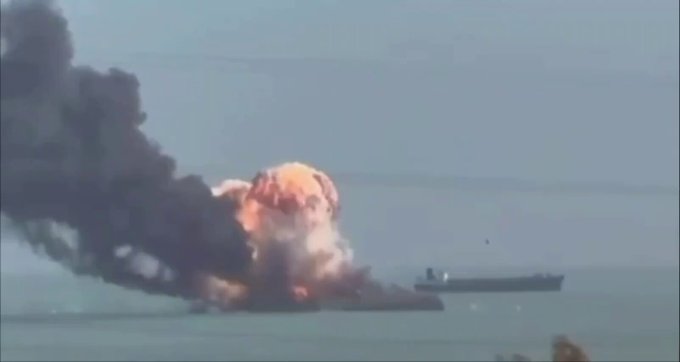
An Iran oil tanker was struck by the US (Image X.com)
India has 75 days of reserves, no plan to reach the IEA’s 90-day threshold, and 88% import dependence. P. Sesh Kumar, former Director General of the CAG, says the playbook needs a complete rethink.
By P. SESH KUMAR
New Delhi, March 19, 2026 — Energy security, often reduced to the comforting arithmetic of “days of reserves,” is in reality a far more complex and dynamic construct. The comparison between India’s 70–75 days of oil cover and Japan’s 200 plus days is striking-but also misleading if interpreted simplistically. Japan’s resilience is not merely a function of storage capacity; it is the outcome of a deeply layered system combining diversification, strategic reserves, domestic efficiency, and disciplined transition pathways. This narrative critically examines what these pillars mean in the Indian context-what is realistically achievable, what is fiscally prudent, and what risks remain unavoidable. It argues that India’s path lies not in replicating Japan’s scale, but in building a uniquely Indian, multi-layered energy resilience architecture that balances affordability, growth, and strategic autonomy.
The Seductive Myth of “200 Days”: Why India Should Not Imitate Japan Blindly
The headline number-Japan’s 200+ days of oil reserves-has an undeniable appeal. It conveys strength, preparedness, and insulation from global shocks. But policy is not built on headlines; it is built on context.
Japan is a high-income, energy-import-dependent island economy with decades of institutionalised energy security planning. Its reserve system includes government stocks, legally mandated private-sector inventories, and even joint storage arrangements with oil-producing nations. Crucially, Japan’s energy demand is stable or declining due to demographic and efficiency factors.
India, by contrast, is a rapidly growing, energy-hungry economy. Its oil demand is rising, its fiscal space is constrained, and its development priorities are far broader. Attempting to scale reserves from roughly 75 days to 200 days would require not just cavern construction but massive capital outlays to purchase and maintain crude inventories. The opportunity cost is enormous: every rupee locked in underground oil is a rupee not spent on infrastructure, healthcare, or energy transition.
The more relevant global benchmark is the 90-day requirement under the International Energy Agency (IEA) framework. India’s realistic and prudent target should be to cross this threshold sustainably, not chase Japan’s exceptional level. Beyond that, resilience must come from smarter systems, not just bigger stockpiles.
Diversification: India’s First Line of Defence, But Not a Silver Bullet
Diversification, in the Indian context, is less about independence and more about flexibility. India cannot eliminate import dependence in the foreseeable future; what it can do is avoid excessive reliance on any single geography, supplier, or route.
Over the past few years, India has demonstrated pragmatic diversification. The sharp rise in imports from Russia after the Ukraine conflict reduced dependence on traditional West Asian suppliers. When Russian supplies tightened, refiners pivoted to Africa, Latin America, and the United States. This is diversification in motion-dynamic, opportunistic, and market-driven.
But diversification must go deeper.
It must include refinery flexibility so that Indian refineries can process a wide spectrum of crude grades. It must extend to shipping and insurance ecosystems, ensuring that geopolitical disruptions-whether in the Strait of Hormuz or elsewhere-do not paralyse supply chains. It must involve long-term contracts combined with spot-market agility, balancing stability with cost optimisation.
There is also a strategic dimension. Investments in overseas oil assets-through entities like ONGC Videsh-do not eliminate import dependence, but they provide a measure of control and preferential access. Similarly, expanding LNG sourcing diversity reduces vulnerability in the gas segment, which is increasingly critical for fertilizers and city gas.
Diversification, therefore, is not a destination. It is a continuous process of risk redistribution.
Domestic Production: The Hard Truth of Geological Constraints
The phrase “boost domestic production” often carries an implicit promise that India can drill its way out of import dependence. The reality is far more sobering.
India’s import dependence has already crossed 85–88 percent, and domestic crude production has remained broadly stagnant. This is not merely a policy failure; it is a geological reality. India does not possess the kind of easily accessible hydrocarbon reserves that transformed economies like the United States.
Yet, dismissing domestic production would be equally misguided.
What India can-and must-do is extract more from what it already has. Enhanced oil recovery techniques, improved field management, and technological upgrades can increase output from mature fields. Policy reforms that simplify licensing, ensure pricing clarity, and reduce regulatory friction can attract private and foreign investment into exploration.
Natural gas offers a more promising avenue. Expanding domestic gas production can reduce reliance on imported LNG in key sectors such as fertilizers, power, and city gas distribution. Even incremental gains matter because of India’s sheer scale: a small percentage reduction in import dependence translates into billions of dollars saved.
Domestic production, therefore, is not about transformation; it is about incremental resilience.
Transition to Alternative Fuels: The Only Long-Term Escape Route
If diversification manages risk and domestic production trims dependence, the transition to alternative fuels is the only pathway that fundamentally alters India’s vulnerability.
But here too, realism is essential.
Oil consumption in India is heavily concentrated in transport, petrochemicals, LPG, and industry. Each of these sectors transitions at a different pace.
Ethanol blending is one of India’s most practical short-term tools. The move toward 20 percent blending in petrol reduces crude import requirements at the margin while supporting domestic agriculture. However, it raises questions of feedstock availability, water use, and food security. Ethanol is a bridge, not a destination.
Electric mobility offers deeper structural change. The most impactful segments are not luxury cars but two-wheelers, three-wheelers, buses, and delivery fleets. Electrification in these segments directly reduces oil demand while leveraging India’s increasingly diversified electricity mix.
Compressed biogas and city gas distribution provide alternatives in cooking and transport, reducing LPG and diesel dependence. Renewable energy expansion, while primarily targeting electricity, indirectly enhances energy security by freeing up fossil fuels for critical uses.
Hydrogen, often hailed as the future, remains a long-term prospect due to cost and infrastructure constraints. Hydrogen is seen as a clean fuel of the future because it produces only water when used, but it is still very expensive to produce and store.
It also needs new infrastructure like special pipelines, storage systems, and fueling stations, which will take time and large investments to build.
The key insight is this: transition is not a single leap but a mosaic of sector-specific shifts.
Ras Laffan attack: what Iran’s strike on Qatar’s LNG hub means
Storage Reimagined: From Quantity to Strategy
The debate on reserves often focuses on “how much,” but the more important question is “how well.”
India’s reserves must be geographically diversified, operationally accessible, and integrated with refining and distribution networks. Public-private partnerships can reduce fiscal burden while enhancing utilisation efficiency.
Strategic reserves should also be complemented by commercial stocks and mandatory industry holdings, creating a layered system similar to Japan’s-but scaled to Indian realities.
Storage is not just about surviving a shock; it is about buying time for policy response.
The Indian Way Forward: Building a Multi-Layered Shield
India’s energy security strategy must evolve from a single-axis approach to a multi-dimensional framework.
It must accept that complete self-sufficiency is neither feasible nor necessary. Instead, the goal should be managed dependence-where risks are diversified, shocks are absorbed, and recovery is swift.
Fiscal prudence must guide reserve expansion. Strategic clarity must drive diversification. Policy stability must underpin domestic production. And long-term vision must shape the transition to alternative fuels.
Most importantly, these elements must not operate in silos. Energy security is not the mandate of a single ministry; it is a whole-of-government, whole-of-economy challenge.
Resilience Is a System, Not a Stockpile
The comparison with Japan is useful-but only if interpreted correctly. Japan’s strength lies not in its 200 days of reserves, but in the system that supports them.
India does not need to replicate Japan’s numbers. It needs to replicate its discipline, adaptability, and strategic coherence.
Because in the end, energy security is not about how long you can survive without imports. It is about how quickly you can adapt when the world stops behaving predictably.
South Pars gas field: Trump’s threat, the denial that didn’t hold
Follow The Raisina Hills on WhatsApp, Instagram, YouTube, Facebook, and LinkedIn




About The Author