‘Sword Over Minorities’: Opposition Slams New FCRA Bill
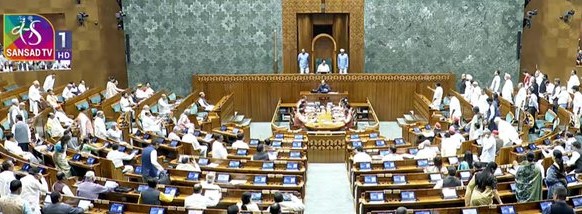
Parliament on Monday witnessed Opposition uproar (Image Sansad TV)
Congress’s K.C. Venugopal says the Foreign Contribution Amendment Bill targets minorities and charitable organisations. The Catholic Bishops’ Conference warns of “executive overreach” into constitutionally protected freedoms. The government says it is about transparency.
By NIRENDRA DEV
New Delhi, March 31, 2026 — India’s parliament is debating a new amendment to the Foreign Contribution (Regulation) Act — a law that governs how non-governmental organisations receive overseas funding — and it has detonated a political and religious controversy that cuts to the heart of questions about civil society, minority rights, and the limits of state power.
The Foreign Contribution (Regulation) Amendment Bill was introduced by Union Minister of State for Home Nityanand Rai, who said the legislation aims to “enhance transparency and ensure proper utilisation of funds.” The opposition is not persuaded.
‘A Sword of Damocles Over Minorities’
Congress general secretary (Organisation) and senior Kerala leader K.C. Venugopal has emerged as the bill’s most pointed critic, framing the legislation in explicitly communal terms: “The FCRA bill was aimed at bringing Christian communities under control and was hanging over minorities like a sword of Damocles.”
Venugopal — who is also being discussed as a potential future Chief Minister of poll-bound Kerala — said the amendments target minority communities and charitable organisations, and would restrict their functioning while enabling greater central intervention in their affairs. His remarks came days after India’s top Catholic body formally flagged the bill in near-identical language.
Congress MP Manish Tewari had earlier challenged the bill’s constitutional architecture in Lok Sabha, arguing the government proposal “suffers from excessive delegation of essential legislative functions” — leaving core decisions about the management and disposal of assets to be prescribed by the central government through rules, rather than fixed in legislation.
The Catholic Church’s Warning: ‘Undue Interference’
The Catholic Bishops’ Conference of India — the apex body of the Catholic Church in India — has issued a formal objection to the proposed amendments, describing them as enabling “executive overreach” into constitutionally guaranteed freedoms.
The Conference warned specifically of: “Clauses that grant sweeping powers to the Central Government, allowing it to deny renewal or cancel licenses of organizations. More significantly, the proposed framework would permit a newly constituted authority to assume control over institutions, including their funds, properties, and other assets.”
The bishops added that the changes, “brought under the pretext of licence renewal,” raised serious concerns about “undue interference” in the functioning of minority institutions. Congress had earlier warned, during parliamentary debates on the Waqf Amendment Bill, that similar legislation would follow targeting other minority communities — a warning that, in their reading, has now been borne out.
A Decade of Cancellations: The FCRA Record
The bill does not arrive in a vacuum. The Modi government’s use of FCRA as a regulatory instrument against civil society organisations has a documented track record:
2015: Approximately 10,000 FCRA licences cancelled, including those of Greenpeace, the Ford Foundation, and around 20 Christian organisations.
2019: A further 1,807 NGOs lost their licences.
2020: A government order barred delicensed organisations from applying for fresh licences for three years.
2021: Major institutions including Oxfam India, IIT Delhi, the Indira Gandhi National Centre for Arts, the Nehru Museum, and the Press Institute of India all encountered FCRA-related difficulties.
December 2021: The Ministry of Home Affairs declined to renew the FCRA registration of the Missionaries of Charity — the organisation founded by Mother Teresa. The decision drew international attention before subsequently being resolved.
The Government’s Counter-Argument: Misuse Is Real
Officials and some analysts argue the crackdown has not been arbitrary. Several organisations, government sources have maintained, used foreign funding for activities far removed from their stated charitable purposes.
The cases cited include organisations whose staff participated in anti-CAA protests in Assam in January 2020 — prompting officials to argue that funds designated for leprosy care or mental healthcare could not legitimately finance political mobilisation. Similarly, the Centre for Equity Studies, associated with bureaucrat-turned-activist Harsh Mander, and Oxfam India were accused by government-aligned bodies of using foreign funds in ways connected to the February 2020 Delhi riots — allegations both organisations deny.
In November 2021, National Security Advisor Ajit Doval explicitly named “social organisations” as a new generation threat in an address to police officials — a remark that opposition parties said revealed the ideological logic behind the licensing crackdown.
The Cost of Restriction: A Covid-19 Case Study
The practical consequences of FCRA restrictions became visible during the second wave of Covid-19 in 2021. Prime Minister Modi asked officials in May of that year to explore mobilising civil society volunteers to relieve pressure on the healthcare system. But the civil society infrastructure capable of responding had been weakened — and sources cited FCRA-related resource restrictions as a key reason that “nothing much could be done.”
The FCRA, in this reading, is not merely a political instrument. It is a governance one — and its use has costs that are eventually paid by the populations these organisations serve.
At a Glance
| Factor | Detail |
| Bill | Foreign Contribution (Regulation) Amendment Bill |
| Introduced by | Nityanand Rai, MoS Home Affairs |
| Government rationale | Transparency; proper utilisation of foreign funds |
| Key opposition critic | K.C. Venugopal, AICC General Secretary (Congress) |
| Venugopal’s charge | Bill targets Christian and minority communities |
| Lok Sabha challenge | Manish Tewari (Congress) — excessive legislative delegation |
| Church response | Catholic Bishops’ Conference: “executive overreach,” risk of asset seizure |
| FCRA cancellations since 2015 | 10,000+ licences cancelled; Oxfam, IIT Delhi, Nehru Museum affected |
| Most controversial case | Missionaries of Charity (Mother Teresa’s organisation) — licence not renewed, Dec 2021 |
| NSA Doval remark | Named “social organisations” as new generation threat, Nov 2021 |
| Covid-19 impact | FCRA-weakened civil society unable to assist during 2021 second wave |
| Political context | Congress had warned during Waqf Bill debate that minority NGOs would be next |
(This is an opinion piece. Views expressed are author’s own.)
Follow The Raisina Hills on WhatsApp, Instagram, YouTube, Facebook, and LinkedIn




About The Author