Contrapposto Review: A Sweeping Novel of Art, Friendship, and Creative Purpose
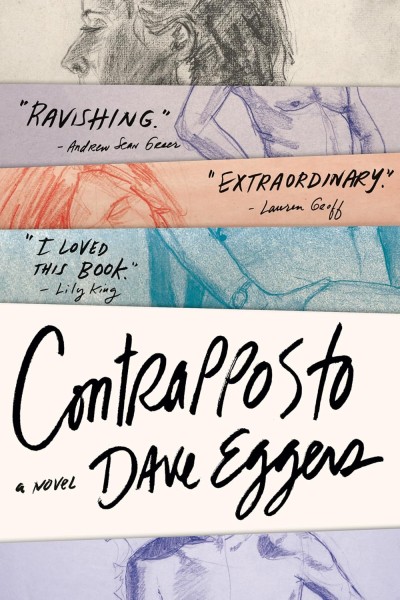
Dave Eggers’s Contrapposto follows two lifelong friends across six decades and several continents (Image book cover)
BOOK REVIEW. The Book Desk.
Contrapposto by Dave Eggers. Knopf, 432 pp., June 9, 2026.
Dave Eggers has spent his career thrusting ordinary characters into extraordinary circumstances — the bureaucratic surrealism of A Hologram for the King, the techno-dystopia of The Circle. With Contrapposto, his first adult novel in five years, he keeps the satirical instinct but trades the high-concept premise for something rarer: a long, warm, generous human life, rendered in full.
The novel follows Robert “Cricket” Dib, a shy Indiana boy who discovers early that he can draw. At nine years old he meets Olympia Argyros — a year older and incalculably more daring — and their friendship becomes the spine of the book, bending and flexing across more than six decades. The novel nods to the picaresque tradition, following Cricket and Olympia through various stages of their lives, across several continents, in seven parts that each launch the reader forward in time.
Cricket’s childhood is defined by a dysfunctional home, an absent mother, and an abusive boyfriend in her orbit. His sole solace as a child is drawing, a gift encouraged by his grandfather Silas. When Silas dies, Cricket is largely on his own — and it is Olympia who gives him direction, pushing him toward figure drawing, art school, and eventually a life lived stubbornly on his own terms.
The art world is the novel’s canvas, and Eggers paints it with both affection and acid. The novel deploys that most traditional of narrative art forms — realist fiction — to consider what it means to make art in a society that has detached value from creative skill.
JD Vance’s Communion Review: Faith, Politics & Contradiction
Cricket is a classically trained draftsman in an era that has moved decisively toward concept over craft. His inability to suppress his skill for the sake of a trend becomes a form of quiet rebellion, a stubborn refusal to sell out that costs him commercially but preserves something essential in his work.
Eggers gives this debate a human face through the character of Kyle, a college acquaintance who rises to enormous success in the art world despite — or perhaps because of — having none of Cricket’s technical gifts.
Kyle is the artist as project manager, demanding NDAs and claiming ownership of others’ ideas. He is funny and troubling in equal measure, and Eggers, to his credit, refuses to make him simply a villain. Cricket genuinely admires some of what Kyle produces, even as he cannot stomach how it gets made.
The novel’s true engine, though, is the friendship between Cricket and Olympia. It is a bildungsroman and a novel of ideas, exploring the meaning of art and the unfairness, pretensions, and occasional skulduggery of the art world — but all of that would feel academic without the emotional weight these two characters carry. Their relationship resists easy categorization: it is not platonic, occasionally sexual, but not defined by sex. They love and need each other, but it remains above all a friendship.
Eggers has a particular gift for rendering the textures of long relationships — the way affection accumulates like sediment, how old wounds stay tender decades later, how two people can be the defining fact of each other’s lives without ever quite resolving what that means. The novel’s emotional intelligence is most visible in its quieter passages, especially when the characters are old and the years between them feel suddenly very full.
Cricket’s anxieties and fears are vivid, especially as he pursues manual jobs — tile work, ship breaking — that underscore his love of detail and his urge to keep moving. These stretches away from the art world ground the novel and keep it from floating off into precociousness. Eggers is always best when he remembers that most lives involve a great deal of labour for very little recognition, and that this is not a tragedy.
Where the novel stumbles slightly is in its didactic moments. An art teacher named Marcus Carpenter thunders like a prophet about the death of skill and beauty, and seems teleported from Wise Elder central casting. This kind of heavy-handedness — the novel’s thesis delivered through a character rather than embodied in the drama — is a recurring Eggers tendency, and readers familiar with his work will recognize it. It is a minor flaw in an otherwise assured book.
Critics have responded with near-unanimous warmth. The Los Angeles Times called it a big-hearted, deeply moving story, praising its life-affirming conclusion. The Chicago Tribune described it as a rare smart book about the joy of being creative and open to everything, while the San Francisco Chronicle called it a moving, humane, and witty portrait of a lifelong friendship. The New York Times offered perhaps the most characteristic assessment, describing the novel as an earthy, warm return to form and noting that to call the book merely “moving” would be too easy — the emotional range is wider than that.
Contrapposto is also illustrated throughout with drawings by Eggers himself — work he credits, characteristically, to Cricket. The drawings are not decorative; they are part of the novel’s argument, proof that the kind of patient, skilled, representational art the book champions still holds beauty and meaning. Whether or not you find that argument persuasive, the drawings are lovely, and they deepen the sense that Eggers has put something genuinely personal into this book.
At 432 pages spanning sixty-five years, Contrapposto is one of Eggers’s most ambitious works — and one of his most satisfying. It asks what art is for, what friendship costs, and whether it is possible to live with integrity in a world that rewards spectacle over substance. Its answer, offered without sentimentality, is yes. Just barely, and not without sacrifice — but yes.
Verdict: A big, generous, beautifully observed novel. Eggers at his most mature.
The Invisible Arsenal: How America Learned to Fight Wars Without Firing a Shot
Follow The Raisina Hills on WhatsApp, Instagram, YouTube, Facebook, and LinkedIn




About The Author