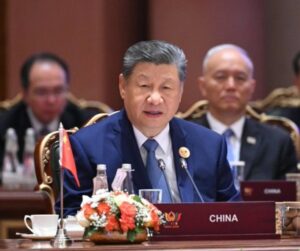
The Invisible Arsenal: How America Learned to Fight Wars Without Firing a Shot
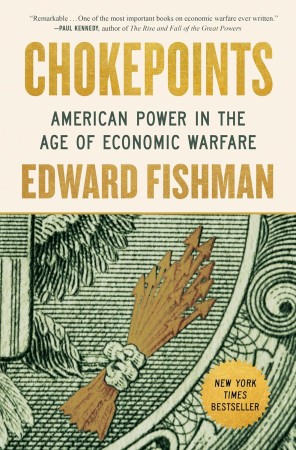
Cover of Chokepoints by Edward Fishman (Image Book cover)
Book Desk. June 2026.
A review of Chokepoints: American Power in the Age of Economic Warfare by Edward Fishman
Edward Fishman’s Chokepoints reveals how finance, technology, and sanctions have become America’s most powerful geopolitical weapons. A compelling review of one of the most important foreign policy books of the decade.
There is a version of geopolitical history told in troop movements and missile counts. Edward Fishman has written a different book — one about the spreadsheets, legal memos, and obscure regulatory filings that have quietly reshaped the world order since September 11, 2001. Chokepoints: American Power in the Age of Economic Warfare is that rarest of things: a policy book that reads like a thriller.
Fishman, a former official at the U.S. State Department, the Pentagon, and the Treasury Department, brings genuine insider authority to a subject most people encounter only as headlines — sanctions on Russia, chip bans on China, oil price caps after Ukraine. His central insight is elegantly simple: the United States controls a set of infrastructure nodes so indispensable to the global economy that whoever dominates them can coerce nearly any nation on earth without deploying a single soldier. He calls these nodes “chokepoints.”
“Deftly written, Chokepoints is a compelling and dramatic narrative about the new shape of geopolitics… a timely guide to the fragmenting of the global economy and the rising tensions that go with it,” wrote Daniel Yergin in The Wall Street Journal.
What Is a Chokepoint?
Fishman’s definition is precise and persuasive. A chokepoint is a domain so dominated by one state — or a small coalition — that it cannot be readily substituted. The U.S. dollar, which underpins international trade and finance. The CHIPS clearing network, through which trillions in transactions flow daily. Advanced semiconductor fabrication, where American intellectual property sits at every layer of the supply chain. Maritime insurance, concentrated in a handful of London and New York firms. Control any one of these, Fishman argues, and you hold a lever capable of moving the entire global economy.
What makes his account genuinely surprising is the origin story. These chokepoints were not the product of grand strategic design. They arose as unintended by-products of post-Cold War liberalization and private-sector innovation — and were only later recognized by policymakers as instruments of coercion. The book’s great contribution is tracing exactly when, and how, that recognition dawned.
“(Fishman’s book) brings everything together, explaining both how the United States acquired the outsized power to punish anyone, anywhere, and how it learned to use and abuse that power,” wrote Keith Johnson in Foreign Policy.
Regime Change: The Book That Exposes How Trump Rewired the American Presidency
A Cast of Unlikely Warriors
The narrative engine of Chokepoints is its characters. Fishman structures the story around the diplomats, lawyers, and financial technicians who turned sanctions from a blunt diplomatic instrument into a precision weapon. Treasury officials like Stuart Levey and Daleep Singh emerge as pivotal figures — bureaucratic innovators operating largely outside public view, crafting the architecture of financial warfare that presidents then wielded against Iran, Russia, and China.
“Fishman chronicles the pivotal moments in this new era of economic warfare… by following the public servants who built America’s economic arsenal… It’s the people behind the scenes who take center stage. The book even features a cast of characters that wouldn’t feel out of place in the appendix of a George R.R. Martin novel,” wrote Big Think in its review of the book.
The book moves through six thematic sections — from the birth of the globalized economy through 9/11, the Iran nuclear campaign, Crimea, the chip war with China, and finally the sweeping sanctions response to Russia’s 2022 invasion of Ukraine. Each episode builds on the last, showing how each crisis forced American policymakers to extend their economic toolkit further than they’d imagined possible.
Regime Change: Toward a Postliberal Future — An In-Depth Book Review
The Risks of Overreach
Fishman is no triumphalist. He is as alert to the dangers of economic warfare as he is awed by its possibilities. The more aggressively the United States exploits these chokepoints, the harder its adversaries work to engineer around them. China’s push toward alternative payment systems, Russia’s construction of parallel financial infrastructure, and the broader BRICS effort to reduce dollar dependence all reflect what Fishman calls the erosion of American leverage through overuse.
He proposes a geo-economic “impossible trinity” — the argument that states cannot simultaneously sustain deep economic interdependence, safeguard their economic security, and engage in open geopolitical rivalry. Something must give. The post-Cold War era assumed interdependence would pacify rivalry; Chokepoints documents, in granular detail, why that assumption failed.
“A gripping, firsthand account of America’s efforts to weaponize the world economy against its resurgent adversaries. From the high-stakes campaign to halt Iran’s nuclear program to the cutting-edge strategy to deny China access to AI chips, Chokepoints is an unparalleled guide to America’s use of sanctions and export controls over recent decades,” wrote Chris Miller, author of Chip War.
Writing and Accessibility
Policy books about sanctions and financial clearing systems have no business being readable. Chokepoints is. Fishman has a journalist’s instinct for the telling anecdote and a practitioner’s precision with the technical detail, and he rarely lets the two crowd each other out. Complex mechanisms — secondary sanctions, the Foreign Direct Product Rule, oil price cap enforcement — are explained with enough clarity that a general reader grasps the stakes without feeling lectured.
At 560 pages, the book earns its length. The chronological structure, moving decade by decade through administrations and crises, gives readers a coherent through-line without sacrificing depth. This is not a book of op-ed arguments padded to hardcover length; it is a genuine history of a revolution in statecraft, told from inside the room where it happened.
Chokepoints is the essential book for understanding how American power actually operates in the twenty-first century — not through military supremacy alone, but through the invisible architecture of global finance and technology.
Edward Fishman has produced a landmark work of contemporary history that is simultaneously a policy manual, a geopolitical warning, and an unexpectedly gripping read. Essential for policymakers, business strategists, investors with global exposure, and anyone trying to make sense of the world fracturing around them.
JD Vance’s Communion Review: Faith, Politics & Contradiction
Follow The Raisina Hills on WhatsApp, Instagram, YouTube, Facebook, and LinkedIn




About The Author