Ram Rajya or House Tax? Bihar’s New Rural Levy Draws Fire
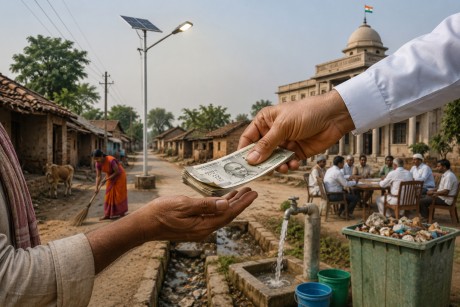
Why Bihar's ₹1,200 Panchayat Charge Is Becoming a Political Flashpoint (A representative image)
By RAJESHWAR JAISWAL
Why Bihar’s ₹1,200 Panchayat Charge Is Becoming a Political Flashpoint
Patna, July 5, 2026 — A proposal by the Bihar government to empower gram panchayats by allowing them to levy an annual user charge of up to ₹1,200 per household has triggered political debate, with critics accusing the ruling NDA of asking villagers to pay for services they say are often patchy or inadequate.
The government appeared determined to make Bihar’s villages “wealthier”—by first collecting money from them. If every rural household pays around ₹1,200 a year, imagine how much revenue the panchayats will earn. Residents would now contribute towards streetlights, sanitation, drainage and tap-water schemes.
The proposed levy forms part of the Bihar government’s broader effort to strengthen the finances of gram panchayats and urban local bodies by enabling them to raise their own resources for civic services instead of relying entirely on state grants.
‘Paying for Services Already Promised’
The question remains open whether villagers would readily accept paying additional charges for civic amenities that governments are already expected to provide.
While roads, drains and streetlights have expanded over the years, many villages continue to struggle with irregular sanitation, clogged drains and inconsistent water supply.
People know how often drains are cleaned, how regularly garbage is collected and how reliable tap water is. The quality of services should improve before additional charges are imposed.
Centre or State?
The people in Bihar wonder whether the idea originated with the Bihar government or was influenced by the Centre. No evidence for either claim is available.
But it is understood that any state government would most hesitate to willingly introduce a politically sensitive household levy unless it believed the move was unavoidable, A comparison with medieval ruler Alauddin Khilji nonetheless is unavoidable. The Delhi Sultanate had also imposed a form of house tax centuries ago.
The analogy is clearly rhetorical rather than historical equivalence, but it servs to underline the argument that governments have long relied on household taxation to finance administration.
‘Ram Rajya Comes with a Bill?’
Many voters in Bihar had expected “Ram Rajya” after supporting the BJP-led government, only to discover that better local governance might now come with an annual bill.
Supporters of the proposal, however, argue that financially stronger panchayats will be better equipped to maintain local infrastructure and improve civic services without depending entirely on higher levels of government.
Whether rural households see the proposed charge as an investment in better governance or simply another burden is likely to become a key political issue as Bihar heads toward another electoral season.
(This is an opinion piece. Views expressed are the author’s own.)
When Even ‘Boka’ Aren’t Safe: Bihar’s Lawlessness Sparks Fresh Debate
Follow The Raisina Hills on WhatsApp, Instagram, YouTube, Facebook, and LinkedIn




About The Author