The Bharatmala Files: Rebadged Roads, Rising Costs and Parliamentary Silence
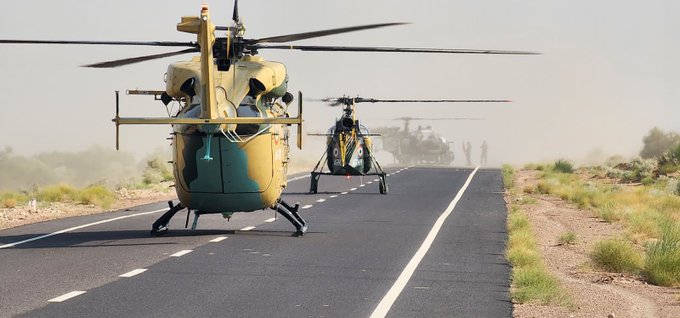
Military chopper landed on a highway built under Bharatmala scheme in Rajasthan. (Image PIB)
By P. SESH KUMAR
Inside Bharatmala: What the CAG Audit Revealed About India’s Biggest Highway Programme
New Delhi, August 7, 2026 —Bharatmala Pariyojana, approved by the Cabinet Committee on Economic Affairs in October 2017, is an umbrella programme of 34,800 kilometres in five years for Rs 5.35 lakh crore, delivered through the National Highways Authority of India (NHAI), the National Highways and Infrastructure Development Corporation (NHIDC), the road wing of the Ministry and state agencies. On 10 August 2023 the CAG tabled Report No. 19 of 2023, a performance audit of Phase-I covering 2017-18 to 2020-21, with forty-one recommendations.
Of the 70,050 kilometres NHAI was to develop under Phase-I, audit found that forty-nine per cent–34,972 kilometres–had already been developed or awarded under earlier highway schemes before Bharatmala was approved, with no proposal to develop them further. Audit recommended their removal from the target length.
Rebadging is not construction. Half of the programme’s headline length was, on the auditor’s reading, an accounting decision. Anyone who cites Bharatmala kilometres as post-2014 creation is therefore double-counting on a very large scale, and the chart’s expressway and highway lines inherit that problem.
Then the money. Against the Cabinet’s approved norm of Rs 13.98 crore per kilometre of civil cost, sanctioned civil cost came to Rs 23.89 crore–seventy-one per cent higher. Pre-construction cost, approved at Rs 1.39 crore per kilometre, was sanctioned at Rs 8.28 crore, roughly six times over.
Aggregated differently, the per-kilometre project cost rose from about Rs 14 crore to Rs 24 crore. As at March 2023, 76 per cent of the CCEA-approved length had been awarded while 158 per cent of CCEA-approved funds had been sanctioned. That single sentence is the most damaging in the report, because it describes a programme that has consumed more than one and a half times its financial authorisation to deliver three-quarters of its physical authorisation, without returning to the Cabinet for revised approval.
ICRA independently estimated the Phase-I cost at Rs 10.64 lakh crore, averaging Rs 31.6 crore a kilometre, and noted that awarding activity fell 48 per cent year on year while revised Cabinet approval remained pending.
Audit also found that funds of Rs 1.57 lakh crore approved for other schemes were being used to report achievements under Bharatmala, and recommended scheme-wise mapping of releases so that one scheme’s money does not become another scheme’s trophy; the Ministry undertook to streamline project-wise accounting. For anyone who has spent a career in government accounts, this is the most familiar and the most corrosive finding of all–not theft, but the quiet migration of credit.
On process, the numbers are stark. The CCEA required every Bharatmala project to be appraised by the Project Appraisal and Technical Scrutiny Committee. Audit sampled 50 projects; 35 had floated tender notices with no appraisal by that committee at all. Audit found instances of implementing agencies selecting bidders who did not meet tender conditions or who submitted falsified documents, and of tenders floated without prepared detailed project reports or on the basis of inaccurate ones. It recommended investigation of the tendering anomalies, fixing responsibility on erring officials, and evaluation of bids through an e-tendering portal.
On financing structure, the drift was almost total. Of 23,268 kilometres to be built, only 1.8 per cent went the Build-Operate-Transfer (BOT) (toll) route against an approved 10 per cent, while 48 per cent went engineering-procurement-construction (EPC) against 30 and 50 per cent hybrid annuity against 60.6
The significance is fiscal, not technical: BOT places construction and traffic risk on the concessionaire, EPC places all of it on the exchequer.
A programme designed with a tenth of its length at private risk delivered less than a fiftieth. And on sequencing, audit found incomplete legacy projects folded into Bharatmala without resolving the bottlenecks that had stalled them–the Bihar-Jharkhand border highway, due November 2021, stood at 62 per cent in March 2023, held up by right of way and forest land disputes– and no systematic prioritisation method, with 46 per cent of the length of 11 high-priority corridors unawarded as at March 2023.6
Count them, since a count was asked for. Rebadged length; unauthorised cost escalation on civil works; a six-fold escalation on pre-construction; sanction of funds beyond Cabinet authorisation; cross-scheme fund attribution; absence of mandated appraisal in seventy per cent of a sample; award to ineligible or falsely documented bidders; tendering without or against detailed project reports; abandonment of the approved financing mix; inheritance of unresolved bottlenecks; absence of prioritisation criteria; absence of outcome parameters and of any monitoring mechanism against a logistics performance benchmark. Twelve heads of deficiency, forty-one recommendations, and a Cabinet approval that had, on audit’s reading, ceased to function as a financial limit.
India Shines with Port Turnaround Time but Long Journey Awaits
Rs 250.77 Crore a Kilometre: The Dwarka Expressway
One project became the report’s public face. The Dwarka Expressway, 29.06 kilometres from Delhi to Gurugram, was sanctioned on EPC terms at a civil cost of Rs 7,287.29 crore—Rs 250.77 crore a kilometre against the CCEA’s approved per-kilometre civil cost of Rs 18.20 crore, or roughly fourteen times. Audit noted that the project was appraised and approved without a detailed project report; that it had originated in Haryana’s Gurgaon-Manesar Urban Complex Plan 2031 and was absorbed into Bharatmala after the state made no evident progress; that Haryana handed 90 metres of right of way to NHAI free of cost, sufficient for fourteen lanes at grade; and that MoRTH nonetheless prioritised an elevated configuration in November 2018, split into four packages approved between January and March 2018, with completion dates falling between November 2020 and September 2022.
The Ministry’s reply deserves a fair hearing, because it is substantially correct on its own terms. The Rs 18.20 crore figure, it said, was a normative cost used to formulate the programme for Cabinet approval, not a project-wise sanction; project-wise costs were never approved at that level of granularity. Civil cost varies with design, terrain and location, and under Bharatmala the average for special projects carrying substantial lengths of bridges, viaducts and tunnels is Rs 152 crore a kilometre.
The Dwarka Expressway is India’s first eight-lane expressway on a single pier, with two four-level interchanges and a 3.8-kilometre eight-lane tunnel; the approved civil cost across the four packages was Rs 206.39 crore a kilometre and the awarded cost Rs 181.94 crore, against audit’s Rs 250.77; the elevated structure alone averages about Rs 150 crore a kilometre, with the balance covering ground-level six-laning, underpasses and flyovers as service roads.
The single-pier design, it argued, makes the most economical use of the available right of way.
Both propositions can be true at once, and that is the intellectually uncomfortable centre of this whole affair. The Ministry is right that a normative programme average is not a project sanction and that comparing a tunnelled, interchanged, elevated urban corridor with a flat greenfield bypass is an apples-to-oranges exercise. Audit is right that when the actual cost of a marquee project exceeds the norm on which Cabinet approval was obtained by an order of magnitude, and when the design decision that produced that multiple was taken after a ninety-metre right of way sufficient for fourteen at-grade lanes had been handed over free, and without a detailed project report, then the appraisal system has not merely been stretched — it has been bypassed.
The question audit was really asking is not “why so expensive?” but “who decided, on what analysis, that the expensive option was necessary, and where is that analysis?” No published answer has yet supplied the alternatives-considered note that any competent option appraisal would have produced.
There is an epilogue. In the monsoon of 2026, complaints of structural damage on the Dwarka Expressway focused on the service roads and connecting links: a newly built 1.3-kilometre link near Sectors 102 and 102A eroded badly, service roads shed their asphalt within weeks of repair, and seepage appeared in underpasses. Restoration followed. The corridor was built for about Rs 9,000 crore and opened in two phases in 2024 and 2025.14 The eight-lane single-pier viaduct– the engineering marvel– is not what failed. What failed was the ordinary carriageway beside it, which is a recurring signature in Indian infrastructure: heroic on the signature structure, indifferent on the approach.
Bibek Debroy Memorial Lecture: Shaktikanta Das Weighs Economy
Tolls, Escrows, and the Officer Who Was Transferred
The same August 2023 tabling carried a separate compliance audit of NHAI toll operations in southern India, covering forty-one randomly selected plazas across Andhra Pradesh, Karnataka, Tamil Nadu, Kerala and Telangana. Audit found that at five plazas a total of Rs 132.05 crore had been collected from road users in violation of the fee rules–including continued collection at Nathavalasa, Chalageri and Hebbalu during periods of construction delay, when the rules forbid any levy, and Rs 7.87 crore at two plazas between August 2018 and March 2021.
At the Paranur public-funded plaza, excess collection of Rs 22.10 crore was found between 2017-18 and 2020-21, and user fee was being levied for a bridge built in 1954, although structures predating 1956 are exempt.
The mirror-image finding was that NHAI itself lost Rs 133.36 crore because two concession agreements contained no revenue-sharing provision. Opposition members in Parliament also cited a diversion of Rs 3,598.52 crore from escrow accounts; that figure is seen only in political and secondary reporting of the audit rather than verified against the report text, and it should be treated as such.
The toll findings matter out of proportion to their rupee value, because they invert the usual story. Cost overruns are the state’s money. Illegal tolling is the citizen’s money, collected at a barrier, in cash or by FASTag, from people with no practical means of contesting the levy and no forum in which to recover it.
A hundred and thirty-two crore across five plazas in one region, extrapolated across a national network of hundreds, is not a rounding error; it is a systemic revenue leak flowing the wrong way. And nothing in the public domain suggests refund.
There is one further episode that a former auditor cannot pass over in silence. Within weeks of the tabling, press reports noted the transfer of the principal officer in charge of the Bharatmala performance audit from Delhi to Thiruvananthapuram, alongside the officer responsible for the Ayushman Bharat report.
The CAG’s office responded that the transfers were a matter of administrative convenience and that audit reports are the product of extensive teams over prolonged periods and cannot be attributed to any single officer.
Both statements are institutionally true. Both are also, in context, beside the point. The value of a supreme audit institution rests entirely on the perception that reporting an inconvenient finding carries no career cost. Once that perception is even arguably in question, the institution has lost something it cannot recover by press release.
The Public Accounts Committee (PAC), for its part, received a presentation on the report in September 2023 but deferred examination pending the ministry’s action-taken note and the auditor’s vetting of it. What happened after that deferral is the subject of the next section.
(This is the second of the series. First of the series is as under. This is an opinion piece. Views expressed are the author’s own.)
The Great Infrastructure Claim: Did India Really Build Most of Modern India After 2014?
Follow The Raisina Hills on WhatsApp, Instagram, YouTube, Facebook, and LinkedIn




About The Author